Solanaceae
Marmalade bush: Fast Growing
Streptosolen jamesonii
The marmalade bush thrives in full sun to partial shade, requiring at least 4 to 6 hours of direct daily light for abundant flowering. Water every 3 to 4 days, keeping the soil slightly moist but never waterlogged—excess water is the primary cause of plant issues. Use fertile, well-drained substrate enriched with organic matter, and fertilize every 3 weeks during spring and summer. It is sensitive to cold and does not tolerate temperatures below 10°C (50°F); it should be protected or grown in pots in regions with harsh winters. Annual pruning in spring encourages branching and new blooms.
Every 4 days
Bright indirect
10° - 29°C
40% - 60%
Categories
What is Marmalade bush?
Marmalade bush (Streptosolen jamesonii) is a medium-care plant from the Solanaceae family. The marmalade bush (Streptosolen jamesonii) is an ornamental perennial, semi-woody, and scrambling shrub native to the Andean regions of Colombia, Ecuador, Peru, and Bolivia in South America. Belonging to the Solanaceae family, it can reach 1.5 to 2 meters in height, featuring long, flexible, and ar...
Marmalade bush grows up to 2.0m, spread of 150cm, watering every 4 days, 10°C – 29°C, 40–60% humidity. It is suitable for indoor environments and not safe for pets.
Without precautions, ingestion can cause irritation in pets. Keep out of reach of cats and dogs. Without adequate drainage, root rot can develop within 8 days.
How to Care for Marmalade bush?
TLDR: Marmalade bush needs Bright indirect, watering every 4 days, and temperatures between 10-29°C with 40-60% humidity.
How Often Should You Water Marmalade bush?
Water every 3 to 4 days in the summer, allowing the top layer of the substrate to dry slightly between waterings. Reduce frequency in winter. Avoid leaving the plant in standing water, as this promotes root rot.
How Much Light Does Marmalade bush Need?
Prefers full sun or partial shade, with a minimum of 4 to 6 hours of direct sunlight per day. In very hot climates, partial shade prevents heat stress without compromising flowering. When grown indoors, it needs to be placed near a bright window facing south, southwest, or west.
What Is the Best Soil for Marmalade bush?
Use a fertile, light, and well-drained substrate with a pH between 5.5 and 6.5—a mix of potting soil, humus, sand, and perlite works well. Good drainage is essential to prevent root rot.
What Pot Should You Use for Marmalade bush?
Prefer large pots with good drainage that accommodate the expanding root system—clay or ceramic pots are ideal as they promote air exchange and prevent excessive moisture buildup.
Care Schedule
Fertilize
Every 21 days
What Is Marmalade bush and Where Does It Come From?
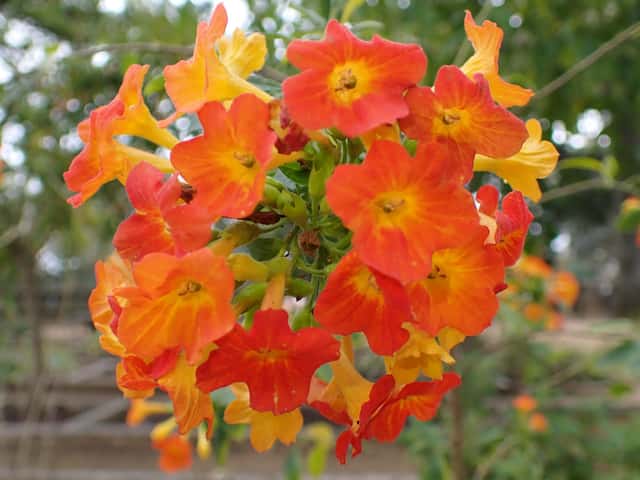
The marmalade bush (Streptosolen jamesonii) is an ornamental perennial, semi-woody, and scrambling shrub native to the Andean regions of Colombia, Ecuador, Peru, and Bolivia in South America. Belonging to the Solanaceae family, it can reach 1.5 to 2 meters in height, featuring long, flexible, and arching branches. Its leaves are ovate to elliptical, dark green, glossy, and deeply veined. The trumpet-shaped flowers bloom in clusters and change color as they mature—starting yellow and evolving into shades of orange and red—an effect reminiscent of orange marmalade, which gives the plant its popular name. It flowers intensely during spring and summer, attracting hummingbirds, bees, and butterflies to the garden.
How Big Does Marmalade bush Grow?
TLDR: Marmalade bush can reach up to 2.0m tall with Fast growth rate.
Max height
2.0m
Spread
1.5m
Growth rate
Fast
Foliage
Evergreen
Warning: Toxic Plant
This plant can be toxic if ingested. Keep out of reach of:
Plant Uses
Ornamental
Great for decoration
Is your plant showing symptoms?
Click on the symptom to discover possible causes:
What Diseases Commonly Affect Marmalade bush?
TLDR: Marmalade bush is susceptible to 9 known diseases. Monitor regularly for early detection.
Aphids
Aphids are small, soft-bodied, pear-shaped insects (1/16 to 1/8 inch long) that feed by sucking nutrient-rich sap from plants. They reproduce rapidly and can quickly weaken plants, causing distorted growth and transmitting plant viruses. Aphids come in various colors including green, black, red, yellow, brown, and gray. They secrete honeydew, a sticky substance that attracts ants and encourages sooty mold growth.
Scale Insects
Scale insects are small sap-sucking pests that appear as brown, shell-like bumps on plant stems and leaves. There are over 25 species, divided into armored (hard) and unarmored (soft) scales. They feed by piercing plant tissue and extracting sap, which weakens the plant and can lead to yellowing, stunted growth, and even death if left untreated. They also excrete honeydew, which attracts ants and promotes sooty mold growth.
Spider Mites
Spider mites are tiny arachnids (less than 1/20 inch long) related to spiders and ticks that feed on plant sap. They thrive in hot, dry conditions and can cause significant damage to ornamental and vegetable plants. During severe infestations, crop losses can reach 14% or higher as these pests disrupt vital plant processes including photosynthesis, carbon dioxide absorption, and transpiration.
Mealybugs
Mealybugs are small, soft-bodied insects covered with a white, waxy, cottony material. They are common pests of houseplants and outdoor plants in mild climates. These sap-sucking insects feed on plant tissue, causing damage, stunted growth, and can lead to plant death if left untreated. They produce sticky honeydew which attracts sooty mold.
Meaning & Symbolism
With its flowers transitioning from yellow to intense orange, the marmalade bush is associated with joy, vitality, and positive energy, often used in gardens and events to convey optimism and good vibes.
Compare with similar plants
| Attribute | Difficulty | Light | Watering | Pet Safe |
|---|---|---|---|---|
| Dark Fieldcap | Medium | Low light | 2d | ⚠️ |
| Azalea | Medium | Partial shade | 3d | ⚠️ |
| Muriel's Bamboo | Medium | Partial shade | 3d | ✓ |
| Bougainvillea | Medium | Direct sun | 7d | ⚠️ |




