Asteraceae
Marsh jaumea: Ground Cover Plant
Jaumea carnosa
An outdoor plant for full sun to light shade and soil that stays wet. It handles salt, alkaline ground and seasonal flooding, yet grows best on fresh water. Once it settles in it needs very little from you.
Every 3 days
Bright indirect
-23° - °C
% - %
Categories
What is Marsh jaumea?
Marsh jaumea (Jaumea carnosa) is a easy-care plant from the Asteraceae family. Marsh jaumea (Jaumea carnosa) is a low perennial in the daisy family that grows in coastal salt marshes, tidal flats and at the base of sea cliffs, from British Columbia down to northern Baja California. It creeps along on underground rhizomes and sends up soft, pinkish-green stems usually 15 to 35...
Marsh jaumea grows up to 35cm, spread of 90cm, watering every 3 days. It is not suitable for indoor environments and safe for pets.
Unlike many tropical plants, Marsh jaumea tolerates watering mistakes. Best for beginners. Unlike many popular species, Marsh jaumea is safe to keep around pets.
How to Care for Marsh jaumea?
TLDR: Marsh jaumea needs Bright indirect, watering every 3 days, and temperatures between -23-30°C with 40-70% humidity.
How Often Should You Water Marsh jaumea?
Keep the soil moist all the time; standing water is fine. If the leaves start to lose their plump look, it is too dry. Plain fresh water works better than salty water in a garden.
How Much Light Does Marsh jaumea Need?
Give it full sun or mostly sun. It also takes part shade, but stays more compact in a bright spot.
What Is the Best Soil for Marsh jaumea?
Average, clay or gritty soil all work, including heavy ground that drains poorly. It tolerates alkaline and salty soil, so you do not need to amend it.
What Pot Should You Use for Marsh jaumea?
Best planted in the ground, in a wet or coastal spot where it can spread. In a container, use a wide, shallow pot and keep the soil wet; a saucer of water underneath helps.
What Is Marsh jaumea and Where Does It Come From?
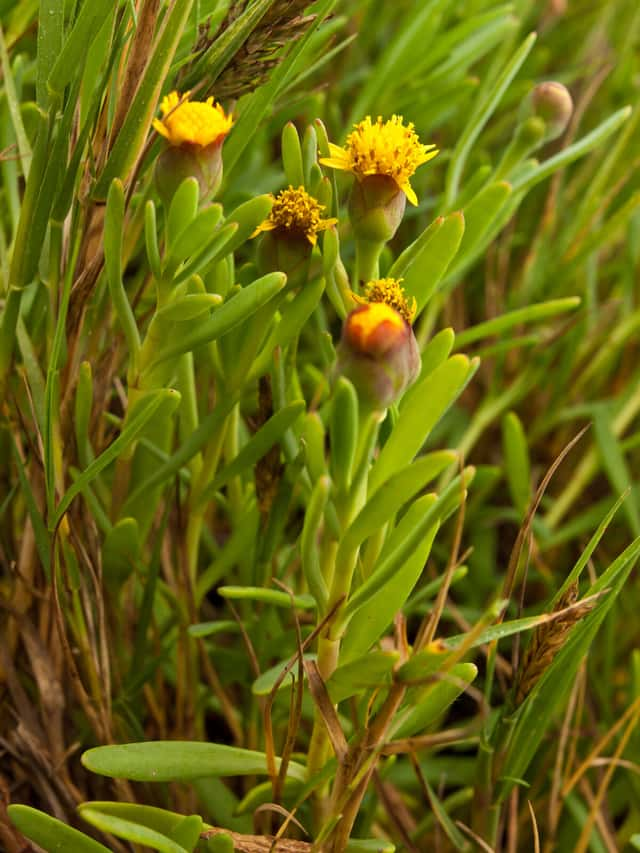
Marsh jaumea (Jaumea carnosa) is a low perennial in the daisy family that grows in coastal salt marshes, tidal flats and at the base of sea cliffs, from British Columbia down to northern Baja California. It creeps along on underground rhizomes and sends up soft, pinkish-green stems usually 15 to 35 cm tall, lined with fleshy, narrow leaves that look a lot like ice plant. From late spring into fall it carries small yellow daisy-like flower heads, about 2 cm across. It can live on seawater by storing salt in its cells, so it holds ground where few other plants survive, and it is used in coastal restoration and erosion control.
How to Propagate Marsh jaumea?
Rhizome division
- Water new divisions with fresh water; the plant grows best on it.
- A piece with more roots attached settles in faster.
- 1 Dig at the edge
Pick a healthy patch and loosen the soil at its edge to reach the creeping underground stems (rhizomes).
- 2 Cut a section
Cut off a piece of rhizome that has at least one shoot with leaves and some roots.
- 3 Replant
Plant it at the same depth in wet soil, in sun, and press the soil down around it.
- 4 Keep it wet
Water so the soil never dries out until new shoots appear.
Materials needed:
How Big Does Marsh jaumea Grow?
TLDR: Marsh jaumea can reach up to 35cm tall with Medium growth rate.
Max height
35cm
Spread
90cm
Foliage
Semi-evergreen
Plant Uses
Ground Cover
Soil coverage
Ornamental
Great for decoration
Edible
Can be consumed
Medicinal
Medicinal properties
Medicinal Uses
- The Kumeyaay people traditionally boiled the scented form into a tea to treat fever. This is a historical use, not a tested remedy.
Culinary Uses
- The Kumeyaay traditionally cooked the plant and ate it as a vegetable. Safety data is limited, so do not eat it without reliable local guidance.
Is your plant showing symptoms?
Click on the symptom to discover possible causes:
What Diseases Commonly Affect Marsh jaumea?
TLDR: Marsh jaumea is susceptible to 1 known diseases. Monitor regularly for early detection.
Compare with similar plants
| Attribute | Difficulty | Light | Watering | Pet Safe |
|---|---|---|---|---|
| Field Maple | Easy | Bright indirect | 14d | ✓ |
| Iberian Houseleek | Easy | Direct sun | 14d | ✓ |
| Silver Birch | Easy | Direct sun | 14d | ✓ |
| Common Blanketflower | Easy | Direct sun | 10d | ✓ |
Choose & Compare
Sources & References
- Salty Susan (Jaumea carnosa) - Nature Collective plant guide
- Jaumea carnosa - PlantLust (The Watershed Nursery)
- Jaumea carnosa - Plants of Upper Newport Bay (UC Irvine)
- Jaumea carnosa - Pacific Northwest Wildflowers
- Jaumea carnosa - Calflora
- Jaumea carnosa - Wikipedia
- Cuscuta salina (salt marsh dodder; host Jaumea carnosa) - Wikipedia





