Amaranthaceae
Marsh samphire
Salicornia europaea
Needs full sun, sandy soil that stays moist and water with a little salt in it. Cut the tips to eat and leave the base to regrow. It dies at the end of the season, so save some seed.
Every 3 days
Direct sun
° - °C
% - %
Categories
What is Marsh samphire?
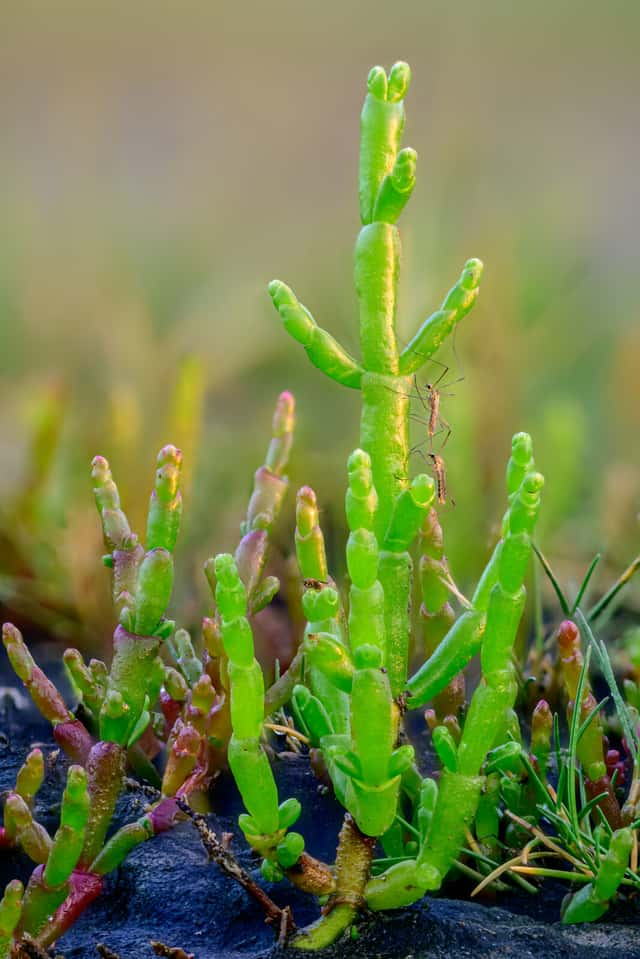
Marsh samphire (Salicornia europaea) is a medium-care plant from the Amaranthaceae family. Salicornia europaea is a small annual that grows in salt marshes, beaches and mangroves across Europe and much of Asia. It has no real leaves: what you see are fleshy, jointed green stems that look like a little bunch of fingers. In autumn it turns red or purple. The flowers are tiny and green, tuck...
Marsh samphire grows up to 40cm, watering every 3 days. It is not suitable for indoor environments and safe for pets.
Unlike many popular species, Marsh samphire is safe to keep around pets.
How to Care for Marsh samphire?
TLDR: Marsh samphire needs Direct sun, watering every 3 days, and temperatures between 15-30°C with 40-70% humidity.
How Often Should You Water Marsh samphire?
Keep the soil moist, watering every 2 to 3 days in hot weather. Once a week, water with salty water: 1 teaspoon of sea salt per half litre.
How Much Light Does Marsh samphire Need?
Direct sun all day. It will not grow in shade.
What Is the Best Soil for Marsh samphire?
Loose sandy soil. It copes with salty and chalky ground where little else grows.
What Pot Should You Use for Marsh samphire?
A wide, shallow pot or tray with drainage holes, standing in a saucer of water so the soil never dries out.
What Is Marsh samphire and Where Does It Come From?
Salicornia europaea is a small annual that grows in salt marshes, beaches and mangroves across Europe and much of Asia. It has no real leaves: what you see are fleshy, jointed green stems that look like a little bunch of fingers. In autumn it turns red or purple. The flowers are tiny and green, tucked into the joints. It reaches 30 to 40 cm. The stems taste salty and are eaten raw or cooked, often alongside fish. Its ash was once used to make glass and soap, which is where the name glasswort comes from. It lives for one season: it comes up in spring, sets seed in late summer and dies.
How to Propagate Marsh samphire?
Seed
Fresh seed germinates best. In autumn, let a few plants drop seed in the bed.
- 1 Scatter the seeds on top of moist sandy soil without covering them
- 2 Keep the soil wet by standing the tray in a saucer of water
- 3 Move outdoors after the last frost
- 4 Start watering with salty water once the seedlings are established
Materials needed:
How Big Does Marsh samphire Grow?
TLDR: Marsh samphire can reach up to 40cm tall with Slow growth rate.
Max height
40cm
Growth rate
Slow
Foliage
Deciduous
Plant Uses
Edible
Can be consumed
Culinary Uses
- Raw tips in salads
- Briefly boiled in unsalted water, with butter or olive oil
- Side for fish and seafood
- Pickled
Is your plant showing symptoms?
Click on the symptom to discover possible causes:
What Diseases Commonly Affect Marsh samphire?
TLDR: Marsh samphire is susceptible to 4 known diseases. Monitor regularly for early detection.
Aphids
Aphids are small, soft-bodied, pear-shaped insects (1/16 to 1/8 inch long) that feed by sucking nutrient-rich sap from plants. They reproduce rapidly and can quickly weaken plants, causing distorted growth and transmitting plant viruses. Aphids come in various colors including green, black, red, yellow, brown, and gray. They secrete honeydew, a sticky substance that attracts ants and encourages sooty mold growth.
Damping Off
Damping off is a soil-borne fungal disease that affects seeds and young seedlings, causing rotting of stem and root tissues at and below the soil line. It is caused by several fungi including Pythium, Rhizoctonia, Fusarium, and Phytophthora. The disease thrives in cold, wet conditions with poor air circulation.
Root Rot
Root rot is a serious fungal disease that affects the root system of plants, causing them to decay and die. It is primarily caused by overwatering, poor drainage, or soil-borne fungi such as Pythium, Phytophthora, Rhizoctonia, and Fusarium. The disease thrives in waterlogged conditions where roots are deprived of oxygen, making them susceptible to fungal infection.
Slugs and Snails
Slugs and snails are mollusks that feed on plant tissue, causing irregular holes in leaves and damage to young seedlings. They are most active at night and in moist conditions, leaving characteristic silvery slime trails. These pests can quickly devastate gardens, especially during wet seasons.
Fun Facts
Its ash was once a raw material for glass and soap
In the UK it is sold at fishmongers as samphire
The seed gives an edible oil similar to safflower oil
Frequently asked questions
Does samphire really need salt water?
When do I harvest marsh samphire?
Why has my samphire turned red?
Can I grow it indoors?
Compare with similar plants
| Attribute | Difficulty | Light | Watering | Pet Safe |
|---|---|---|---|---|
| Dark Fieldcap | Medium | Low light | 2d | ⚠️ |
| Azalea | Medium | Partial shade | 3d | ⚠️ |
| Muriel's Bamboo | Medium | Partial shade | 3d | ✓ |
| Bougainvillea | Medium | Direct sun | 7d | ⚠️ |