Asteraceae
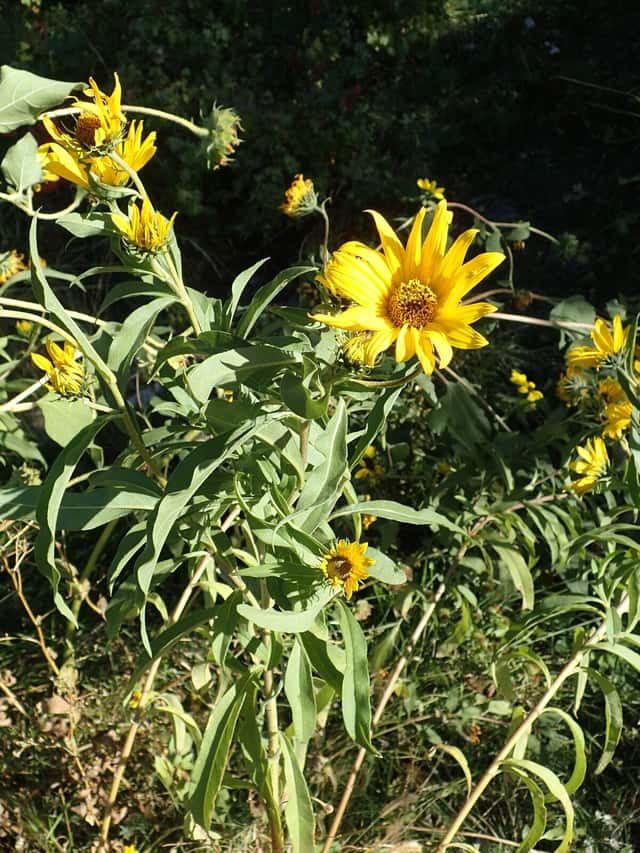
Maximilian sunflower (Helianthus maximiliani)
Helianthus maximiliani
A very easy plant if you have room and sun. Plant it in full sun, with no shade, in deep soil from sandy to clay, pH 6 to 8. Once established it handles drought and needs little water or fertilizer. In very rich soil it grows too tall and flops: stake it or plant in leaner soil. Cut back old stems at the end of the season. It spreads by rhizomes and seed, so give it a spot where it can roam.
Every 10 days
Direct sun
° - °C
% - %
Categories
What is Maximilian sunflower?
Maximilian sunflower (Helianthus maximiliani) is a easy-care plant from the Asteraceae family. Maximilian sunflower (Helianthus maximiliani) is a perennial sunflower in the Asteraceae family, native to the prairies of central North America from Canada to northern Mexico. It is named after Prince Maximilian of Wied-Neuwied, who came across it on his travels. It forms clumps of upright, hairy s...
Maximilian sunflower grows up to 3.0m, spread of 120cm, watering every 10 days. It is not suitable for indoor environments and safe for pets.
Unlike many tropical plants, Maximilian sunflower tolerates watering mistakes. Best for beginners. Unlike many popular species, Maximilian sunflower is safe to keep around pets.
How to Care for Maximilian sunflower?
TLDR: Maximilian sunflower needs Direct sun, watering every 10 days, and temperatures between 15-30°C with 40-70% humidity.
How Often Should You Water Maximilian sunflower?
Water every 1 to 2 weeks in the first year if it does not rain. After that, only during long droughts: the deep roots cope well. Too much water in rich soil makes the stems weak.
How Much Light Does Maximilian sunflower Need?
Full sun all day. It does not tolerate shade; in part shade it gets floppy and blooms poorly.
What Is the Best Soil for Maximilian sunflower?
Deep soil (50 cm or more), loam to clay, pH 6 to 8. It accepts poor and rocky soil. It grows poorly in gravel, very dense clay or salty soil.
What Pot Should You Use for Maximilian sunflower?
Best in the ground. Because of its height and rhizomes, it only does well in very large, deep containers.
What Is Maximilian sunflower and Where Does It Come From?
Maximilian sunflower (Helianthus maximiliani) is a perennial sunflower in the Asteraceae family, native to the prairies of central North America from Canada to northern Mexico. It is named after Prince Maximilian of Wied-Neuwied, who came across it on his travels. It forms clumps of upright, hairy stems 1 to 3 m tall with narrow leaves up to 30 cm long, grayish from fine white hairs and folded upward. From late summer into early fall the stems fill with yellow flower heads 5 to 7 cm across, with 15 to 40 rays and a faint chocolate scent. It spreads by rhizomes and seed into large colonies, draws bees and butterflies, and its seeds feed birds.
How to Propagate Maximilian sunflower?
Seed
The seed needs a long cold period to germinate. Some plants bloom the first year, but they reach full size in the second.
- 1 In early winter, rake seeds into loose topsoil
- 2 Cover with 0.5 to 1 cm of soil or mulch
- 3 Let winter cold break dormancy
- 4 Or keep seeds in moist sand in the fridge for 8 weeks and sow in spring
Materials needed:
Division
Dividing also helps keep the colony in check.
- 1 In late winter, before new growth, dig around a plant at least 1 year old
- 2 Separate new shoots with a piece of rhizome
- 3 Replant at the same depth and water well
Materials needed:
How Big Does Maximilian sunflower Grow?
TLDR: Maximilian sunflower can reach up to 3.0m tall with Fast growth rate.
Max height
3.0m
Spread
1.2m
Growth rate
Fast
Plant Uses
Ornamental
Great for decoration
Edible
Can be consumed
Medicinal Uses
- American pioneers added the blossoms to bathwater to ease arthritis pain; efficacy not proven.
Culinary Uses
- Native American groups such as the Sioux ate the rhizome, much like Jerusalem artichoke.
- The seeds can be eaten as a snack, like those of other sunflowers.
Is your plant showing symptoms?
Click on the symptom to discover possible causes:
What Diseases Commonly Affect Maximilian sunflower?
TLDR: Maximilian sunflower is susceptible to 3 known diseases. Monitor regularly for early detection.
Powdery Mildew
Powdery mildew is a common fungal disease caused by various fungi species including Erysiphe, Podosphaera, Oïdium, and Leveillula. It affects over 10,000 plant species worldwide. The disease thrives in warm, dry climates with high humidity and appears as a distinctive white powdery coating on plant surfaces.
Rust
Rust is a common fungal disease caused by fungi in the order Pucciniales that affects a wide variety of plants. The disease gets its name from the characteristic orange, yellow, or reddish-brown pustules that appear on leaves, resembling metal rust. This obligate fungal parasite requires living plants to survive and can cause significant economic losses in agricultural crops.
White Mold
White mold (Sclerotinia sclerotiorum) is a devastating fungal disease affecting over 400 plant species worldwide. The fungus produces black, seed-like structures (sclerotia) that can survive in soil for 5 or more years. The disease is favored by cool, moist weather (50-68°F/10-20°C), especially during flowering.
Fun Facts
It is named after the German prince Maximilian of Wied-Neuwied, who explored North America in the 19th century.
Its flowers have a faint chocolate scent.
It releases chemicals that slow the growth of nearby plants, but they do not harm animals.
Frequently asked questions
Does Maximilian sunflower come back every year?
Why are my stems flopping over?
Does it spread a lot?
Does it have pests or diseases?
Compare with similar plants
| Attribute | Difficulty | Light | Watering | Pet Safe |
|---|---|---|---|---|
| Field Maple | Easy | Bright indirect | 14d | ✓ |
| Iberian Houseleek | Easy | Direct sun | 14d | ✓ |
| Silver Birch | Easy | Direct sun | 14d | ✓ |
| Common Blanketflower | Easy | Direct sun | 10d | ✓ |





