Rosaceae
Medlar: Edible Plant
Mespilus germanica
Medlar trees are undemanding once established: give them a sunny to lightly shaded spot, well-drained loamy soil, and occasional deep watering while young. They tolerate cold winters, poor soils, and neglect better than most fruit trees, and rarely need spraying or heavy pruning.
Every 10 days
Bright indirect
-20° - °C
% - %
Categories
What is Medlar?
Medlar (Mespilus germanica) is a easy-care plant from the Rosaceae family. The medlar (Mespilus germanica) is a small deciduous tree or large shrub in the rose family, native to the mountains of southeastern Europe, the Caucasus, and northern Iran. It grows slowly into a spreading, rounded crown 4-8 m tall and wide, with dark green oblong leaves that turn russet in autumn....
Medlar grows up to 8.0m, spread of 800cm, watering every 10 days. It is not suitable for indoor environments and safe for pets.
Unlike many tropical plants, Medlar tolerates watering mistakes. Best for beginners. Unlike many popular species, Medlar is safe to keep around pets.
How to Care for Medlar?
TLDR: Medlar needs Bright indirect, watering every 10 days, and temperatures between -20-30°C with 40-70% humidity.
How Often Should You Water Medlar?
Water new trees deeply and regularly through their first two or three summers; once established, medlars are fairly drought-tolerant and only need supplemental water during prolonged dry spells.
How Much Light Does Medlar Need?
Plant in full sun for the best fruit set and flavor, though medlar tolerates partial shade reasonably well.
What Is the Best Soil for Medlar?
Use fertile, well-drained loamy soil with a pH around 6.0-7.0; avoid waterlogged ground, which encourages root problems.
What Pot Should You Use for Medlar?
Best grown in open ground; if container culture is attempted while young, use a large, deep pot with excellent drainage and move it to the ground as soon as practical.
What Is Medlar and Where Does It Come From?
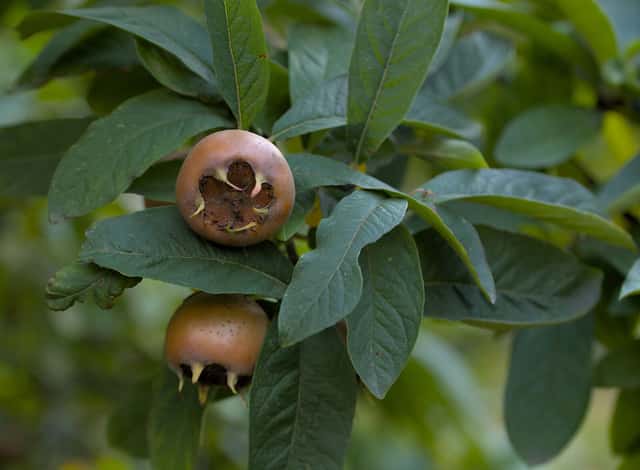
The medlar (Mespilus germanica) is a small deciduous tree or large shrub in the rose family, native to the mountains of southeastern Europe, the Caucasus, and northern Iran. It grows slowly into a spreading, rounded crown 4-8 m tall and wide, with dark green oblong leaves that turn russet in autumn. Its five-petaled white to pale-pink flowers open late, in May or June, well after most other fruit trees have finished blooming. The brown, apple-shaped fruit does not ripen on the tree; it must "blett" (soften through frost or storage) before it becomes sweet and edible.
How to Propagate Medlar?
Grafting onto rootstock
Commercial medlars are almost always grafted onto quince, hawthorn, or pear rootstock to control vigor and speed fruiting; whip-and-tongue or chip-budding are the usual methods.
- 1 Select a healthy one-year-old scion from a fruiting medlar
- 2 Make matching cuts on scion and rootstock
- 3 Bind the union tightly with grafting tape
- 4 Seal with grafting wax and keep moist until the union forms
Materials needed:
Hardwood cutting
Take cuttings from vigorous one-year-old shoots; success rates are lower than grafting, so most growers prefer grafted stock for reliable fruiting.
- 1 Cut 10-15 cm lengths of one-year-old wood
- 2 Remove lower leaves and dip the base in rooting hormone
- 3 Insert into free-draining compost and keep in bright, indirect light
- 4 Keep compost moist until roots establish
Materials needed:
How Big Does Medlar Grow?
TLDR: Medlar can reach up to 8.0m tall with Medium growth rate.
Max height
8.0m
Spread
8.0m
Growth rate
Medium
Foliage
Deciduous
Plant Uses
Edible
Can be consumed
Medicinal
Medicinal properties
Medicinal Uses
- Traditionally used as a mild astringent for digestive complaints
- Used in folk medicine as a diuretic
Culinary Uses
- Made into jelly, jam, and fruit cheese once bletted
- Eaten raw, scooped from the skin, after bletting
- Used in cakes, dumplings, and fruit leathers
Is your plant showing symptoms?
Click on the symptom to discover possible causes:
What Diseases Commonly Affect Medlar?
TLDR: Medlar is susceptible to 5 known diseases. Monitor regularly for early detection.
Fire Blight
Fire blight is a highly destructive and contagious bacterial disease caused by Erwinia amylovora. It primarily affects plants in the Rosaceae family, including apple, pear, quince trees, and various ornamental plants. The disease can destroy an entire orchard in a single growing season under ideal conditions, with the bacterium moving approximately 11 inches per week in new growth.
Powdery Mildew
Powdery mildew is a common fungal disease caused by various fungi species including Erysiphe, Podosphaera, Oïdium, and Leveillula. It affects over 10,000 plant species worldwide. The disease thrives in warm, dry climates with high humidity and appears as a distinctive white powdery coating on plant surfaces.
Leaf Spot
Leaf spot is a common fungal disease caused by various pathogens including Alternaria, Ascochyta, Colletotrichum, Septoria, and Venturia. It primarily affects leaves, causing discolored spots that can lead to premature leaf drop if left untreated.
Brown Rot
Monilinia is a genus of ascomycete fungi that causes blossom blight and brown rot in fruit trees. It spreads most rapidly in cool, wet weather, particularly during the bloom period. Symptoms include flowers that turn brown and remain attached to the shoots, small tan spots on fruit that expand into gray-beige spore rings (sporodochia), twig dieback, and 'mummified' fruit that shrivels and often persists on the tree. It primarily affects stone fruits (peach, nectarine, apricot, plum, cherry) but can also infect pome fruits such as apple and pear.
Meaning & Symbolism
In European folklore the medlar became a symbol of patience and transience: its fruit is only truly ready to enjoy after it appears to be past its prime, a fact that made it a favorite metaphor for hidden sweetness and delayed gratification in medieval and Elizabethan literature.
Compare with similar plants
| Attribute | Difficulty | Light | Watering | Pet Safe |
|---|---|---|---|---|
| Field Maple | Easy | Bright indirect | 14d | ✓ |
| Silver Birch | Easy | Direct sun | 14d | ✓ |
| Common Blanketflower | Easy | Direct sun | 10d | ✓ |
| Cushion Bush | Easy | Direct sun | 14d | ✓ |





