Asteraceae
Melancholy thistle: Edible Plant
Cirsium heterophyllum
An easy-to-grow, frost-resistant perennial requiring a sunny to semi-shaded position and fertile, constantly moist but well-drained soil with a near-neutral pH. It does not tolerate drying out or waterlogging. It is practically resistant to pests and diseases, although it can be attacked by powdery mildew, aphids, and rust (Puccinia cnici-oleracei).
Every 5 days
Bright indirect
-30° - 25°C
40% - 85%
Categories
What is Melancholy thistle?
Melancholy thistle (Cirsium heterophyllum) is a easy-care plant from the Asteraceae family. The melancholy thistle (Cirsium heterophyllum) is a spineless, mountain perennial from the Asteraceae family, reaching 50–150 cm in height. The unwinged stem bears lanceolate leaves that are green and smooth on top, while the underside is covered with a dense, white tomentum—hence the name "heteroph...
Melancholy thistle grows up to 1.5m, spread of 50cm, watering every 5 days, -30°C – 25°C, 40–85% humidity. It is not suitable for indoor environments and safe for pets.
Unlike many tropical plants, Melancholy thistle tolerates watering mistakes. Best for beginners. Unlike many popular species, Melancholy thistle is safe to keep around pets.
How to Care for Melancholy thistle?
TLDR: Melancholy thistle needs Bright indirect, watering every 5 days, and temperatures between -30-25°C with 40-85% humidity.
How Often Should You Water Melancholy thistle?
Water regularly, keeping the soil constantly moist—approximately every 5 days during the growing season, and more frequently during droughts. Avoid waterlogging, as excess water promotes root rot.
How Much Light Does Melancholy thistle Need?
It grows best in full sun but also tolerates light shade—choose a spot with at least several hours of direct sunlight per day.
What Is the Best Soil for Melancholy thistle?
Prefers fertile, humus-rich soil with a pH of 6.5–7.5, which is well-drained but moisture-retentive. It performs well in clay, sandy, and limestone soils, provided they are rich in nutrients.
What Pot Should You Use for Melancholy thistle?
This is not a typical houseplant—it works best in the ground, in a perennial border, or a wildflower meadow. If you choose to grow it in a container regardless, select a wide, deep (min. 30–40 cm) and well-drained vessel to accommodate its extensive root system.
Care Schedule
Fertilize
Every 60 days
What Is Melancholy thistle and Where Does It Come From?
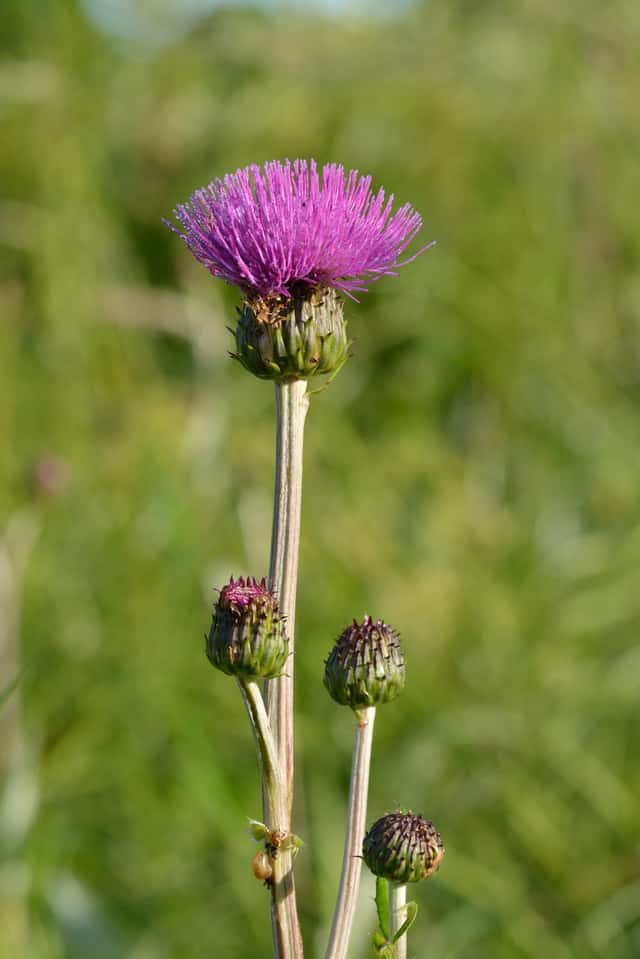
The melancholy thistle (Cirsium heterophyllum) is a spineless, mountain perennial from the Asteraceae family, reaching 50–150 cm in height. The unwinged stem bears lanceolate leaves that are green and smooth on top, while the underside is covered with a dense, white tomentum—hence the name "heterophyllum" (different leaves). It blooms from June to August, producing solitary, spherical flower heads of a purple-red color, reaching 3–5 cm in diameter. It naturally occurs in mountain meadows, tall-herb communities, and forest edges across northern and central Europe and Siberia, extending as far as the Altai Mountains.
How to Propagate Melancholy thistle?
How Big Does Melancholy thistle Grow?
TLDR: Melancholy thistle can reach up to 1.5m tall with Slow growth rate.
Max height
1.5m
Spread
50cm
Growth rate
Slow
Foliage
Deciduous
Plant Uses
Ornamental
Great for decoration
Edible
Can be consumed
Medicinal
Medicinal properties
Medicinal Uses
- Traditionally used in herbal medicine as a remedy for melancholy and depression—an infusion of the root was said to improve mood, as described by Nicholas Culpeper in 1669.
Culinary Uses
- Young, peeled shoots can be eaten raw or cooked, similar to asparagus—the plant is notable for its lack of spines, which makes harvesting easier.
Is your plant showing symptoms?
Click on the symptom to discover possible causes:
What Diseases Commonly Affect Melancholy thistle?
TLDR: Melancholy thistle is susceptible to 4 known diseases. Monitor regularly for early detection.
Powdery Mildew
Powdery mildew is a common fungal disease caused by various fungi species including Erysiphe, Podosphaera, Oïdium, and Leveillula. It affects over 10,000 plant species worldwide. The disease thrives in warm, dry climates with high humidity and appears as a distinctive white powdery coating on plant surfaces.
Aphids
Aphids are small, soft-bodied, pear-shaped insects (1/16 to 1/8 inch long) that feed by sucking nutrient-rich sap from plants. They reproduce rapidly and can quickly weaken plants, causing distorted growth and transmitting plant viruses. Aphids come in various colors including green, black, red, yellow, brown, and gray. They secrete honeydew, a sticky substance that attracts ants and encourages sooty mold growth.
Rust
Rust is a common fungal disease caused by fungi in the order Pucciniales that affects a wide variety of plants. The disease gets its name from the characteristic orange, yellow, or reddish-brown pustules that appear on leaves, resembling metal rust. This obligate fungal parasite requires living plants to survive and can cause significant economic losses in agricultural crops.
Root Rot
Root rot is a serious fungal disease that affects the root system of plants, causing them to decay and die. It is primarily caused by overwatering, poor drainage, or soil-borne fungi such as Pythium, Phytophthora, Rhizoctonia, and Fusarium. The disease thrives in waterlogged conditions where roots are deprived of oxygen, making them susceptible to fungal infection.
Meaning & Symbolism
In ancient herbal traditions, the melancholy thistle was considered a plant that cured melancholy and sadness—English herbalist Nicholas Culpeper wrote in 1669 that it makes a person "as merry as a cricket." The specific epithet "heterophyllum" refers to the characteristic contrast between the green upper side and the white-felted underside of the leaves.
Compare with similar plants
| Attribute | Difficulty | Light | Watering | Pet Safe |
|---|---|---|---|---|
| Field Maple | Easy | Bright indirect | 14d | ✓ |
| Silver Birch | Easy | Direct sun | 14d | ✓ |
| Common Blanketflower | Easy | Direct sun | 10d | ✓ |
| Cushion Bush | Easy | Direct sun | 14d | ✓ |
Choose & Compare
Sources & References
- Cirsium heterophyllum | melancholy thistle - RHS
- Cirsium helenioides (ostrożeń dwubarwny) - Atlas roślin polskich
- Melancholy thistle (Cirsium heterophyllum) Care Guide - ForwardPlant
- Cirsium heterophyllum - Wikipedia
- Puccinia cnici-oleracei - NatureSpot
- Melancholy Thistle (Cirsium heterophyllum) - Botanical Realm





