Asphodelaceae
Mitre Aloe: Full Sun Plant
Aloe mitriformis
Mitre Aloe requires plenty of direct sunlight, well-draining sandy soil, and only moderate watering – the soil must completely dry out between waterings. It tolerates drought and moderately cool temperatures, but protect it from severe frost below 0 °C.
Every 14 days
Direct sun
0° - 32°C
20% - 40%
Categories
What is Mitre Aloe?
Mitre Aloe (Aloe mitriformis) is a easy-care plant from the Asphodelaceae family. Mitre Aloe is a succulent plant from the Asphodelaceae family, native to the mountainous regions of the Western and Northern Cape in South Africa, where it grows among sandstone rocks at altitudes of 1200 – 1500 m. It forms creeping stems up to 2 m long, at the ends of which are dense rosettes of fl...
Mitre Aloe grows up to 30cm, spread of 100cm, watering every 14 days, 0°C – 32°C, 20–40% humidity. It is suitable for indoor environments and not safe for pets.
Unlike many tropical plants, Mitre Aloe tolerates watering mistakes. Best for beginners. Without precautions, ingestion can cause irritation in pets. Keep out of reach of cats and dogs. Without adequate drainage, root rot can develop within 28 days.
How to Care for Mitre Aloe?
TLDR: Mitre Aloe needs Direct sun, watering every 14 days, and temperatures between 0-32°C with 20-40% humidity.
How Often Should You Water Mitre Aloe?
Water thoroughly until water drains from the drainage holes, then allow the substrate to dry out completely (usually 10 – 14 days). Significantly reduce watering in winter; the plant can survive even longer periods of drought.
How Much Light Does Mitre Aloe Need?
Place in the sunniest spot – ideally direct sun for at least 5 – 6 hours daily. In insufficient light, the leaves lose their compact shape and grayish tint.
What Is the Best Soil for Mitre Aloe?
Use a well-draining substrate for cacti and succulents with a high proportion (50 – 70%) of mineral components – coarse sand, perlite, or pumice – and a slightly acidic to neutral pH.
What Pot Should You Use for Mitre Aloe?
Choose a terracotta or other breathable pot with large drainage holes, which helps to wick away excess moisture from the roots.
Care Schedule
Fertilize
Every 60 days
Repot
Every 730 days
What Is Mitre Aloe and Where Does It Come From?
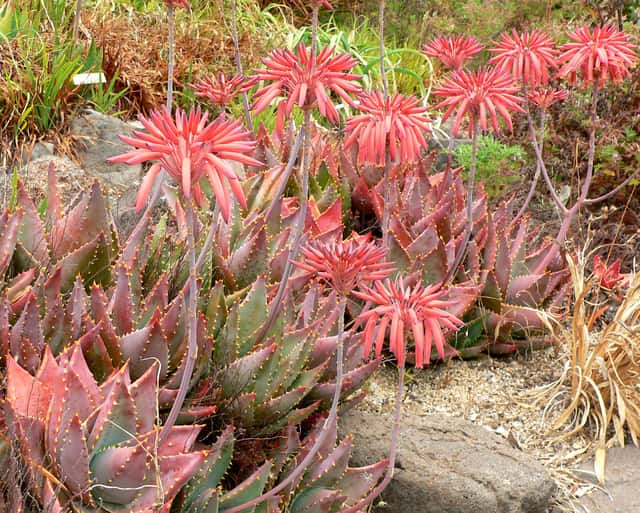
Mitre Aloe is a succulent plant from the Asphodelaceae family, native to the mountainous regions of the Western and Northern Cape in South Africa, where it grows among sandstone rocks at altitudes of 1200 – 1500 m. It forms creeping stems up to 2 m long, at the ends of which are dense rosettes of fleshy, grayish-green leaves with sharp teeth along the edges. In summer, branched flower stalks with dense clusters of dark red to bright red flowers emerge from the plant. It is a low-maintenance, fast-growing, and resilient plant that can survive long periods without watering and even mild frosts.
How to Propagate Mitre Aloe?
How Big Does Mitre Aloe Grow?
TLDR: Mitre Aloe can reach up to 30cm tall with Fast growth rate.
Max height
30cm
Spread
1.0m
Growth rate
Fast
Foliage
Evergreen
Warning: Toxic Plant
This plant can be toxic if ingested. Keep out of reach of:
Plant Uses
Ornamental
Great for decoration
Medicinal
Medicinal properties
Medicinal Uses
- The bitter yellow sap from the leaves is traditionally used as a laxative
- The pulp and sap from the leaves are used for healing wounds and burns
Is your plant showing symptoms?
Click on the symptom to discover possible causes:
What Diseases Commonly Affect Mitre Aloe?
TLDR: Mitre Aloe is susceptible to 6 known diseases. Monitor regularly for early detection.
Root Rot
Root rot is a serious fungal disease that affects the root system of plants, causing them to decay and die. It is primarily caused by overwatering, poor drainage, or soil-borne fungi such as Pythium, Phytophthora, Rhizoctonia, and Fusarium. The disease thrives in waterlogged conditions where roots are deprived of oxygen, making them susceptible to fungal infection.
Scale Insects
Scale insects are small sap-sucking pests that appear as brown, shell-like bumps on plant stems and leaves. There are over 25 species, divided into armored (hard) and unarmored (soft) scales. They feed by piercing plant tissue and extracting sap, which weakens the plant and can lead to yellowing, stunted growth, and even death if left untreated. They also excrete honeydew, which attracts ants and promotes sooty mold growth.
Aphids
Aphids are small, soft-bodied, pear-shaped insects (1/16 to 1/8 inch long) that feed by sucking nutrient-rich sap from plants. They reproduce rapidly and can quickly weaken plants, causing distorted growth and transmitting plant viruses. Aphids come in various colors including green, black, red, yellow, brown, and gray. They secrete honeydew, a sticky substance that attracts ants and encourages sooty mold growth.
Damping Off
Damping off is a soil-borne fungal disease that affects seeds and young seedlings, causing rotting of stem and root tissues at and below the soil line. It is caused by several fungi including Pythium, Rhizoctonia, Fusarium, and Phytophthora. The disease thrives in cold, wet conditions with poor air circulation.
Meaning & Symbolism
In folk symbolism, aloe represents resilience, protection, and healing power – qualities that reflect its ability to survive in harsh, dry environments.
Compare with similar plants
| Attribute | Difficulty | Light | Watering | Pet Safe |
|---|---|---|---|---|
| Field Maple | Easy | Bright indirect | 14d | ✓ |
| Silver Birch | Easy | Direct sun | 14d | ✓ |
| Common Blanketflower | Easy | Direct sun | 10d | ✓ |
| Cushion Bush | Easy | Direct sun | 14d | ✓ |





