Araceae
Moccmocc: Edible Plant
Montrichardia arborescens
Prefers full sun to partial shade and permanently waterlogged soil rich in organic matter, tolerating fresh, brackish, and even salt water. It is fast-growing but sensitive to cold, unable to withstand low temperatures or prolonged dry periods. Ideal for cultivation on the edges of ponds, tanks, and water gardens; it is not suitable as an indoor plant.
Every 2 days
Bright indirect
18° - 35°C
70% - 100%
Categories
What is Moccmocc?
Moccmocc (Montrichardia arborescens) is a medium-care plant from the Araceae family. The moccmocc (Montrichardia arborescens) is a perennial aquatic shrub in the Araceae family, native to mangroves, flooded forests (igapós), and the banks of rivers and streams across tropical America, the Caribbean, and Mesoamerica to the Brazilian Amazon. It forms vigorous clumps with erect stems u...
Moccmocc grows up to 3.0m, watering every 2 days, 18°C – 35°C, 70–100% humidity. It is not suitable for indoor environments and not safe for pets.
Without precautions, ingestion can cause irritation in pets. Keep out of reach of cats and dogs.
How to Care for Moccmocc?
TLDR: Moccmocc needs Bright indirect, watering every 2 days, and temperatures between 18-35°C with 70-100% humidity.
How Often Should You Water Moccmocc?
Keep the soil or substrate constantly waterlogged or even submerged — the moccmocc is a marsh plant and does not tolerate dry soil for long, although it can withstand short periods of drought.
How Much Light Does Moccmocc Need?
Grow in full sun or partial shade; in locations with insufficient light, growth becomes slower and the habit less vigorous.
What Is the Best Soil for Moccmocc?
Use soil rich in organic matter that is always moist or flooded; the plant tolerates everything from sandy to clay soils, as long as they remain saturated with water.
What Pot Should You Use for Moccmocc?
As a plant of flooded environments, it is best suited for direct planting on the banks of ponds and tanks; if grown in a pot, prefer large containers without drainage holes (cachepot style), keeping the substrate always waterlogged.
Care Schedule
Fertilize
Every 45 days
What Is Moccmocc and Where Does It Come From?
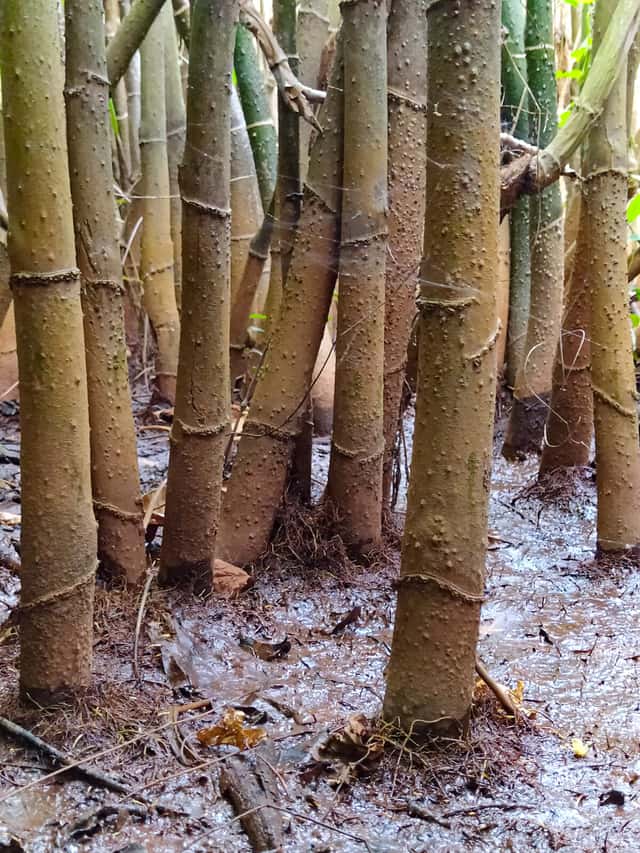
The moccmocc (Montrichardia arborescens) is a perennial aquatic shrub in the Araceae family, native to mangroves, flooded forests (igapós), and the banks of rivers and streams across tropical America, the Caribbean, and Mesoamerica to the Brazilian Amazon. It forms vigorous clumps with erect stems up to 3 m (occasionally 7 m), supported by prop roots and featuring spines on the internodes, along with large arrow-shaped leaves. Its spadix inflorescences, with a spathe that is light green on the outside and white on the inside, give rise to edible infrutescences, and the plant is traditionally used by riverside communities for medicinal and nutritional purposes.
How to Propagate Moccmocc?
Rhizome division
Use gloves when handling the plant, as the stem sap is caustic and can irritate the skin.
- 1 Choose an established clump with multiple stems/rhizomes
- 2 Cut a section of the rhizome with roots and at least one bud
- 3 Plant immediately in waterlogged soil or on the edge of a tank
- 4 Keep the substrate constantly moist until established
Materials needed:
Seeds
Do not store the seeds; they do not tolerate desiccation or low temperatures.
- 1 Harvest the ripe fruits from the spadix and extract the seeds
- 2 Sow immediately, as the seeds are recalcitrant and lose viability quickly when drying
- 3 Keep the substrate saturated with water and at a constant warm temperature
- 4 Protect against fungi during germination, as the seeds are susceptible to rotting
Materials needed:
How Big Does Moccmocc Grow?
TLDR: Moccmocc can reach up to 3.0m tall with Fast growth rate.
Max height
3.0m
Growth rate
Fast
Foliage
Evergreen
Warning: Toxic Plant
This plant can be toxic if ingested. Keep out of reach of:
Plant Uses
Ornamental
Great for decoration
Medicinal
Medicinal properties
Edible
Can be consumed
Medicinal Uses
- Stem sap used topically on cuts and nosebleeds
- Infusion of dried roots and leaves for hypertension
- Traditional use as an anti-rheumatic and diuretic
- Leaf poultices for abscesses and tumors
Culinary Uses
- Ripe fruits from the spadix consumed raw or cooked
- Seeds cooked or toasted
Is your plant showing symptoms?
Click on the symptom to discover possible causes:
What Diseases Commonly Affect Moccmocc?
TLDR: Moccmocc is susceptible to 5 known diseases. Monitor regularly for early detection.
Leaf Spot
Leaf spot is a common fungal disease caused by various pathogens including Alternaria, Ascochyta, Colletotrichum, Septoria, and Venturia. It primarily affects leaves, causing discolored spots that can lead to premature leaf drop if left untreated.
Anthracnose
Anthracnose is a fungal disease caused by fungi in the genus Colletotrichum that affects many plants, including vegetables, fruits, and trees. The disease thrives in cool, wet conditions, causing dark, sunken lesions on leaves, stems, flowers, and fruits.
Mealybugs
Mealybugs are small, soft-bodied insects covered with a white, waxy, cottony material. They are common pests of houseplants and outdoor plants in mild climates. These sap-sucking insects feed on plant tissue, causing damage, stunted growth, and can lead to plant death if left untreated. They produce sticky honeydew which attracts sooty mold.
Aphids
Aphids are small, soft-bodied, pear-shaped insects (1/16 to 1/8 inch long) that feed by sucking nutrient-rich sap from plants. They reproduce rapidly and can quickly weaken plants, causing distorted growth and transmitting plant viruses. Aphids come in various colors including green, black, red, yellow, brown, and gray. They secrete honeydew, a sticky substance that attracts ants and encourages sooty mold growth.
Meaning & Symbolism
A symbol of Amazonian riverside life, the moccmocc represents the resilience of plants that thrive between land and water, historically associated by traditional peoples with healing, protection, and the balance of floodplain and mangrove ecosystems.
Compare with similar plants
| Attribute | Difficulty | Light | Watering | Pet Safe |
|---|---|---|---|---|
| Dark Fieldcap | Medium | Low light | 2d | ⚠️ |
| Azalea | Medium | Partial shade | 3d | ⚠️ |
| Muriel's Bamboo | Medium | Partial shade | 3d | ✓ |
| Bougainvillea | Medium | Direct sun | 7d | ⚠️ |
Choose & Compare
Sources & References
- Montrichardia arborescens - Wikipedia
- Montrichardia arborescens (Mocou Mocou) - Top Tropicals
- Montrichardia arborescens - NParks FloraFaunaWeb
- Montrichardia Arborescens (Mocou Mocou) - Tropilab
- Chemical characterization, acute oral toxicity and antinociceptive potential of Montrichardia linifera leaves - Frontiers in Pharmacology




