Cactaceae
Monkey's Tail Cactus: Low Water Needs
Hildewintera colademononis
Grow the Monkey's Tail Cactus in a location with bright, indirect light, tolerating a few hours of direct morning sun. Water only when the substrate is completely dry, approximately every 15 days in summer, reducing significantly in winter. Use a mineral-based, lightweight, and very well-draining substrate specifically for cacti. Maintain temperatures between 15°C and 25°C (59°F - 77°F), protecting the plant from frost. Fertilize monthly in spring and summer with a cactus fertilizer.
Every 15 days
Bright indirect
10° - 32°C
20% - 50%
Categories
What is Monkey's Tail Cactus?
Monkey's Tail Cactus (Hildewintera colademononis) is a easy-care plant from the Cactaceae family. Hildewintera colademononis, also classified as Cleistocactus colademononis, is an epiphytic and pendulous cactus native to the moist rocky slopes of Florida province in the Santa Cruz department of Bolivia, where it grows hanging from cliffs at altitudes of up to 1,500 meters. Its cylindrical stems,...
Monkey's Tail Cactus grows up to 2.5m, spread of 40cm, watering every 15 days, 10°C – 32°C, 20–50% humidity. It is suitable for indoor environments and safe for pets.
Unlike many tropical plants, Monkey's Tail Cactus tolerates watering mistakes. Best for beginners. Unlike many popular species, Monkey's Tail Cactus is safe to keep around pets. Without adequate drainage, root rot can develop within 30 days.
How to Care for Monkey's Tail Cactus?
TLDR: Monkey's Tail Cactus needs Bright indirect, watering every 15 days, and temperatures between 10-32°C with 20-50% humidity.
How Often Should You Water Monkey's Tail Cactus?
Water moderately, allowing the substrate to dry out completely between waterings—on average every 15 days during spring and summer. In winter, drastically reduce or suspend watering, as excess water is the main cause of root rot for this species.
How Much Light Does Monkey's Tail Cactus Need?
Prefers abundant light, preferably bright indirect light, but tolerates a few hours of direct morning sun. Avoid strong afternoon sun, which can burn the stems. It is an ideal plant for balconies and hanging spots with good luminosity.
What Is the Best Soil for Monkey's Tail Cactus?
Use a loose, lightweight substrate with excellent drainage, such as ready-made mixes for cacti and succulents or a homemade combination of soil, coarse sand, and perlite or pumice. The ideal pH is slightly acidic to neutral.
What Pot Should You Use for Monkey's Tail Cactus?
Being a species with trailing stems, it is ideal for hanging pots (planters) or high shelves, allowing the stems to grow freely downwards. The pot must have generous drainage holes and, preferably, be made of a porous material like terracotta.
Care Schedule
Fertilize
Every 30 days
Repot
Every 730 days
What Is Monkey's Tail Cactus and Where Does It Come From?
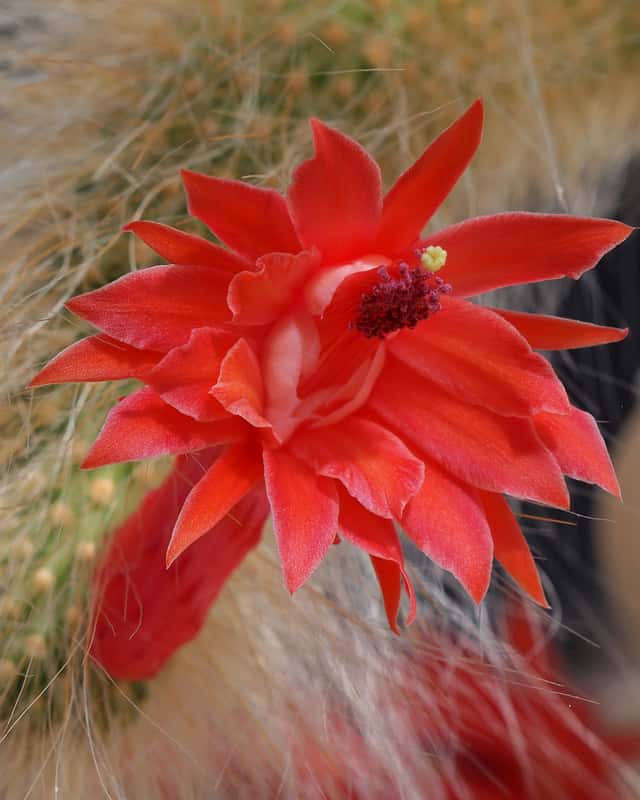
Hildewintera colademononis, also classified as Cleistocactus colademononis, is an epiphytic and pendulous cactus native to the moist rocky slopes of Florida province in the Santa Cruz department of Bolivia, where it grows hanging from cliffs at altitudes of up to 1,500 meters. Its cylindrical stems, 3 to 7 cm in diameter, can reach up to 2.5 meters in length and are covered by dozens of white, thin, and hair-like soft spines that resemble a monkey's furry tail—the origin of its popular nickname. Between spring and summer, it produces vibrant red flowers up to 8 cm long that bloom almost horizontally along the stems. It is a relatively fast-growing species, ideal for hanging baskets, and has received the prestigious Award of Garden Merit from the Royal Horticultural Society.
How to Propagate Monkey's Tail Cactus?
Stem cuttings
- Avoid watering immediately after planting to prevent the cut from rotting.
- Rooting usually occurs within a few weeks in warm temperatures.
- 1 Cutting
Cut a healthy stem segment at least 10 cm long using a clean, sharp tool.
- 2 Callousing
Let the cut dry in a shaded, ventilated area for 2 to 3 days until a callus forms at the end.
- 3 Planting
Plant the cutting in cactus substrate in a warm spot with indirect light, and water only when the substrate dries out.
Materials needed:
Seeds
- Seed propagation is slower and less predictable than stem cuttings.
- 1 Collection
Harvest ripe fruits after flowering and extract the seeds.
- 2 Sowing
Distribute the seeds on the surface of a light, moist substrate without covering them.
- 3 Germination
Keep in a warm place with indirect light until germination, maintaining constant humidity.
Materials needed:
How Big Does Monkey's Tail Cactus Grow?
TLDR: Monkey's Tail Cactus can reach up to 2.5m tall with Fast growth rate.
Max height
2.5m
Spread
40cm
Growth rate
Fast
Foliage
Evergreen
Plant Uses
Ornamental
Great for decoration
Is your plant showing symptoms?
Click on the symptom to discover possible causes:
What Diseases Commonly Affect Monkey's Tail Cactus?
TLDR: Monkey's Tail Cactus is susceptible to 4 known diseases. Monitor regularly for early detection.
Root Rot
Root rot is a serious fungal disease that affects the root system of plants, causing them to decay and die. It is primarily caused by overwatering, poor drainage, or soil-borne fungi such as Pythium, Phytophthora, Rhizoctonia, and Fusarium. The disease thrives in waterlogged conditions where roots are deprived of oxygen, making them susceptible to fungal infection.
Scale Insects
Scale insects are small sap-sucking pests that appear as brown, shell-like bumps on plant stems and leaves. There are over 25 species, divided into armored (hard) and unarmored (soft) scales. They feed by piercing plant tissue and extracting sap, which weakens the plant and can lead to yellowing, stunted growth, and even death if left untreated. They also excrete honeydew, which attracts ants and promotes sooty mold growth.
Mealybugs
Mealybugs are small, soft-bodied insects covered with a white, waxy, cottony material. They are common pests of houseplants and outdoor plants in mild climates. These sap-sucking insects feed on plant tissue, causing damage, stunted growth, and can lead to plant death if left untreated. They produce sticky honeydew which attracts sooty mold.
Spider Mites
Spider mites are tiny arachnids (less than 1/20 inch long) related to spiders and ticks that feed on plant sap. They thrive in hot, dry conditions and can cause significant damage to ornamental and vegetable plants. During severe infestations, crop losses can reach 14% or higher as these pests disrupt vital plant processes including photosynthesis, carbon dioxide absorption, and transpiration.
Meaning & Symbolism
As a cactus with long, pendulous stems, the Monkey's Tail often symbolizes resilience, originality, and protection—qualities associated with its ability to survive on arid rocky cliffs. Its peculiar and playful shape also makes it a symbol of relaxation and good humor in interior decoration.
Compare with similar plants
| Attribute | Difficulty | Light | Watering | Pet Safe |
|---|---|---|---|---|
| Field Maple | Easy | Bright indirect | 14d | ✓ |
| Silver Birch | Easy | Direct sun | 14d | ✓ |
| Common Blanketflower | Easy | Direct sun | 10d | ✓ |
| Cushion Bush | Easy | Direct sun | 14d | ✓ |





