Asteraceae
Mount Everest Senecio (Curio ficoides)
Curio ficoides
An easy succulent that wants lots of sun and little water. Indoors, give it your brightest window; in low light it stretches and flops over. Water only when the soil has dried out, and almost stop in winter. It does not survive hard frost: below about -2 °C the leaves are damaged. Cut back long stems once a year and root the tips as new plants.
Every 14 days
Bright indirect
-2° - 40°C
% - %
Categories
What is Mount Everest senecio?
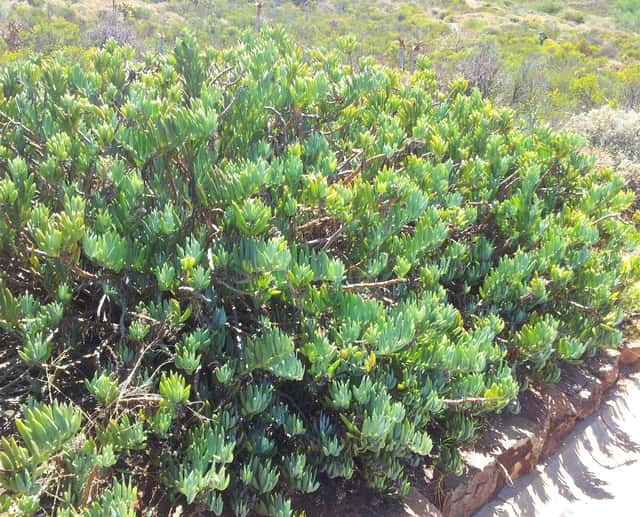
Mount Everest senecio (Curio ficoides) is a easy-care plant from the Asteraceae family. Curio ficoides, formerly Senecio ficoides, is a succulent in the daisy family (Asteraceae) native to South Africa, from the Namaqualand region. It forms a shrub over 1 meter tall with fleshy, brittle stems. The leaves are thick, long and flattened on the sides like a blade, and they look blue-grey b...
Mount Everest senecio grows up to 1.2m, watering every 14 days, -2°C – 40°C. It is suitable for indoor environments and safe for pets.
Unlike many tropical plants, Mount Everest senecio tolerates watering mistakes. Best for beginners. Unlike many popular species, Mount Everest senecio is safe to keep around pets. Without adequate drainage, root rot can develop within 28 days.
How to Care for Mount Everest senecio?
TLDR: Mount Everest senecio needs Bright indirect, watering every 14 days, and temperatures between -2-40°C with 40-70% humidity.
How Often Should You Water Mount Everest senecio?
Soak the soil, then wait until it is completely dry before watering again, roughly every 1 to 3 weeks in warm weather. In winter, water once a month or less. Wrinkled leaves mean it is thirsty; a soft, dark stem base means too much water.
How Much Light Does Mount Everest senecio Need?
Full sun or your brightest window, with at least 6 hours of strong light. In very hot places, some afternoon shade prevents scorched leaves. Turn the pot once a month so it grows straight.
What Is the Best Soil for Mount Everest senecio?
Cactus and succulent mix with coarse sand or perlite added so water drains fast. Always use a pot with a drainage hole.
What Pot Should You Use for Mount Everest senecio?
A terracotta pot with a drainage hole, which dries faster than plastic. The plant gets tall and top-heavy, so choose a wide, stable pot.
Care Schedule
Fertilize
Every 30 days
Rotate
Every 30 days
Repot
Every 1095 days
What Is Mount Everest senecio and Where Does It Come From?
Curio ficoides, formerly Senecio ficoides, is a succulent in the daisy family (Asteraceae) native to South Africa, from the Namaqualand region. It forms a shrub over 1 meter tall with fleshy, brittle stems. The leaves are thick, long and flattened on the sides like a blade, and they look blue-grey because of a white powdery coating. The flowers are small, white or cream, with no showy petals, and appear in clusters at the branch tips. In the trade it is sold as 'Mount Everest' or 'Skyscraper', names for a selection with very upright growth.
How to Propagate Mount Everest senecio?
Stem cutting
It roots almost every time. Several cuttings in one pot give a fuller plant.
- 1 Cut a stem tip 10 to 15 cm long
- 2 Strip the leaves from the bottom 5 cm
- 3 Let the cutting dry in the shade for a few days until the cut seals
- 4 Push it 3 to 5 cm deep into slightly moist succulent mix
- 5 Keep it in bright light out of strong sun until new leaves appear
Materials needed:
How Big Does Mount Everest senecio Grow?
TLDR: Mount Everest senecio can reach up to 1.2m tall with Fast growth rate.
Max height
1.2m
Growth rate
Fast
Foliage
Evergreen
Plant Uses
Ornamental
Great for decoration
Ground Cover
Soil coverage
Is your plant showing symptoms?
Click on the symptom to discover possible causes:
What Diseases Commonly Affect Mount Everest senecio?
TLDR: Mount Everest senecio is susceptible to 6 known diseases. Monitor regularly for early detection.
Root Rot
Root rot is a serious fungal disease that affects the root system of plants, causing them to decay and die. It is primarily caused by overwatering, poor drainage, or soil-borne fungi such as Pythium, Phytophthora, Rhizoctonia, and Fusarium. The disease thrives in waterlogged conditions where roots are deprived of oxygen, making them susceptible to fungal infection.
Mealybugs
Mealybugs are small, soft-bodied insects covered with a white, waxy, cottony material. They are common pests of houseplants and outdoor plants in mild climates. These sap-sucking insects feed on plant tissue, causing damage, stunted growth, and can lead to plant death if left untreated. They produce sticky honeydew which attracts sooty mold.
Scale Insects
Scale insects are small sap-sucking pests that appear as brown, shell-like bumps on plant stems and leaves. There are over 25 species, divided into armored (hard) and unarmored (soft) scales. They feed by piercing plant tissue and extracting sap, which weakens the plant and can lead to yellowing, stunted growth, and even death if left untreated. They also excrete honeydew, which attracts ants and promotes sooty mold growth.
Aphids
Aphids are small, soft-bodied, pear-shaped insects (1/16 to 1/8 inch long) that feed by sucking nutrient-rich sap from plants. They reproduce rapidly and can quickly weaken plants, causing distorted growth and transmitting plant viruses. Aphids come in various colors including green, black, red, yellow, brown, and gray. They secrete honeydew, a sticky substance that attracts ants and encourages sooty mold growth.
Fun Facts
The white powder that makes the leaves look blue helps the plant lose less water in strong sun.
It has been grown in Europe since 1702, before Linnaeus gave it a name.
Stems that touch the ground can put out roots and start new plants on their own.
Frequently asked questions
Why is my senecio stretching and flopping over?
How often should I water it?
The base of the stem turned soft and dark. What now?
Is it toxic to cats and dogs?
Compare with similar plants
| Attribute | Difficulty | Light | Watering | Pet Safe |
|---|---|---|---|---|
| Field Maple | Easy | Bright indirect | 14d | ✓ |
| Iberian Houseleek | Easy | Direct sun | 14d | ✓ |
| Silver Birch | Easy | Direct sun | 14d | ✓ |
| Common Blanketflower | Easy | Direct sun | 10d | ✓ |





