Caryophyllaceae
Mountain Sandwort: Ground Cover Plant
Arenaria montana
Grow Mountain Sandwort in a sunny to partially shaded location in poor, sandy, and well-draining soil – waterlogging of the roots is more dangerous for it than drought. Water moderately, especially during dry periods in spring and summer, allowing the substrate to dry out slightly between waterings. After flowering at the turn of June and July, lightly prune the plant to encourage a compact shape; never cut into older woody growth, as it will not sprout again from there. It hardly requires fertilization; a light spring dose of balanced fertilizer is sufficient.
Every 7 days
Bright indirect
10° - 24°C
% - %
Categories
What is Mountain Sandwort?
Mountain Sandwort (Arenaria montana) is a easy-care plant from the Caryophyllaceae family. Mountain Sandwort is a low-growing, evergreen perennial cushion-forming shrub from the carnation family (Caryophyllaceae), originating from the mountainous regions of southwestern Europe and northwestern Africa – from the Pyrenees across Portugal to northern Morocco. It forms dense clumps with narro...
Mountain Sandwort grows up to 20cm, spread of 30cm, watering every 7 days, 10°C – 24°C. It is not suitable for indoor environments and safe for pets.
Unlike many tropical plants, Mountain Sandwort tolerates watering mistakes. Best for beginners. Unlike many popular species, Mountain Sandwort is safe to keep around pets.
How to Care for Mountain Sandwort?
TLDR: Mountain Sandwort needs Bright indirect, watering every 7 days, and temperatures between 10-24°C with 40-70% humidity.
How Often Should You Water Mountain Sandwort?
The roots of Mountain Sandwort quickly rot in waterlogged soil because they cannot function in water-saturated substrate. Therefore, water sparingly but regularly – the substrate should dry out slightly between waterings, but should never completely dry out for an extended period.
How Much Light Does Mountain Sandwort Need?
It grows best in full sun; in warmer regions, it will appreciate light partial shade or placement between stones where the roots remain cool while the leaves and flowers stay in the sun.
What Is the Best Soil for Mountain Sandwort?
It requires poor, gravelly or sandy soil with excellent drainage; it quickly perishes in heavy clay or constantly moist soil. A slightly acidic to neutral pH is ideal, but it also tolerates calcareous substrates.
What Pot Should You Use for Mountain Sandwort?
For container cultivation, choose a wide, shallow bowl or planter with large drainage holes and a layer of gravel at the bottom; unglazed terracotta is ideal as it wicks away excess moisture from the roots.
Care Schedule
Fertilize
Every 180 days
What Is Mountain Sandwort and Where Does It Come From?
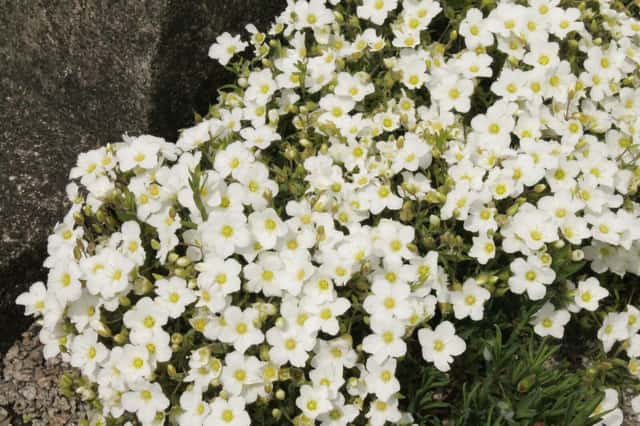
Mountain Sandwort is a low-growing, evergreen perennial cushion-forming shrub from the carnation family (Caryophyllaceae), originating from the mountainous regions of southwestern Europe and northwestern Africa – from the Pyrenees across Portugal to northern Morocco. It forms dense clumps with narrow, lance-shaped, grey-green leaves that are completely covered by a profusion of tiny white flowers from spring to summer. In nature, it grows on rocky slopes, heathlands, and forest edges at altitudes of 400–1850 m, which explains its requirement for permeable, poor soil and excellent drainage. Due to its low maintenance and long flowering period, it is popular as a groundcover plant for rock gardens, gravel beds, and cracks between paving stones.
How to Propagate Mountain Sandwort?
How Big Does Mountain Sandwort Grow?
TLDR: Mountain Sandwort can reach up to 20cm tall with Slow growth rate.
Max height
20cm
Spread
30cm
Growth rate
Slow
Foliage
Evergreen
Plant Uses
Ornamental
Great for decoration
Ground Cover
Soil coverage
Is your plant showing symptoms?
Click on the symptom to discover possible causes:
What Diseases Commonly Affect Mountain Sandwort?
TLDR: Mountain Sandwort is susceptible to 5 known diseases. Monitor regularly for early detection.
Root Rot
Root rot is a serious fungal disease that affects the root system of plants, causing them to decay and die. It is primarily caused by overwatering, poor drainage, or soil-borne fungi such as Pythium, Phytophthora, Rhizoctonia, and Fusarium. The disease thrives in waterlogged conditions where roots are deprived of oxygen, making them susceptible to fungal infection.
Overwatering
Overwatering occurs when plants receive too much water, depriving roots of oxygen and causing root rot. This environmental stress is one of the most common causes of houseplant death, as waterlogged soil prevents roots from breathing and functioning properly.
Aphids
Aphids are small, soft-bodied, pear-shaped insects (1/16 to 1/8 inch long) that feed by sucking nutrient-rich sap from plants. They reproduce rapidly and can quickly weaken plants, causing distorted growth and transmitting plant viruses. Aphids come in various colors including green, black, red, yellow, brown, and gray. They secrete honeydew, a sticky substance that attracts ants and encourages sooty mold growth.
Spider Mites
Spider mites are tiny arachnids (less than 1/20 inch long) related to spiders and ticks that feed on plant sap. They thrive in hot, dry conditions and can cause significant damage to ornamental and vegetable plants. During severe infestations, crop losses can reach 14% or higher as these pests disrupt vital plant processes including photosynthesis, carbon dioxide absorption, and transpiration.
Meaning & Symbolism
Mountain Sandwort, a tiny rock plant enduring wind and drought on high mountain slopes, symbolizes unobtrusive resilience and modesty – the ability to bloom even in the poorest places.
Compare with similar plants
| Attribute | Difficulty | Light | Watering | Pet Safe |
|---|---|---|---|---|
| Field Maple | Easy | Bright indirect | 14d | ✓ |
| Silver Birch | Easy | Direct sun | 14d | ✓ |
| Common Blanketflower | Easy | Direct sun | 10d | ✓ |
| Cushion Bush | Easy | Direct sun | 14d | ✓ |





