Berberidaceae
Heavenly Bamboo (Nandina): How to Grow and Care
Nandina
Easy-care evergreen shrub ideal for outdoor gardens. Thrives in full sun to partial shade with well-drained soil. Water every 7-10 days; drought-tolerant once established. Prune annually to maintain compact shape. WARNING: All parts of the plant are toxic to cats, dogs, birds, and humans.
Every 8 days
Bright indirect
-15° - 38°C
40% - 70%
Categories
What is Heavenly Bamboo / Sacred Bamboo (genus)?
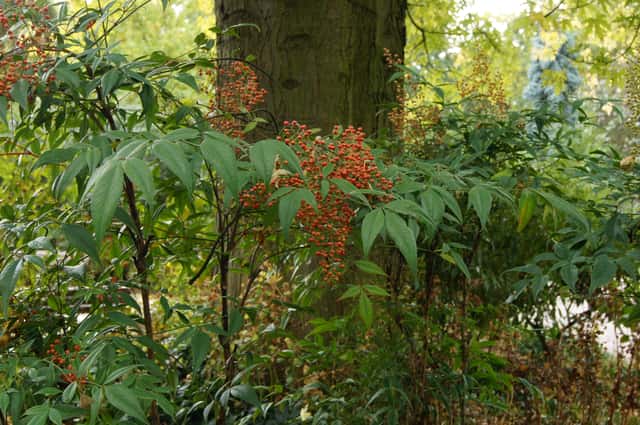
Heavenly Bamboo / Sacred Bamboo (genus) (Nandina) is a easy-care plant from the Berberidaceae family. Nandina is a compact, evergreen shrub native to eastern Asia (Japan, China, and the Himalayas), belonging to the family Berberidaceae. Despite its common name "Heavenly Bamboo," it is not a true bamboo. It features elegant foliage with brilliant red new growth, white spring flowers, and vibrant red...
Heavenly Bamboo / Sacred Bamboo (genus) grows up to 2.4m, spread of 150cm, watering every 8 days, -15°C – 38°C, 40–70% humidity. It is not suitable for indoor environments and not safe for pets.
Unlike many tropical plants, Heavenly Bamboo / Sacred Bamboo (genus) tolerates watering mistakes. Best for beginners. Without precautions, ingestion can cause irritation in pets. Keep out of reach of cats and dogs.
How to Care for Heavenly Bamboo / Sacred Bamboo (genus)?
TLDR: Heavenly Bamboo / Sacred Bamboo (genus) needs Bright indirect, watering every 8 days, and temperatures between -15-38°C with 40-70% humidity.
How Often Should You Water Heavenly Bamboo / Sacred Bamboo (genus)?
Water every 7-10 days for young plants. Established plants are drought-tolerant and need watering only during extended dry spells. Avoid waterlogging — soggy soil causes root rot.
How Much Light Does Heavenly Bamboo / Sacred Bamboo (genus) Need?
Prefers full sun to partial shade. More sun produces more intense foliage colors, especially the signature red tones. Tolerates partial shade but may reduce berry production.
What Is the Best Soil for Heavenly Bamboo / Sacred Bamboo (genus)?
Use well-draining, slightly acidic soil (pH 5.5-6.5). Amend with sand or perlite to improve drainage. Avoid waterlogged or compacted soils.
What Pot Should You Use for Heavenly Bamboo / Sacred Bamboo (genus)?
Ceramic or terracotta pots are ideal for outdoor cultivation. If growing in a container, choose a large pot with generous drainage holes.
Care Schedule
Fertilize
Every 90 days
What Is Heavenly Bamboo / Sacred Bamboo (genus) and Where Does It Come From?
Nandina is a compact, evergreen shrub native to eastern Asia (Japan, China, and the Himalayas), belonging to the family Berberidaceae. Despite its common name "Heavenly Bamboo," it is not a true bamboo. It features elegant foliage with brilliant red new growth, white spring flowers, and vibrant red berries in fall and winter. Widely used in ornamental landscaping across USDA zones 6-11.
How to Propagate Heavenly Bamboo / Sacred Bamboo (genus)?
Stem Cutting
Use semi-hardwood cuttings for better success rates. Maintain consistent moisture without waterlogging the substrate.
- 1 Take a semi-hardwood cutting of 10-15 cm in summer or early fall
- 2 Remove lower leaves, keeping 2-3 leaves at the top
- 3 Apply rooting hormone to the cut end
- 4 Plant in well-draining, moist rooting medium
- 5 Keep in indirect light with high humidity until rooted
Materials needed:
Seed Propagation
Cold stratification is essential to break seed dormancy in Nandina.
- 1 Collect ripe seeds from red berries in fall
- 2 Clean off the pulp and dry seeds for 1-2 days
- 3 Cold-stratify seeds in moist sand for 60-90 days
- 4 Sow in light, well-draining seed mix in spring
- 5 Keep moist at 18-22°C until germination
Materials needed:
How Big Does Heavenly Bamboo / Sacred Bamboo (genus) Grow?
TLDR: Heavenly Bamboo / Sacred Bamboo (genus) can reach up to 2.4m tall with Slow growth rate.
Max height
2.4m
Spread
1.5m
Growth rate
Slow
Foliage
Evergreen
Warning: Toxic Plant
This plant can be toxic if ingested. Keep out of reach of:
Plant Uses
Ornamental
Great for decoration
Is your plant showing symptoms?
Click on the symptom to discover possible causes:
What Diseases Commonly Affect Heavenly Bamboo / Sacred Bamboo (genus)?
TLDR: Heavenly Bamboo / Sacred Bamboo (genus) is susceptible to 5 known diseases. Monitor regularly for early detection.
Leaf Spot
Leaf spot is a common fungal disease caused by various pathogens including Alternaria, Ascochyta, Colletotrichum, Septoria, and Venturia. It primarily affects leaves, causing discolored spots that can lead to premature leaf drop if left untreated.
Root Rot
Root rot is a serious fungal disease that affects the root system of plants, causing them to decay and die. It is primarily caused by overwatering, poor drainage, or soil-borne fungi such as Pythium, Phytophthora, Rhizoctonia, and Fusarium. The disease thrives in waterlogged conditions where roots are deprived of oxygen, making them susceptible to fungal infection.
Anthracnose
Anthracnose is a fungal disease caused by fungi in the genus Colletotrichum that affects many plants, including vegetables, fruits, and trees. The disease thrives in cool, wet conditions, causing dark, sunken lesions on leaves, stems, flowers, and fruits.
Scale Insects
Scale insects are small sap-sucking pests that appear as brown, shell-like bumps on plant stems and leaves. There are over 25 species, divided into armored (hard) and unarmored (soft) scales. They feed by piercing plant tissue and extracting sap, which weakens the plant and can lead to yellowing, stunted growth, and even death if left untreated. They also excrete honeydew, which attracts ants and promotes sooty mold growth.
Meaning & Symbolism
In Japanese culture, Nandina symbolizes longevity and good fortune. It is traditionally planted at entrances to homes as a protective charm.
Fun Facts
Despite its name, Heavenly Bamboo is not a true bamboo — it belongs to the Berberidaceae family, related to barberries.
Nandina berries are highly toxic to birds, particularly Cedar Waxwings, and can be lethal if consumed in large quantities.
Nandina has been cultivated in Japan for centuries and is considered a good luck plant, traditionally placed at home entrances.
The new foliage of Nandina emerges bright red, turns green in summer, and returns to red and bronze in fall and winter.
Frequently asked questions
How often should I water Nandina?
Is Nandina toxic to pets?
Does Nandina need pruning?
Can Nandina grow in shade?
What diseases affect Nandina?
Compare with similar plants
| Attribute | Difficulty | Light | Watering | Pet Safe |
|---|---|---|---|---|
| Field Maple | Easy | Bright indirect | 14d | ✓ |
| Silver Birch | Easy | Direct sun | 14d | ✓ |
| Common Blanketflower | Easy | Direct sun | 10d | ✓ |
| Cushion Bush | Easy | Direct sun | 14d | ✓ |





