Oleaceae
Phillyrea angustifolia (Narrow-leaved Phillyrea) Care Guide
Phillyrea angustifolia
An easy-care, drought-tolerant shrub once established. Plant in full sun to light shade in well-drained soil; water sparingly and let the soil dry between waterings. Tolerant of poor, sandy, or saline soils and coastal winds, it needs little feeding or attention beyond an occasional shaping prune.
Every 14 days
Bright indirect
-15° - 35°C
40% - 60%
Categories
What is Narrow-leaved Phillyrea?
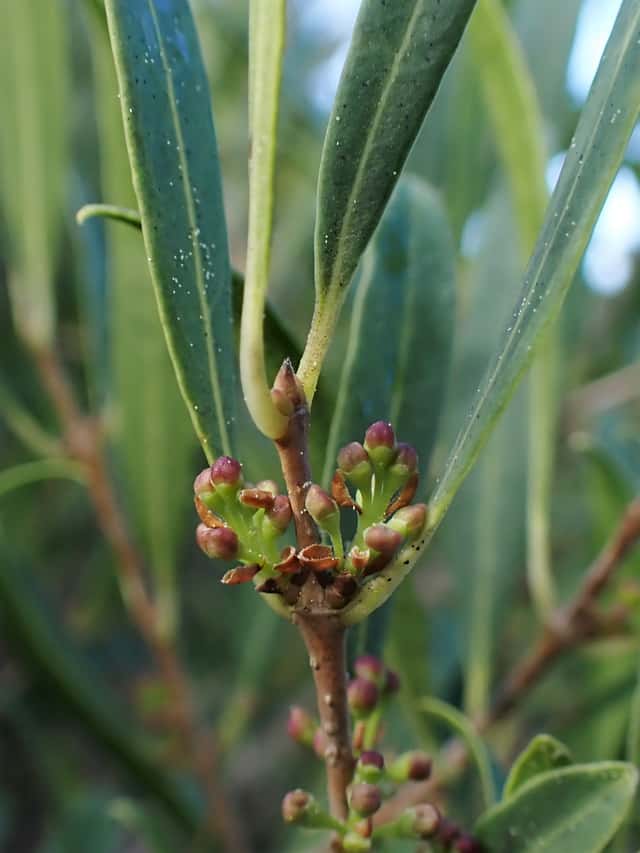
Narrow-leaved Phillyrea (Phillyrea angustifolia) is a easy-care plant from the Oleaceae family. Phillyrea angustifolia is an evergreen Mediterranean shrub in the olive family (Oleaceae), prized for its narrow, leathery dark-green leaves and small clusters of fragrant creamy-white flowers in late spring. Native to the Iberian Peninsula and wider Mediterranean basin, it forms part of the maquis...
Narrow-leaved Phillyrea grows up to 4.0m, spread of 200cm, watering every 14 days, -15°C – 35°C, 40–60% humidity. It is not suitable for indoor environments and safe for pets.
Unlike many tropical plants, Narrow-leaved Phillyrea tolerates watering mistakes. Best for beginners. Unlike many popular species, Narrow-leaved Phillyrea is safe to keep around pets.
How to Care for Narrow-leaved Phillyrea?
TLDR: Narrow-leaved Phillyrea needs Bright indirect, watering every 14 days, and temperatures between -15-35°C with 40-60% humidity.
How Often Should You Water Narrow-leaved Phillyrea?
Water moderately during the first growing season to help roots establish, then only during prolonged drought - overwatering and waterlogged soil are the main risks to this drought-tolerant shrub.
How Much Light Does Narrow-leaved Phillyrea Need?
Grow in full sun for the densest, most compact growth, though it tolerates partial shade, especially in hot climates.
What Is the Best Soil for Narrow-leaved Phillyrea?
Thrives in well-drained soil of almost any texture, including sandy, chalky, and saline soils; avoid heavy, waterlogged ground.
What Pot Should You Use for Narrow-leaved Phillyrea?
Best grown in the ground; if containerized, use a large pot with excellent drainage holes and a gritty, free-draining mix.
What Is Narrow-leaved Phillyrea and Where Does It Come From?
Phillyrea angustifolia is an evergreen Mediterranean shrub in the olive family (Oleaceae), prized for its narrow, leathery dark-green leaves and small clusters of fragrant creamy-white flowers in late spring. Native to the Iberian Peninsula and wider Mediterranean basin, it forms part of the maquis scrubland and is valued in gardens for hedging, topiary, and coastal plantings thanks to its wind and drought tolerance.
How to Propagate Narrow-leaved Phillyrea?
Semi-ripe stem cuttings
Bottom heat and a propagator lid improve rooting success; be patient, as phillyrea roots slowly.
- 1 Take 10-15cm semi-ripe cuttings from healthy side shoots in late summer
- 2 Remove lower leaves and dip the cut end in rooting hormone
- 3 Insert into a free-draining cutting mix of sand and perlite
- 4 Keep in a shaded, humid spot until roots form
Materials needed:
How Big Does Narrow-leaved Phillyrea Grow?
TLDR: Narrow-leaved Phillyrea can reach up to 4.0m tall with Slow growth rate.
Max height
4.0m
Spread
2.0m
Growth rate
Slow
Foliage
Evergreen
Plant Uses
Ornamental
Great for decoration
Is your plant showing symptoms?
Click on the symptom to discover possible causes:
What Diseases Commonly Affect Narrow-leaved Phillyrea?
TLDR: Narrow-leaved Phillyrea is susceptible to 4 known diseases. Monitor regularly for early detection.
Aphids
Aphids are small, soft-bodied, pear-shaped insects (1/16 to 1/8 inch long) that feed by sucking nutrient-rich sap from plants. They reproduce rapidly and can quickly weaken plants, causing distorted growth and transmitting plant viruses. Aphids come in various colors including green, black, red, yellow, brown, and gray. They secrete honeydew, a sticky substance that attracts ants and encourages sooty mold growth.
Scale Insects
Scale insects are small sap-sucking pests that appear as brown, shell-like bumps on plant stems and leaves. There are over 25 species, divided into armored (hard) and unarmored (soft) scales. They feed by piercing plant tissue and extracting sap, which weakens the plant and can lead to yellowing, stunted growth, and even death if left untreated. They also excrete honeydew, which attracts ants and promotes sooty mold growth.
Whiteflies
Whiteflies are small, soft-bodied, winged insects closely related to aphids and mealybugs. They are moth-like in appearance, about 1/16 inch long, triangular in shape, and gray-white in color. These sap-sucking pests feed on plant tissue, causing yellowing, stunted growth, and wilting. They also excrete honeydew, which attracts ants and promotes sooty mold growth. Whiteflies can transmit serious plant viruses.
Root Rot
Root rot is a serious fungal disease that affects the root system of plants, causing them to decay and die. It is primarily caused by overwatering, poor drainage, or soil-borne fungi such as Pythium, Phytophthora, Rhizoctonia, and Fusarium. The disease thrives in waterlogged conditions where roots are deprived of oxygen, making them susceptible to fungal infection.
Meaning & Symbolism
In Mediterranean tradition, evergreen maquis shrubs like Phillyrea symbolize resilience and endurance, having adapted for millennia to drought, wind, and poor soils.
Fun Facts
Phillyrea angustifolia is a key component of Mediterranean maquis scrubland alongside myrtle and mastic.
Its narrow, olive-like leaves have led to common names such as 'mock privet' and comparisons with true olive trees.
Some ancient specimens are thought to live for centuries, growing very slowly into dense, gnarled shrubs or small trees.
Frequently asked questions
Is Phillyrea angustifolia toxic to pets?
How much water does Phillyrea angustifolia need?
Does Phillyrea angustifolia need full sun?
How do you propagate Phillyrea angustifolia?
Compare with similar plants
| Attribute | Difficulty | Light | Watering | Pet Safe |
|---|---|---|---|---|
| Field Maple | Easy | Bright indirect | 14d | ✓ |
| Silver Birch | Easy | Direct sun | 14d | ✓ |
| Common Blanketflower | Easy | Direct sun | 10d | ✓ |
| Cushion Bush | Easy | Direct sun | 14d | ✓ |





