Amaryllidaceae
Netted-veined Amaryllis (Hippeastrum reticulatum)
Hippeastrum reticulatum
Bright part shade, sandy free-draining soil kept lightly moist while growing, and a 4 to 6 week drier rest in late winter. Protect from frost. All parts are toxic to pets and people.
Every 7 days
Partial shade
-1° - °C
% - %
Categories
What is Netted-veined Amaryllis?
Netted-veined Amaryllis (Hippeastrum reticulatum) is a medium-care plant from the Amaryllidaceae family. Netted-veined amaryllis (Hippeastrum reticulatum) is a bulb from Brazil's Atlantic Forest, where it grows in damp sandy soil under a light canopy. It has broad, glossy leaves; in the form most grown (var. striatifolium) each leaf has a white stripe down the middle. From late summer into autumn it se...
Netted-veined Amaryllis grows up to 60cm, spread of 45cm, watering every 7 days. It is suitable for indoor environments and not safe for pets.
Without precautions, ingestion can cause irritation in pets. Keep out of reach of cats and dogs. Without adequate drainage, root rot can develop within 14 days.
How to Care for Netted-veined Amaryllis?
TLDR: Netted-veined Amaryllis needs Partial shade, watering every 7 days, and temperatures between -1-30°C with 40-70% humidity.
How Often Should You Water Netted-veined Amaryllis?
Water when the top few centimetres dry out, usually once a week while growing and flowering. In late winter, cut back for 4 to 6 weeks without letting the bulb shrivel. Never leave water in the saucer: the bulb rots.
How Much Light Does Netted-veined Amaryllis Need?
Bright light with partial shade, like a woodland edge. Morning sun is fine; strong afternoon sun yellows the leaves. Indoors, near a bright window.
What Is the Best Soil for Netted-veined Amaryllis?
Sandy or gritty soil with some organic matter (leaf mould or compost) that drains fast. Plant with the neck of the bulb above the soil.
What Pot Should You Use for Netted-veined Amaryllis?
Clay pot with drainage, only slightly wider than the bulb; it flowers better a little pot-bound.
Care Schedule
Fertilize
Every 30 days
Repot
Every 730 days
What Is Netted-veined Amaryllis and Where Does It Come From?
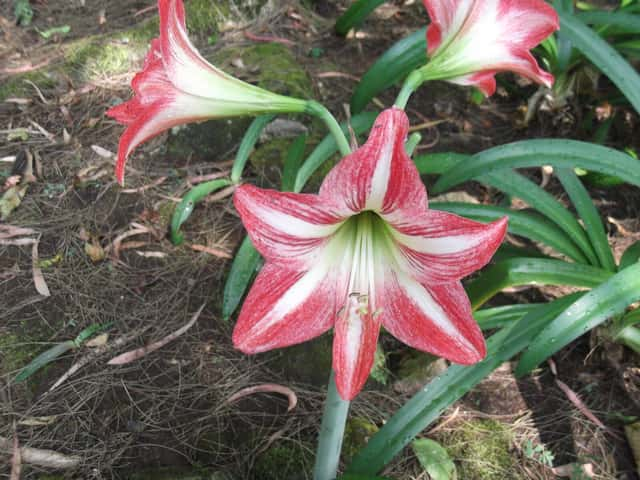
Netted-veined amaryllis (Hippeastrum reticulatum) is a bulb from Brazil's Atlantic Forest, where it grows in damp sandy soil under a light canopy. It has broad, glossy leaves; in the form most grown (var. striatifolium) each leaf has a white stripe down the middle. From late summer into autumn it sends up a 40 to 45 cm stem with 6 to 8 pink flowers covered in a net of darker veins. Unlike the common amaryllis, it keeps its leaves most of the year.
How to Propagate Netted-veined Amaryllis?
Offsets
Offsets take 2 to 3 years to flower.
- 1 At the end of the rest period, unpot the clump
- 2 Gently separate offsets that already have their own roots
- 3 Pot each one in a small pot of sandy mix with the neck showing
- 4 Water sparingly until new leaves appear
Materials needed:
Seed
It is self-fertile, so a single plant can set seed. Seedlings take about 3 years to bloom.
- 1 Collect seeds when the capsule splits to show its red inside
- 2 Sow straight away, the seeds are fleshy and short-lived
- 3 Press them onto moist sandy mix
- 4 Keep bright and humid until they sprout
Materials needed:
How Big Does Netted-veined Amaryllis Grow?
TLDR: Netted-veined Amaryllis can reach up to 60cm tall with Medium growth rate.
Max height
60cm
Spread
45cm
Foliage
Evergreen
Warning: Toxic Plant
This plant can be toxic if ingested. Keep out of reach of:
Plant Uses
Ornamental
Great for decoration
Is your plant showing symptoms?
Click on the symptom to discover possible causes:
What Diseases Commonly Affect Netted-veined Amaryllis?
TLDR: Netted-veined Amaryllis is susceptible to 4 known diseases. Monitor regularly for early detection.
Root Rot
Root rot is a serious fungal disease that affects the root system of plants, causing them to decay and die. It is primarily caused by overwatering, poor drainage, or soil-borne fungi such as Pythium, Phytophthora, Rhizoctonia, and Fusarium. The disease thrives in waterlogged conditions where roots are deprived of oxygen, making them susceptible to fungal infection.
Red Blotch (Stagonospora curtisii)
A common fungal disease affecting bulbous plants such as Amaryllis. It is characterized by elongated, bright red lesions that can deform leaves and stems, eventually weakening the bulb over time.
Mealybugs
Mealybugs are small, soft-bodied insects covered with a white, waxy, cottony material. They are common pests of houseplants and outdoor plants in mild climates. These sap-sucking insects feed on plant tissue, causing damage, stunted growth, and can lead to plant death if left untreated. They produce sticky honeydew which attracts sooty mold.
Spider Mites
Spider mites are tiny arachnids (less than 1/20 inch long) related to spiders and ticks that feed on plant sap. They thrive in hot, dry conditions and can cause significant damage to ornamental and vegetable plants. During severe infestations, crop losses can reach 14% or higher as these pests disrupt vital plant processes including photosynthesis, carbon dioxide absorption, and transpiration.
Fun Facts
It reached Europe from Brazil in 1777, one of the first amaryllis grown there
Reticulatum means netted, for the dark veins on the petals
Unlike most amaryllis it can pollinate itself
Its seeds are fleshy and orange, not flat and black like other amaryllis
Frequently asked questions
When does Hippeastrum reticulatum bloom?
Does it lose its leaves?
Does it like full sun?
Is it poisonous?
Compare with similar plants
| Attribute | Difficulty | Light | Watering | Pet Safe |
|---|---|---|---|---|
| Dark Fieldcap | Medium | Low light | 2d | ⚠️ |
| Azalea | Medium | Partial shade | 3d | ⚠️ |
| Muriel's Bamboo | Medium | Partial shade | 3d | ✓ |
| Bougainvillea | Medium | Direct sun | 7d | ⚠️ |