Asteraceae
Nodeweed: Edible Plant
Synedrella nodiflora
A hardy herb that grows spontaneously in gardens, flowerbeds, roadsides, and vacant lots. It prefers partial shade and soil rich in organic matter but can tolerate full sun. In practice, the most common care is to pull it out before it flowers to prevent it from spreading.
Every 4 days
Bright indirect
° - °C
% - %
Categories
What is Nodeweed?
Nodeweed (Synedrella nodiflora) is a easy-care plant from the Asteraceae family. Synedrella nodiflora is an annual herb in the daisy family (Asteraceae) and the only species in its genus. Native to the tropical Americas, it now grows as a spontaneous plant throughout almost all tropical regions. It reaches 25 to 90 cm in height, featuring a quadrangular, hairy stem that sometime...
Nodeweed grows up to 90cm, watering every 4 days. It is not suitable for indoor environments and safe for pets.
Unlike many tropical plants, Nodeweed tolerates watering mistakes. Best for beginners. Unlike many popular species, Nodeweed is safe to keep around pets.
How to Care for Nodeweed?
TLDR: Nodeweed needs Bright indirect, watering every 4 days, and temperatures between 15-30°C with 40-70% humidity.
How Often Should You Water Nodeweed?
It prefers moist soil without becoming waterlogged. If kept in a pot, water when the substrate surface begins to dry, which typically occurs every 3 to 4 days in hot weather.
How Much Light Does Nodeweed Need?
It grows best in partial shade or filtered light, where it tends to grow taller. It survives in full sun but tends to remain low-growing and smaller.
What Is the Best Soil for Nodeweed?
Prefers loose soil rich in organic matter, such as fertilized garden beds, but adapts to various soil types.
What Pot Should You Use for Nodeweed?
If you wish to cultivate it, use a small to medium-sized pot with drainage holes and a substrate containing organic compost.
What Is Nodeweed and Where Does It Come From?
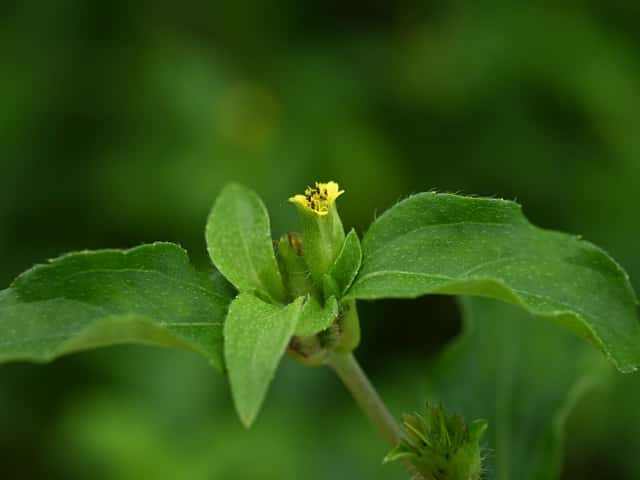
Synedrella nodiflora is an annual herb in the daisy family (Asteraceae) and the only species in its genus. Native to the tropical Americas, it now grows as a spontaneous plant throughout almost all tropical regions. It reaches 25 to 90 cm in height, featuring a quadrangular, hairy stem that sometimes roots at the lower nodes. It has opposite, oval, and serrated leaves with three prominent veins, and small yellow flower heads (5 to 10 mm) that grow in clusters near the leaf axils. It flowers and fruits year-round, completing its cycle in two to three months and releasing thousands of seeds with bristles that cling to clothing and animal fur.
How to Propagate Nodeweed?
Seeds
Seeds from the outer flowers germinate quickly, while those from the center can remain dormant for months, ensuring new plants continue to emerge. Remove flowers before they dry if you do not want the plant to spread.
- 1 Harvest the dry flower heads and separate the bristled seeds
- 2 Scatter the seeds over loose, moist soil and cover lightly
- 3 Keep the soil moist in a partially shaded area until germination
- 4 Thin out the seedlings, leaving about 20 cm between them
Materials needed:
How Big Does Nodeweed Grow?
TLDR: Nodeweed can reach up to 90cm tall with Fast growth rate.
Max height
90cm
Growth rate
Fast
Plant Uses
Edible
Can be consumed
Medicinal
Medicinal properties
Medicinal Uses
- Leaves used in poultices for rheumatism and leg pain in Indonesian traditional medicine
- Leaf infusion used as a laxative in Ghana (traditional use, without clinical evidence)
Culinary Uses
- Young leaves eaten cooked as a vegetable or raw in salads in Southeast Asia
Is your plant showing symptoms?
Click on the symptom to discover possible causes:
What Diseases Commonly Affect Nodeweed?
TLDR: Nodeweed is susceptible to 3 known diseases. Monitor regularly for early detection.
Root-Knot Nematodes
Root-knot nematodes (Meloidogyne species) are microscopic roundworms that parasitize plant roots, causing characteristic galls or knots. These soil-borne pests are among the most economically damaging plant pathogens worldwide, affecting a wide range of ornamental and edible plants. The nematodes inject enzymes into root cells, causing abnormal swelling and disrupting water and nutrient uptake.
Leaf Spot
Leaf spot is a common fungal disease caused by various pathogens including Alternaria, Ascochyta, Colletotrichum, Septoria, and Venturia. It primarily affects leaves, causing discolored spots that can lead to premature leaf drop if left untreated.
Viruses
Viral diseases are infectious conditions caused by tiny intracellular parasites that require host cells to survive. Viruses are typically transmitted to plants by insects and mites. Some viruses are severe plant pathogens, such as Rose Rosette Virus or Tobacco Rattle Virus.
Compare with similar plants
| Attribute | Difficulty | Light | Watering | Pet Safe |
|---|---|---|---|---|
| Field Maple | Easy | Bright indirect | 14d | ✓ |
| Iberian Houseleek | Easy | Direct sun | 14d | ✓ |
| Silver Birch | Easy | Direct sun | 14d | ✓ |
| Common Blanketflower | Easy | Direct sun | 10d | ✓ |





