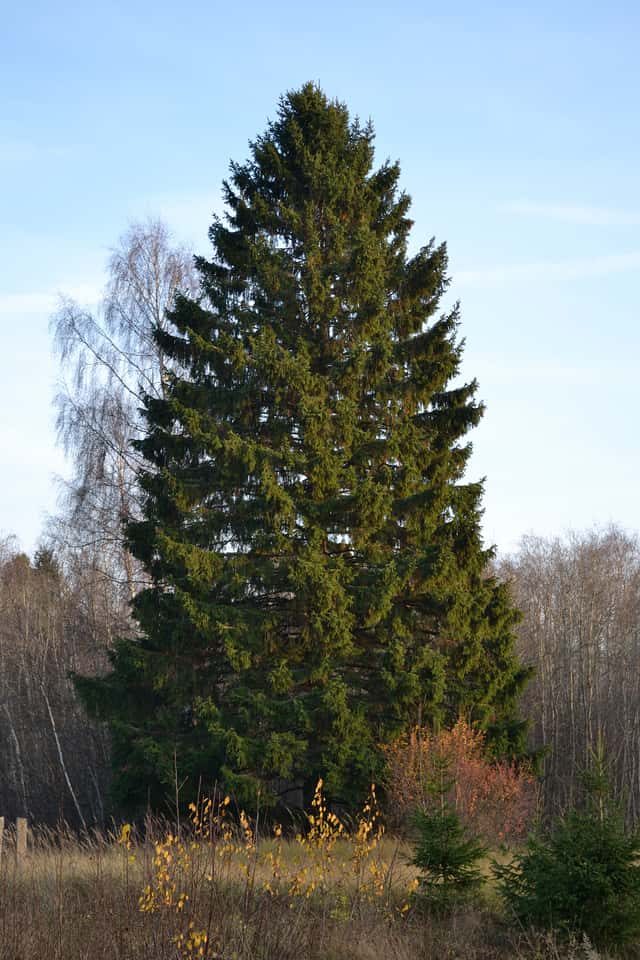
Pinaceae
Norway Spruce (Picea abies)
Picea abies
Prefers full to partial sun, well-drained slightly acidic soil, and moderate watering while avoiding waterlogging. Very cold hardy but struggles with prolonged heat and drought.
Every 7 days
Direct sun
-40° - 24°C
% - %
Categories
What is Norway Spruce?
Norway Spruce (Picea abies) is a medium-care plant from the Pinaceae family. Norway Spruce (Picea abies) is a fast-growing evergreen conifer native to northern and central Europe, widely planted as a Christmas tree and ornamental landscape tree. It has a conical crown, dark green needles, and distinctive pendulous cones.
Norway Spruce grows up to 18.0m, spread of 900cm, watering every 7 days, -40°C – 24°C. It is not suitable for indoor environments and safe for pets.
Unlike many popular species, Norway Spruce is safe to keep around pets.
How to Care for Norway Spruce?
TLDR: Norway Spruce needs Direct sun, watering every 7 days, and temperatures between -40-24°C with 40-70% humidity.
How Often Should You Water Norway Spruce?
Water when the top few centimeters of soil are dry; avoid soggy soil to prevent root rot.
How Much Light Does Norway Spruce Need?
Needs full to partial sun (at least 4-6 hours of direct light daily); does not tolerate deep shade.
What Is the Best Soil for Norway Spruce?
Use sandy loam, well-draining, slightly acidic soil (pH 4.5-6.5).
What Pot Should You Use for Norway Spruce?
Large, deep, well-draining containers for young saplings; permanent ground planting is recommended for mature specimens.
What Is Norway Spruce and Where Does It Come From?
Norway Spruce (Picea abies) is a fast-growing evergreen conifer native to northern and central Europe, widely planted as a Christmas tree and ornamental landscape tree. It has a conical crown, dark green needles, and distinctive pendulous cones.
How to Propagate Norway Spruce?
Seed propagation
Fresh seeds germinate best; cold stratification is essential to break dormancy.
- 1 Collect seeds from mature cones in fall
- 2 Cold-stratify for 4-6 weeks in the refrigerator
- 3 Sow in well-draining substrate in early spring
- 4 Keep moist in indirect light until germination
Materials needed:
Semi-hardwood cuttings
Rooting success is low; use a greenhouse or humidity dome for better results.
- 1 Cut 10-15cm semi-hardwood branches in summer
- 2 Strip needles from the base
- 3 Apply rooting hormone
- 4 Plant in sandy substrate and keep moist
Materials needed:
How Big Does Norway Spruce Grow?
TLDR: Norway Spruce can reach up to 18.0m tall with Fast growth rate.
Max height
18.0m
Spread
9.0m
Growth rate
Fast
Foliage
Evergreen
Plant Uses
Ornamental
Great for decoration
Medicinal Uses
- Young shoots traditionally used in vitamin-C-rich teas and syrups
Culinary Uses
- Young spruce tips used in syrups, teas, and foraged seasoning
Is your plant showing symptoms?
Click on the symptom to discover possible causes:
What Diseases Commonly Affect Norway Spruce?
TLDR: Norway Spruce is susceptible to 8 known diseases. Monitor regularly for early detection.
Canker
Canker is a disease caused by various fungi and bacteria that create necrotic, sunken areas on bark of branches, stems, and trunks. Pathogens enter through wounds and natural openings, especially when plants are stressed. Canker can gradually weaken or kill branches by disrupting water and nutrient flow.
Phytophthora Root Rot
Disease caused by fungus-like organisms (oomycetes) that live in soil and can survive for years. It affects roots, stem, and crown of plants, being especially severe in waterlogged or poorly drained soils. It is the second most common cause of root rot in trees and shrubs.
Rust
Rust is a common fungal disease caused by fungi in the order Pucciniales that affects a wide variety of plants. The disease gets its name from the characteristic orange, yellow, or reddish-brown pustules that appear on leaves, resembling metal rust. This obligate fungal parasite requires living plants to survive and can cause significant economic losses in agricultural crops.
Aphids
Aphids are small, soft-bodied, pear-shaped insects (1/16 to 1/8 inch long) that feed by sucking nutrient-rich sap from plants. They reproduce rapidly and can quickly weaken plants, causing distorted growth and transmitting plant viruses. Aphids come in various colors including green, black, red, yellow, brown, and gray. They secrete honeydew, a sticky substance that attracts ants and encourages sooty mold growth.
Meaning & Symbolism
Symbol of hope, resilience, and everlasting life; the traditional European Christmas tree.
Fun Facts
It is the traditional Christmas tree gifted annually to Trafalgar Square by Norway
It can live over 1,000 years, with the famous clonal specimen Old Tjikko in Sweden having roots around 9,500 years old
Its needles stay on the tree for several years before dropping
Frequently asked questions
Can Norway Spruce be grown in a pot?
How often should I water it?
Is it toxic to cats and dogs?
Compare with similar plants
| Attribute | Difficulty | Light | Watering | Pet Safe |
|---|---|---|---|---|
| Dark Fieldcap | Medium | Low light | 2d | ⚠️ |
| Azalea | Medium | Partial shade | 3d | ⚠️ |
| Muriel's Bamboo | Medium | Partial shade | 3d | ✓ |
| Bougainvillea | Medium | Direct sun | 7d | ⚠️ |




