Orchidaceae
Orange Blossom Orchid (Sarcochilus falcatus)
Sarcochilus falcatus
A cool-growing orchid: moderate shade, high humidity and plenty of moving air. It grows best mounted on hardwood, cork or tree-fern slab rather than in a pot. It must not stay dry for long or sit wet, and it does not tolerate frost or strong heat.
Every 3 days
Partial shade
10° - 30°C
40% - 75%
Categories
What is Orange blossom orchid?
Orange blossom orchid (Sarcochilus falcatus) is a medium-care plant from the Orchidaceae family. Sarcochilus falcatus is a small orchid from eastern Australia, found from Queensland to New South Wales and the far east of Victoria. It grows on trunks and branches, sometimes on rocks, in airy spots in or near moist forest, from the coast up to about 1,200 m. The stem is only 4-8 cm long and carri...
Orange blossom orchid grows up to 20cm, watering every 3 days, 10°C – 30°C, 40–75% humidity. It is suitable for indoor environments and safe for pets.
Unlike many popular species, Orange blossom orchid is safe to keep around pets. Without adequate drainage, root rot can develop within 7 days.
How to Care for Orange blossom orchid?
TLDR: Orange blossom orchid needs Partial shade, watering every 3 days, and temperatures between 10-30°C with 40-75% humidity.
How Often Should You Water Orange blossom orchid?
Mounted on a slab, water or spray the roots once or twice a day in summer and every 7-10 days in winter. In a pot, keep the bark just moist, as with Phalaenopsis, never waterlogged. It has no pseudobulbs to store water.
How Much Light Does Orange blossom orchid Need?
Filtered light with moderate to heavy shade. Direct sun burns the leaves. Indoors, near a bright window with a sheer curtain.
What Is the Best Soil for Orange blossom orchid?
Mount on hardwood, cork or tree-fern slab; in a pot, use well-drained medium orchid bark in a small pot or basket.
What Pot Should You Use for Orange blossom orchid?
Hardwood, cork or tree-fern slab; if potted, a small pot (7-10 cm) or basket with medium bark.
Care Schedule
Fertilize
Every 14 days
What Is Orange blossom orchid and Where Does It Come From?
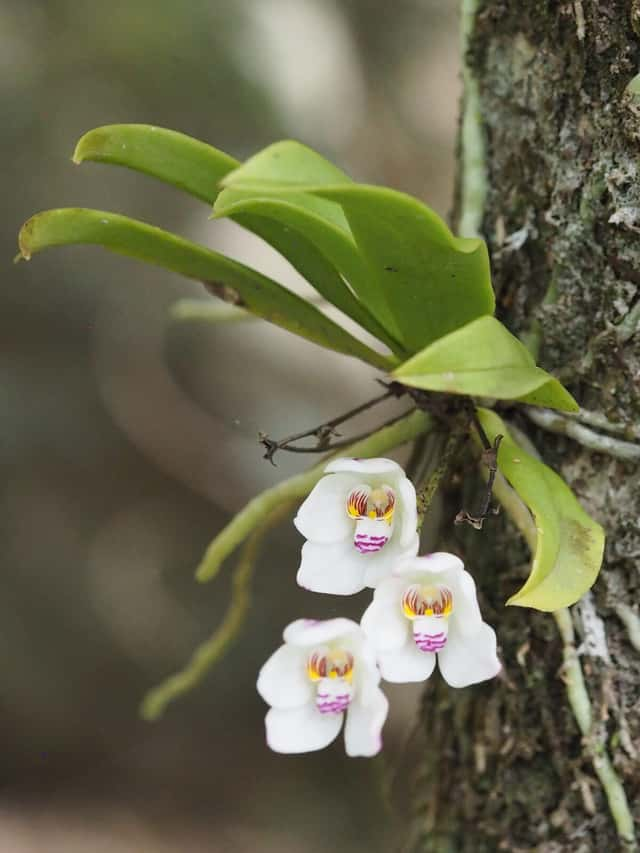
Sarcochilus falcatus is a small orchid from eastern Australia, found from Queensland to New South Wales and the far east of Victoria. It grows on trunks and branches, sometimes on rocks, in airy spots in or near moist forest, from the coast up to about 1,200 m. The stem is only 4-8 cm long and carries 3-8 thick, sickle-shaped leaves 6-16 cm long. From winter into spring it sends out arching stems with 3-12 fragrant white to cream flowers, 2-3 cm across, the lip marked with orange, yellow and purple. Its common name comes from the scent and shape, which recall orange blossom.
How to Propagate Orange blossom orchid?
Division
Do it when new roots start growing: the plant dislikes root disturbance. Seed propagation is done in a lab.
- 1 Wait until the plant has several growths with their own roots
- 2 Carefully separate a piece with at least three leaves and roots
- 3 Tie it to a slab with fishing line until new roots grip
- 4 Keep shaded and humid until established
Materials needed:
How Big Does Orange blossom orchid Grow?
TLDR: Orange blossom orchid can reach up to 20cm tall with Medium growth rate.
Max height
20cm
Foliage
Evergreen
Plant Uses
Ornamental
Great for decoration
Aromatic
Pleasant fragrance
Is your plant showing symptoms?
Click on the symptom to discover possible causes:
What Diseases Commonly Affect Orange blossom orchid?
TLDR: Orange blossom orchid is susceptible to 5 known diseases. Monitor regularly for early detection.
Scale Insects
Scale insects are small sap-sucking pests that appear as brown, shell-like bumps on plant stems and leaves. There are over 25 species, divided into armored (hard) and unarmored (soft) scales. They feed by piercing plant tissue and extracting sap, which weakens the plant and can lead to yellowing, stunted growth, and even death if left untreated. They also excrete honeydew, which attracts ants and promotes sooty mold growth.
Root Rot
Root rot is a serious fungal disease that affects the root system of plants, causing them to decay and die. It is primarily caused by overwatering, poor drainage, or soil-borne fungi such as Pythium, Phytophthora, Rhizoctonia, and Fusarium. The disease thrives in waterlogged conditions where roots are deprived of oxygen, making them susceptible to fungal infection.
Low Humidity Stress
Low humidity stress occurs when indoor air becomes too dry, causing plants to lose moisture faster than they can absorb it through their roots. This is especially common during winter heating periods, near radiators and heating vents, or in air-conditioned spaces. Tropical plants are particularly susceptible to low humidity damage.
Heat Stress
Heat stress occurs when plants are exposed to excessively high temperatures, typically above 85-90°F (29-32°C), causing physiological damage and compromising vital processes such as photosynthesis and transpiration.
Fun Facts
The name falcatus refers to its sickle-shaped leaves.
It is the most common Sarcochilus in the wild, but collecting has made it rare in some areas.
Sarcochilus means fleshy lip, after the thick lip of the flower.
Frequently asked questions
How often should I water Sarcochilus falcatus?
Is it better potted or mounted?
When does it flower?
What temperatures does it tolerate?
Compare with similar plants
| Attribute | Difficulty | Light | Watering | Pet Safe |
|---|---|---|---|---|
| Dark Fieldcap | Medium | Low light | 2d | ⚠️ |
| Azalea | Medium | Partial shade | 3d | ⚠️ |
| Muriel's Bamboo | Medium | Partial shade | 3d | ✓ |
| Bougainvillea | Medium | Direct sun | 7d | ⚠️ |




