Orchidaceae
Orange Cattleya: Pet-Safe Plant
Guarianthe aurantiaca
Give this orchid bright, indirect to lightly filtered light, water thoroughly when the bark mix approaches dryness, and provide high humidity with good air movement. It thrives mounted or potted in a coarse, well-draining bark mix and benefits from a cooler, drier rest after flowering.
Every 9 days
Bright indirect
13° - 29°C
50% - 70%
Categories
What is Orange Cattleya?
Orange Cattleya (Guarianthe aurantiaca) is a medium-care plant from the Orchidaceae family. Guarianthe aurantiaca, commonly known as the Orange Cattleya, is a compact epiphytic orchid native to the tropical and montane forests of Mexico, Guatemala, Honduras, El Salvador, Nicaragua, and Costa Rica. It forms clumps of slender cane-like pseudobulbs topped with a pair of leathery, evergreen le...
Orange Cattleya grows up to 50cm, spread of 40cm, watering every 9 days, 13°C – 29°C, 50–70% humidity. It is suitable for indoor environments and safe for pets.
Unlike many popular species, Orange Cattleya is safe to keep around pets. Without adequate drainage, root rot can develop within 18 days.
How to Care for Orange Cattleya?
TLDR: Orange Cattleya needs Bright indirect, watering every 9 days, and temperatures between 13-29°C with 50-70% humidity.
How Often Should You Water Orange Cattleya?
Water deeply about once a week, letting the bark-based mix dry out between waterings; the pseudobulbs store water, so overwatering is a bigger risk than underwatering.
How Much Light Does Orange Cattleya Need?
Provide bright, filtered light such as an east-facing or lightly shaded south-facing window; leaves should be light green, not dark green (too little light) or yellowish-red (too much).
What Is the Best Soil for Orange Cattleya?
Pot in a coarse, fast-draining bark-based orchid mix (bark, perlite, charcoal) or mount on a slab; never use regular potting soil.
What Pot Should You Use for Orange Cattleya?
Clay or plastic orchid pots with ample drainage holes, or mount on cork/tree-fern slabs to mimic its epiphytic habit.
Care Schedule
Fertilize
Every 14 days
Repot
Every 365 days
What Is Orange Cattleya and Where Does It Come From?
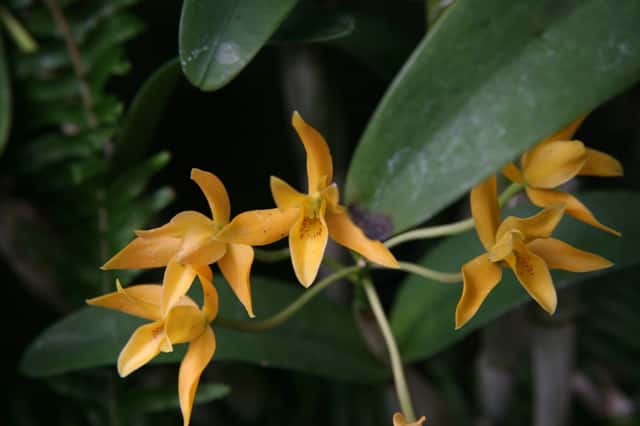
Guarianthe aurantiaca, commonly known as the Orange Cattleya, is a compact epiphytic orchid native to the tropical and montane forests of Mexico, Guatemala, Honduras, El Salvador, Nicaragua, and Costa Rica. It forms clumps of slender cane-like pseudobulbs topped with a pair of leathery, evergreen leaves, and produces clusters of two to eleven small, vividly orange (occasionally yellow) flowers from late winter through spring. Once classified as a Cattleya, this species is now placed in the genus Guarianthe alongside close relatives such as G. skinneri and G. bowringiana.
How to Propagate Orange Cattleya?
Pseudobulb division
Use sterilized tools to prevent disease spread and avoid dividing right before or during flowering.
- 1 Wait until the clump has at least 6-8 healthy pseudobulbs
- 2 Remove the plant from its pot and gently separate the root mass
- 3 Cut through the rhizome with a sterile blade, keeping 3-4 pseudobulbs per division
- 4 Pot each division in fresh bark mix and keep humid until new roots form
Materials needed:
How Big Does Orange Cattleya Grow?
TLDR: Orange Cattleya can reach up to 50cm tall with Medium growth rate.
Max height
50cm
Spread
40cm
Growth rate
Medium
Foliage
Evergreen
Plant Uses
Ornamental
Great for decoration
Is your plant showing symptoms?
Click on the symptom to discover possible causes:
What Diseases Commonly Affect Orange Cattleya?
TLDR: Orange Cattleya is susceptible to 6 known diseases. Monitor regularly for early detection.
Root Rot
Root rot is a serious fungal disease that affects the root system of plants, causing them to decay and die. It is primarily caused by overwatering, poor drainage, or soil-borne fungi such as Pythium, Phytophthora, Rhizoctonia, and Fusarium. The disease thrives in waterlogged conditions where roots are deprived of oxygen, making them susceptible to fungal infection.
Scale Insects
Scale insects are small sap-sucking pests that appear as brown, shell-like bumps on plant stems and leaves. There are over 25 species, divided into armored (hard) and unarmored (soft) scales. They feed by piercing plant tissue and extracting sap, which weakens the plant and can lead to yellowing, stunted growth, and even death if left untreated. They also excrete honeydew, which attracts ants and promotes sooty mold growth.
Mealybugs
Mealybugs are small, soft-bodied insects covered with a white, waxy, cottony material. They are common pests of houseplants and outdoor plants in mild climates. These sap-sucking insects feed on plant tissue, causing damage, stunted growth, and can lead to plant death if left untreated. They produce sticky honeydew which attracts sooty mold.
Spider Mites
Spider mites are tiny arachnids (less than 1/20 inch long) related to spiders and ticks that feed on plant sap. They thrive in hot, dry conditions and can cause significant damage to ornamental and vegetable plants. During severe infestations, crop losses can reach 14% or higher as these pests disrupt vital plant processes including photosynthesis, carbon dioxide absorption, and transpiration.
Meaning & Symbolism
Represents warmth, endurance and tropical beauty; treasured by collectors for its compact clusters of glowing orange blooms.
Compare with similar plants
| Attribute | Difficulty | Light | Watering | Pet Safe |
|---|---|---|---|---|
| Dark Fieldcap | Medium | Low light | 2d | ⚠️ |
| Azalea | Medium | Partial shade | 3d | ⚠️ |
| Muriel's Bamboo | Medium | Partial shade | 3d | ✓ |
| Bougainvillea | Medium | Direct sun | 7d | ⚠️ |




