Altingiaceae
Oriental Sweetgum (Liquidambar orientalis)
Liquidambar orientalis
A tree for larger gardens: full sun or part shade in deep, fertile, moist, acid to neutral soil. Keep the soil moist for the first few years and protect young trees from late frosts. It grows slowly and needs no pruning.
Every 7 days
Bright indirect
-15° - °C
% - %
Categories
What is Oriental sweetgum?
Oriental sweetgum (Liquidambar orientalis) is a medium-care plant from the Altingiaceae family. Oriental sweetgum (Liquidambar orientalis) is a deciduous tree from the eastern Mediterranean, where it forms stands on the floodplains of southwestern Turkey and on the Greek island of Rhodes. In the wild it reaches 30-35 m; in gardens it usually stays at 4-10 m with a dense, rounded crown. The fiv...
Oriental sweetgum grows up to 10.0m, spread of 800cm, watering every 7 days. It is not suitable for indoor environments and safe for pets.
Unlike many popular species, Oriental sweetgum is safe to keep around pets.
How to Care for Oriental sweetgum?
TLDR: Oriental sweetgum needs Bright indirect, watering every 7 days, and temperatures between -15-30°C with 40-70% humidity.
How Often Should You Water Oriental sweetgum?
It likes soil that stays slightly moist and tolerates short floods. Water newly planted trees weekly and during dry summers, soaking the root zone. Once established, it only needs water in long droughts.
How Much Light Does Oriental sweetgum Need?
Full sun gives the best autumn colour; it accepts part shade. In cold areas, pick a spot sheltered from the wind.
What Is the Best Soil for Oriental sweetgum?
Deep, fertile, moist soil, ideally clay or loam, acid to neutral. It grows poorly on shallow soil over chalk, where the leaves can turn yellow.
What Pot Should You Use for Oriental sweetgum?
Not a container tree: plant it in the ground, away from buildings. A young tree can spend 1-2 years in a large, deep pot with drainage holes before planting out.
What Is Oriental sweetgum and Where Does It Come From?
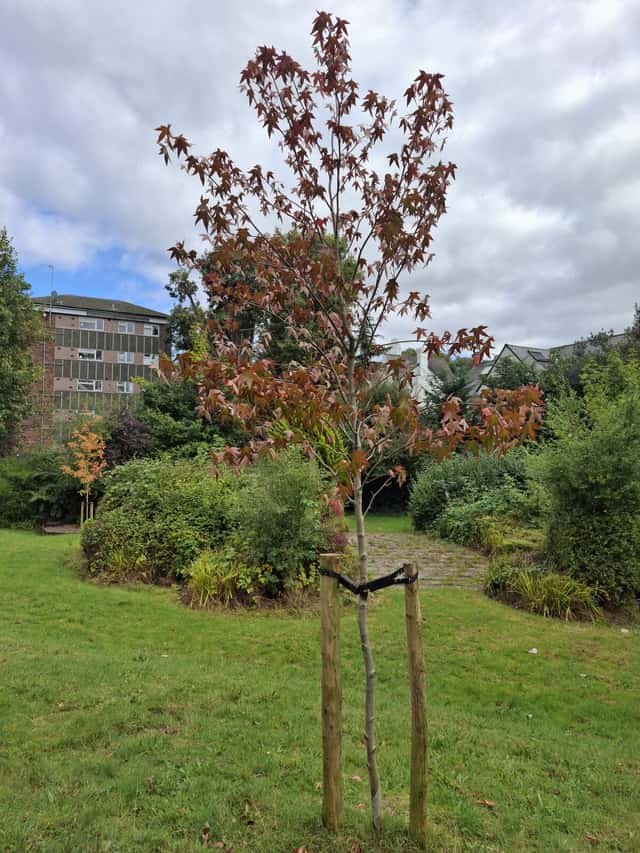
Oriental sweetgum (Liquidambar orientalis) is a deciduous tree from the eastern Mediterranean, where it forms stands on the floodplains of southwestern Turkey and on the Greek island of Rhodes. In the wild it reaches 30-35 m; in gardens it usually stays at 4-10 m with a dense, rounded crown. The five-lobed leaves are smaller and more finely cut than those of American sweetgum and turn yellow, orange and red in autumn. The spring flowers are yellowish-green and inconspicuous; the fruits are spiky balls on long stalks that hang on into winter. The bark yields a fragrant resin, storax, used since antiquity in perfume and medicine. The species is endangered in its native range.
How to Propagate Oriental sweetgum?
Seed
Germination is often poor and uneven, so sow plenty and be patient.
- 1 Collect ripe fruits in autumn and let them dry to release the seeds
- 2 Sow straight away in pots or a seed tray kept in a cold frame
- 3 Stored seed needs 1-3 months of cold stratification before sowing
- 4 Keep the mix moist; germination can take up to 2 years
- 5 Plant out in early summer of the second year and protect over winter
Materials needed:
Semi-hardwood cutting
Use clean tools and keep the air humid around the cuttings.
- 1 In midsummer, cut 10-15 cm tips of this year's shoots that have started to firm up
- 2 Strip the lower leaves and dip the base in rooting hormone
- 3 Insert into a light, moist mix
- 4 Keep in a humid frame with bright light but no direct sun until rooted
Materials needed:
Layering
Slow, but reliable if your tree has low branches.
- 1 In autumn, bend a low branch down to the ground
- 2 Make a small nick in the bark where it will be buried
- 3 Bury that section and pin it down
- 4 Sever from the parent after about a year, once it has rooted
Materials needed:
How Big Does Oriental sweetgum Grow?
TLDR: Oriental sweetgum can reach up to 10.0m tall with Slow growth rate.
Max height
10.0m
Spread
8.0m
Growth rate
Slow
Foliage
Deciduous
Plant Uses
Ornamental
Great for decoration
Medicinal
Medicinal properties
Aromatic
Pleasant fragrance
Medicinal Uses
- The resin (storax) is traditionally applied diluted to the skin and is an ingredient of Friar's Balsam, used for steam inhalation.
- Traditional use without proven efficacy; do not self-treat.
Is your plant showing symptoms?
Click on the symptom to discover possible causes:
What Diseases Commonly Affect Oriental sweetgum?
TLDR: Oriental sweetgum is susceptible to 2 known diseases. Monitor regularly for early detection.
Root Rot
Root rot is a serious fungal disease that affects the root system of plants, causing them to decay and die. It is primarily caused by overwatering, poor drainage, or soil-borne fungi such as Pythium, Phytophthora, Rhizoctonia, and Fusarium. The disease thrives in waterlogged conditions where roots are deprived of oxygen, making them susceptible to fungal infection.
Iron Deficiency
Iron deficiency, commonly known as iron chlorosis, is a nutrient deficiency disorder where plants cannot access sufficient iron from the soil. While iron is typically abundant in soil, various soil conditions can limit plant uptake, resulting in characteristic yellowing of leaves while veins remain green.
Fun Facts
Styrene, the base of polystyrene, is named after storax, this tree's resin.
The species is listed as Endangered by the IUCN.
Storax was traded across the Mediterranean in antiquity for perfume and embalming.
Frequently asked questions
How is it different from American sweetgum?
Is oriental sweetgum cold hardy?
Is it toxic to cats and dogs?
Does it need pruning?
Compare with similar plants
| Attribute | Difficulty | Light | Watering | Pet Safe |
|---|---|---|---|---|
| Dark Fieldcap | Medium | Low light | 2d | ⚠️ |
| Azalea | Medium | Partial shade | 3d | ⚠️ |
| Muriel's Bamboo | Medium | Partial shade | 3d | ✓ |
| Bougainvillea | Medium | Direct sun | 7d | ⚠️ |




