Cyperaceae
Carex oshimensis (Japanese Sedge) Care Guide
Carex oshimensis
Plant in part shade to filtered sun in moist, well-drained soil. Water regularly to keep the soil evenly moist, especially in the first growing season, and reduce watering in winter. Requires little fertilizer, minimal pruning (an annual spring comb-through or shear), and virtually no pest or disease management when air circulation is good.
Every 5 days
Partial shade
° - °C
% - %
Categories
What is Japanese Sedge?
Japanese Sedge (Carex oshimensis) is a easy-care plant from the Cyperaceae family. Carex oshimensis, commonly known as Japanese sedge, is an evergreen, clump-forming ornamental grass-like perennial in the sedge family (Cyperaceae), native to the woodlands and rocky slopes of Honshu Island, Japan, particularly the Izu Oshima region from which its species name derives. In cultivatio...
Japanese Sedge grows up to 30cm, spread of 45cm, watering every 5 days. It is suitable for indoor environments and safe for pets.
Unlike many tropical plants, Japanese Sedge tolerates watering mistakes. Best for beginners. Unlike many popular species, Japanese Sedge is safe to keep around pets. Without adequate drainage, root rot can develop within 10 days.
How to Care for Japanese Sedge?
TLDR: Japanese Sedge needs Partial shade, watering every 5 days, and temperatures between 15-30°C with 40-70% humidity.
How Often Should You Water Japanese Sedge?
Check the top inch of soil and water whenever it starts to feel dry. Carex oshimensis prefers evenly moist, never soggy or bone-dry, soil. Cut back watering during winter dormancy.
How Much Light Does Japanese Sedge Need?
Give it part shade to filtered sun for the richest foliage color; too much full, hot sun can scorch the leaf tips, while deep shade causes the plant to lose vigor and its variegation to fade.
What Is the Best Soil for Japanese Sedge?
Use a well-draining, humus-rich, slightly acidic soil (pH 5.5-6.5). Amend heavy clay with compost to improve drainage and prevent crown and root rot.
What Pot Should You Use for Japanese Sedge?
A wide, shallow container with generous drainage holes suits its shallow, spreading root system; unglazed terracotta or plastic both work well as long as drainage is excellent.
What Is Japanese Sedge and Where Does It Come From?
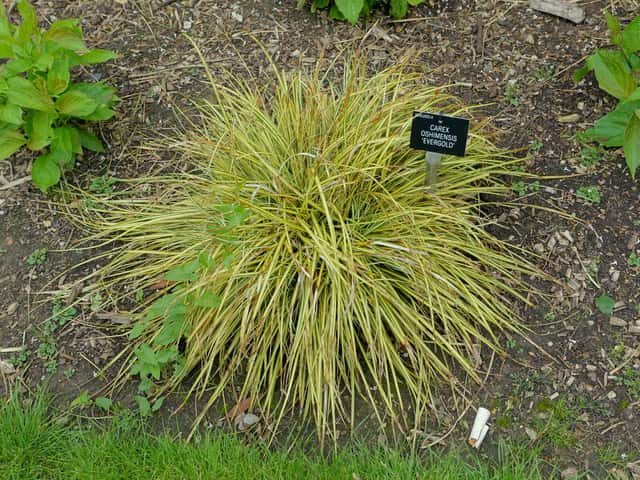
Carex oshimensis, commonly known as Japanese sedge, is an evergreen, clump-forming ornamental grass-like perennial in the sedge family (Cyperaceae), native to the woodlands and rocky slopes of Honshu Island, Japan, particularly the Izu Oshima region from which its species name derives. In cultivation, it is best known through its popular variegated cultivar 'Evergold', prized for narrow, arching leaves striped with a bright creamy-yellow center band bordered by fine dark-green margins. Forming low, fountain-like mounds roughly 30 cm tall and 45 cm wide, it spreads slowly via short rhizomes and produces inconspicuous brown flower spikes in spring. Thriving in part shade to filtered sun, where its variegation stays richest, and in consistently moist, well-drained, slightly acidic soil, Carex oshimensis is prized by gardeners for its low-maintenance, four-season structure. It works beautifully as edging, in mixed containers, along woodland borders, or as a bright groundcover beneath larger shrubs and trees, tolerating occasional drought once established but never thriving in full shade or standing water.
How to Propagate Japanese Sedge?
Rhizome Division
Divide every 2-3 years to keep clumps vigorous and well-shaped; avoid dividing in summer heat or winter dormancy.
- 1 Lift the clump in early spring just as new growth begins
- 2 Gently separate the root mass into sections, each with several shoots and healthy roots
- 3 Trim away any dead or damaged foliage and roots
- 4 Replant divisions immediately at the same depth in moist, well-draining soil
- 5 Water thoroughly and keep consistently moist until new growth is established
Materials needed:
How Big Does Japanese Sedge Grow?
TLDR: Japanese Sedge can reach up to 30cm tall with Slow growth rate.
Max height
30cm
Spread
45cm
Growth rate
Slow
Foliage
Evergreen
Plant Uses
Ornamental
Great for decoration
Ground Cover
Soil coverage
Is your plant showing symptoms?
Click on the symptom to discover possible causes:
What Diseases Commonly Affect Japanese Sedge?
TLDR: Japanese Sedge is susceptible to 9 known diseases. Monitor regularly for early detection.
Root Rot
Root rot is a serious fungal disease that affects the root system of plants, causing them to decay and die. It is primarily caused by overwatering, poor drainage, or soil-borne fungi such as Pythium, Phytophthora, Rhizoctonia, and Fusarium. The disease thrives in waterlogged conditions where roots are deprived of oxygen, making them susceptible to fungal infection.
Crown Rot
Crown rot is a serious fungal disease that attacks the crown (base) of the plant where the stem meets the soil. It is caused by various fungal pathogens including Phytophthora, Fusarium, and Rhizoctonia. The disease thrives in waterlogged conditions and can quickly spread to kill the entire plant if not addressed promptly.
Rust
Rust is a common fungal disease caused by fungi in the order Pucciniales that affects a wide variety of plants. The disease gets its name from the characteristic orange, yellow, or reddish-brown pustules that appear on leaves, resembling metal rust. This obligate fungal parasite requires living plants to survive and can cause significant economic losses in agricultural crops.
Leaf Spot
Leaf spot is a common fungal disease caused by various pathogens including Alternaria, Ascochyta, Colletotrichum, Septoria, and Venturia. It primarily affects leaves, causing discolored spots that can lead to premature leaf drop if left untreated.
Meaning & Symbolism
As an evergreen grass that stays low, graceful and unshaken through the seasons, Carex oshimensis is often associated with resilience, humility and the quiet, understated beauty typical of Japanese woodland gardens.
Fun Facts
The species name 'oshimensis' refers to Izu Oshima, a Japanese island where the plant grows wild on rocky slopes and in woodlands.
Despite looking like a grass, Carex oshimensis is technically a sedge, a different plant family (Cyperaceae) with characteristically triangular, solid stems.
Its popular cultivar 'Evergold' keeps its bright variegated color year-round in mild climates, making it one of the few 'grasses' that looks good even in winter.
Carex oshimensis spreads slowly through short rhizomes rather than aggressive runners, so it stays neatly clumped instead of taking over the garden.
Frequently asked questions
Is Carex oshimensis the same as Carex oshimensis 'Evergold'?
How much light does Carex oshimensis need?
Is Carex oshimensis toxic to pets?
How do I propagate Carex oshimensis?
What diseases affect Carex oshimensis?
Compare with similar plants
| Attribute | Difficulty | Light | Watering | Pet Safe |
|---|---|---|---|---|
| Field Maple | Easy | Bright indirect | 14d | ✓ |
| Silver Birch | Easy | Direct sun | 14d | ✓ |
| Common Blanketflower | Easy | Direct sun | 10d | ✓ |
| Cushion Bush | Easy | Direct sun | 14d | ✓ |





