Onocleaceae
Ostrich fern: Edible Plant
Matteuccia struthiopteris
Prefers partial to full shade, humus-rich soil that is always moist, and a cool climate; sensitive to drought but has no toxicological concerns—safe for pets.
Every 3 days
Low light
-35° - 27°C
60% - 90%
Categories
What is Ostrich fern?
Ostrich fern (Matteuccia struthiopteris) is a medium-care plant from the Onocleaceae family. Matteuccia struthiopteris (Ostrich fern) is a perennial, rhizomatous, and deciduous fern from the Onocleaceae family, native to temperate regions of the Northern Hemisphere (North America, Europe, Asia). It forms erect clumps of leek-green fronds arranged in a crown shape, resembling ostrich feather...
Ostrich fern grows up to 1.5m, spread of 100cm, watering every 3 days, -35°C – 27°C, 60–90% humidity. It is not suitable for indoor environments and safe for pets.
Unlike many popular species, Ostrich fern is safe to keep around pets.
How to Care for Ostrich fern?
TLDR: Ostrich fern needs Low light, watering every 3 days, and temperatures between -35-27°C with 60-90% humidity.
How Often Should You Water Ostrich fern?
Never let the soil dry out; water abundantly 2-3 times a week during the growing season and more frequently during hot weather.
How Much Light Does Ostrich fern Need?
Plant in partial or full shade; morning sun is tolerated only if the soil remains constantly moist—direct afternoon sun will burn the fronds.
What Is the Best Soil for Ostrich fern?
Use soil rich in humus and organic matter, slightly acidic (pH 5-6.5), which retains moisture but does not become waterlogged.
What Pot Should You Use for Ostrich fern?
Grows best planted directly in the garden in a shaded bed; if grown in a pot, choose a large one that retains moisture and has good drainage.
Care Schedule
Fertilize
Every 30 days
What Is Ostrich fern and Where Does It Come From?
Matteuccia struthiopteris (Ostrich fern) is a perennial, rhizomatous, and deciduous fern from the Onocleaceae family, native to temperate regions of the Northern Hemisphere (North America, Europe, Asia). It forms erect clumps of leek-green fronds arranged in a crown shape, resembling ostrich feathers, which can reach 3-5 feet (90-150 cm) in height in cultivation. It is frost-hardy (USDA zones 2-8) but requires partial to full shade and constantly moist soil rich in organic matter—it does not tolerate drought or strong sun exposure, which scorches its fronds. According to the ASPCA, the plant is non-toxic to cats, dogs, or humans. In spring, the young shoots ("fiddleheads") are harvested and consumed as a seasonal vegetable, but only after being thoroughly boiled.
How to Propagate Ostrich fern?
Rhizome division
- Keep divisions well-watered until they are established.
- The plant spreads naturally through lateral runners, forming dense colonies.
- 1 Digging up the plant
Carefully dig around the base of the plant in late winter or early spring, before the new fronds unfurl.
- 2 Separating the crowns
Use a sharp knife or a spade to separate the rhizomes, ensuring each section has at least one growth bud and healthy roots.
- 3 Replanting
Plant the divisions immediately in moist, humus-rich soil at the same depth they were previously, and keep them well-watered until established.
Materials needed:
Spore propagation
- Requires a lot of patience and sterile conditions to avoid mold.
- Maintain a constantly moist environment through fine misting.
- 1 Collecting spores
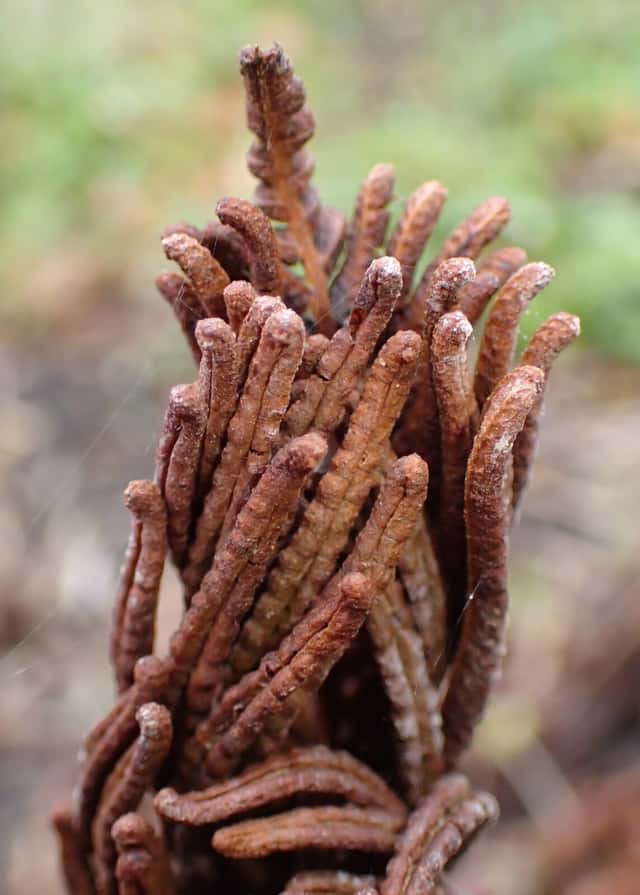
Collect the dark brown fertile fronds in autumn and shake the spores onto clean paper.
- 2 Sowing
Sprinkle the spores onto a sterile, moist growing medium (peat).
- 3 Incubation
Cover the container with clear plastic to maintain humidity near 100% and place it in indirect light.
Materials needed:
How Big Does Ostrich fern Grow?
TLDR: Ostrich fern can reach up to 1.5m tall with Medium growth rate.
Max height
1.5m
Spread
1.0m
Growth rate
Medium
Foliage
Deciduous
Plant Uses
Ornamental
Great for decoration
Edible
Can be consumed
Culinary Uses
- Young shoots (fiddleheads) are edible only after boiling or thorough steaming—raw they contain thiaminase and other toxins
- Used as a seasonal spring garnish in gourmet cuisine
Is your plant showing symptoms?
Click on the symptom to discover possible causes:
What Diseases Commonly Affect Ostrich fern?
TLDR: Ostrich fern is susceptible to 4 known diseases. Monitor regularly for early detection.
Root Rot
Root rot is a serious fungal disease that affects the root system of plants, causing them to decay and die. It is primarily caused by overwatering, poor drainage, or soil-borne fungi such as Pythium, Phytophthora, Rhizoctonia, and Fusarium. The disease thrives in waterlogged conditions where roots are deprived of oxygen, making them susceptible to fungal infection.
Spider Mites
Spider mites are tiny arachnids (less than 1/20 inch long) related to spiders and ticks that feed on plant sap. They thrive in hot, dry conditions and can cause significant damage to ornamental and vegetable plants. During severe infestations, crop losses can reach 14% or higher as these pests disrupt vital plant processes including photosynthesis, carbon dioxide absorption, and transpiration.
Mealybugs
Mealybugs are small, soft-bodied insects covered with a white, waxy, cottony material. They are common pests of houseplants and outdoor plants in mild climates. These sap-sucking insects feed on plant tissue, causing damage, stunted growth, and can lead to plant death if left untreated. They produce sticky honeydew which attracts sooty mold.
Aphids
Aphids are small, soft-bodied, pear-shaped insects (1/16 to 1/8 inch long) that feed by sucking nutrient-rich sap from plants. They reproduce rapidly and can quickly weaken plants, causing distorted growth and transmitting plant viruses. Aphids come in various colors including green, black, red, yellow, brown, and gray. They secrete honeydew, a sticky substance that attracts ants and encourages sooty mold growth.
Meaning & Symbolism
Symbolizes shelter, protection, and new beginnings—its spiral-shaped frond upon emerging (the fiddlehead) evokes renewal and resilience in the face of harsh winters.
Compare with similar plants
| Attribute | Difficulty | Light | Watering | Pet Safe |
|---|---|---|---|---|
| Dark Fieldcap | Medium | Low light | 2d | ⚠️ |
| Azalea | Medium | Partial shade | 3d | ⚠️ |
| Muriel's Bamboo | Medium | Partial shade | 3d | ✓ |
| Bougainvillea | Medium | Direct sun | 7d | ⚠️ |




