Orchidaceae
Pale Umbrella Orchid (Bulbophyllum longiflorum) Care Guide
Bulbophyllum longiflorum
A rewarding orchid for growers comfortable with epiphyte culture. It wants bright, filtered light, high humidity, and a potting medium that holds some moisture but drains quickly so the roots never sit wet. Strong, steady air movement is essential to prevent fungal problems given the humidity it needs.
Every 3 days
Partial shade
15° - 32°C
60% - 80%
Categories
What is Pale Umbrella Orchid?
Pale Umbrella Orchid (Bulbophyllum longiflorum) is a medium-care plant from the Orchidaceae family. The Pale Umbrella Orchid (Bulbophyllum longiflorum) is a widespread epiphytic or lithophytic orchid native to rainforests and hill forests across Africa, Madagascar, the Mascarenes, Seychelles, Southeast Asia, New Guinea, New Caledonia, Fiji and northern Australia. It grows from a creeping rhizome b...
Pale Umbrella Orchid grows up to 20cm, watering every 3 days, 15°C – 32°C, 60–80% humidity. It is suitable for indoor environments and safe for pets.
Unlike many popular species, Pale Umbrella Orchid is safe to keep around pets. Without adequate drainage, root rot can develop within 7 days.
How to Care for Pale Umbrella Orchid?
TLDR: Pale Umbrella Orchid needs Partial shade, watering every 3 days, and temperatures between 15-32°C with 60-80% humidity.
How Often Should You Water Pale Umbrella Orchid?
Water generously while the plant is actively growing (spring through autumn), letting the roots dry quickly afterward — potted plants a few times a week, mounted plants closer to daily. Ease off once new growths mature in autumn, but never let the medium fully dry out for long.
How Much Light Does Pale Umbrella Orchid Need?
Provide bright, indirect or dappled light (roughly 12,000–25,000 lux). Avoid direct afternoon sun, which scorches the foliage; too little light will stunt growth and suppress flowering.
What Is the Best Soil for Pale Umbrella Orchid?
Pot in a fast-draining orchid mix of fine bark, tree-fern fiber or sphagnum, or mount on cork or tree-fern slabs — the goal is quick drying at the roots with no waterlogging.
What Pot Should You Use for Pale Umbrella Orchid?
Mounted on cork/tree-fern slab, or shallow basket/pot with orchid bark mix
Care Schedule
Fertilize
Every 14 days
Misting
Every 3 days
Rotate
Every 7 days
Repot
Every 730 days
What Is Pale Umbrella Orchid and Where Does It Come From?
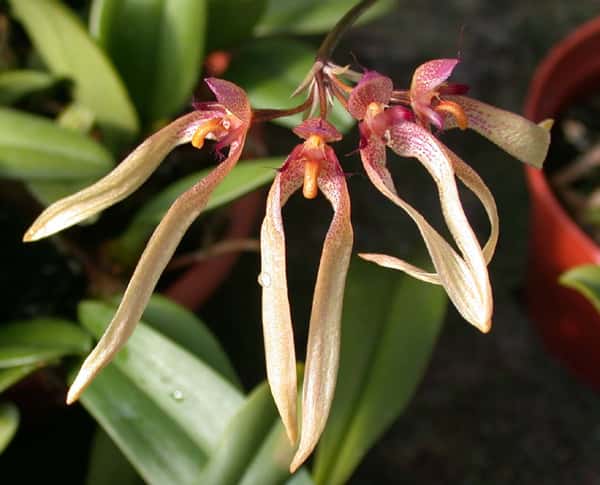
The Pale Umbrella Orchid (Bulbophyllum longiflorum) is a widespread epiphytic or lithophytic orchid native to rainforests and hill forests across Africa, Madagascar, the Mascarenes, Seychelles, Southeast Asia, New Guinea, New Caledonia, Fiji and northern Australia. It grows from a creeping rhizome bearing widely-spaced, dark green pseudobulbs, each topped with a single fleshy leaf. Its most striking feature is the umbrella-like flower cluster: a semicircular umbel of small, greenish cream to yellowish blooms speckled with purple, held on an arching stem above the foliage.
How to Propagate Pale Umbrella Orchid?
Rhizome division
Always use sterilized tools to avoid spreading bacterial or fungal infection between divisions. Do not overwater freshly divided plants until new roots appear.
- 1 Wait until the clump has at least 4-5 healthy pseudobulbs
- 2 Using a sterile blade, cut through the creeping rhizome leaving 3+ pseudobulbs per division
- 3 Let cut surfaces callus for a few hours before mounting or potting
- 4 Mount the division on cork/tree-fern or pot in fresh, fast-draining orchid mix
- 5 Keep humidity high and water lightly until new roots establish
Materials needed:
How Big Does Pale Umbrella Orchid Grow?
TLDR: Pale Umbrella Orchid can reach up to 20cm tall with Medium growth rate.
Max height
20cm
Foliage
Evergreen
Plant Uses
Ornamental
Great for decoration
Is your plant showing symptoms?
Click on the symptom to discover possible causes:
What Diseases Commonly Affect Pale Umbrella Orchid?
TLDR: Pale Umbrella Orchid is susceptible to 6 known diseases. Monitor regularly for early detection.
Aphids
Aphids are small, soft-bodied, pear-shaped insects (1/16 to 1/8 inch long) that feed by sucking nutrient-rich sap from plants. They reproduce rapidly and can quickly weaken plants, causing distorted growth and transmitting plant viruses. Aphids come in various colors including green, black, red, yellow, brown, and gray. They secrete honeydew, a sticky substance that attracts ants and encourages sooty mold growth.
Mealybugs
Mealybugs are small, soft-bodied insects covered with a white, waxy, cottony material. They are common pests of houseplants and outdoor plants in mild climates. These sap-sucking insects feed on plant tissue, causing damage, stunted growth, and can lead to plant death if left untreated. They produce sticky honeydew which attracts sooty mold.
Spider Mites
Spider mites are tiny arachnids (less than 1/20 inch long) related to spiders and ticks that feed on plant sap. They thrive in hot, dry conditions and can cause significant damage to ornamental and vegetable plants. During severe infestations, crop losses can reach 14% or higher as these pests disrupt vital plant processes including photosynthesis, carbon dioxide absorption, and transpiration.
Scale Insects
Scale insects are small sap-sucking pests that appear as brown, shell-like bumps on plant stems and leaves. There are over 25 species, divided into armored (hard) and unarmored (soft) scales. They feed by piercing plant tissue and extracting sap, which weakens the plant and can lead to yellowing, stunted growth, and even death if left untreated. They also excrete honeydew, which attracts ants and promotes sooty mold growth.
Fun Facts
Its flowers open in a striking semicircular umbrella-shaped cluster, which gives the plant its common name.
It is one of the most widely distributed Bulbophyllum species in the world, found from Africa to the Pacific Islands.
The scientific synonym Cirrhopetalum umbellatum refers to the same umbrella-like flower arrangement.
Frequently asked questions
Does the Pale Umbrella Orchid need to be mounted?
How much humidity does Bulbophyllum longiflorum need?
Is Bulbophyllum longiflorum toxic to cats or dogs?
Why is my orchid not flowering?
Compare with similar plants
| Attribute | Difficulty | Light | Watering | Pet Safe |
|---|---|---|---|---|
| Dark Fieldcap | Medium | Low light | 2d | ⚠️ |
| Azalea | Medium | Partial shade | 3d | ⚠️ |
| Muriel's Bamboo | Medium | Partial shade | 3d | ✓ |
| Bougainvillea | Medium | Direct sun | 7d | ⚠️ |




