Amaryllidaceae
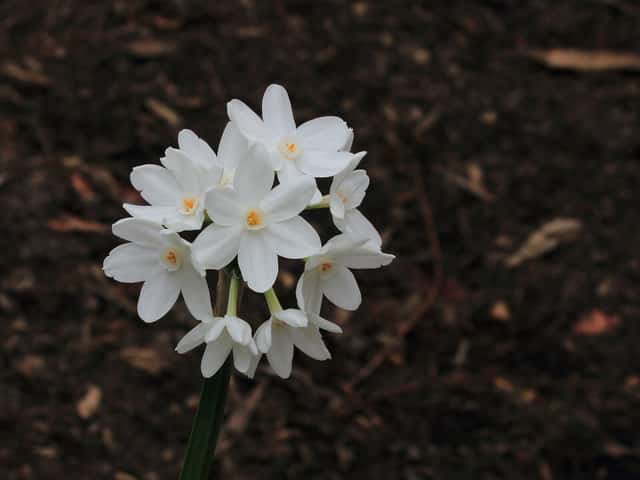
Paperwhite – Narcissus papyraceus
Narcissus papyraceus
Easy to grow: prefers bright, indirect light, well-draining soil, and regular watering without waterlogging. Commonly forced in water with pebbles or in pots with light potting mix, blooming in about 3-4 weeks.
Every 9 days
Bright indirect
10° - 18°C
% - %
Categories
What is Paperwhite?
Paperwhite (Narcissus papyraceus) is a easy-care plant from the Amaryllidaceae family. Narcissus papyraceus, commonly known as paperwhite, is a perennial bulbous plant in the Amaryllidaceae family, native to the Mediterranean region (from southern Portugal and Spain to Greece, plus Morocco and Algeria). It is widely grown to force indoor bloom in winter without needing a chilling peri...
Paperwhite grows up to 45cm, watering every 9 days, 10°C – 18°C. It is suitable for indoor environments and not safe for pets.
Unlike many tropical plants, Paperwhite tolerates watering mistakes. Best for beginners. Without precautions, ingestion can cause irritation in pets. Keep out of reach of cats and dogs. Without adequate drainage, root rot can develop within 18 days.
How to Care for Paperwhite?
TLDR: Paperwhite needs Bright indirect, watering every 9 days, and temperatures between 10-18°C with 40-70% humidity.
How Often Should You Water Paperwhite?
Water when the top 2-3 cm of soil feels dry to the touch. Avoid waterlogging - the bulb is prone to rot in soggy soil. When grown in water, keep the level touching only the roots, never the bulb itself.
How Much Light Does Paperwhite Need?
Prefers bright, indirect to filtered light; less than 30 cm from a sunny window is ideal. Rotate the pot every 2-3 days to keep stems growing straight instead of leaning toward the light.
What Is the Best Soil for Paperwhite?
Use a light, well-draining potting mix rich in organic matter, amended with perlite or vermiculite to prevent waterlogged roots.
What Pot Should You Use for Paperwhite?
A shallow, wide pot with good drainage, or a container without drainage holes for water-and-pebble forcing to support the bulbs.
Care Schedule
Fertilize
Every 45 days
Rotate
Every 3 days
Repot
Every 365 days
What Is Paperwhite and Where Does It Come From?
Narcissus papyraceus, commonly known as paperwhite, is a perennial bulbous plant in the Amaryllidaceae family, native to the Mediterranean region (from southern Portugal and Spain to Greece, plus Morocco and Algeria). It is widely grown to force indoor bloom in winter without needing a chilling period, producing clusters of intensely fragrant white flowers atop slender stems.
How to Propagate Paperwhite?
Bulb offset division
Small offsets may take 2-3 seasons to reach flowering size; discard any soft or rotten bulbs before replanting.
- 1 Wait for the foliage to die back completely after flowering
- 2 Carefully dig up the parent bulb
- 3 Manually separate the small offset bulbs (bulblets) formed at the base
- 4 Replant the offsets separately in well-draining soil
- 5 Water lightly and wait for the next growth cycle the following autumn/winter
Materials needed:
How Big Does Paperwhite Grow?
TLDR: Paperwhite can reach up to 45cm tall with Fast growth rate.
Max height
45cm
Growth rate
Fast
Foliage
Deciduous
Warning: Toxic Plant
This plant can be toxic if ingested. Keep out of reach of:
Plant Uses
Ornamental
Great for decoration
Is your plant showing symptoms?
Click on the symptom to discover possible causes:
What Diseases Commonly Affect Paperwhite?
TLDR: Paperwhite is susceptible to 5 known diseases. Monitor regularly for early detection.
Fusarium Wilt
Fusarium wilt is a serious fungal disease caused by the soil-borne fungus Fusarium oxysporum. The fungus invades roots and blocks the water-conducting vessels (xylem) of the plant, causing progressive wilting and eventual death. Host-specific forms of the pathogen exist that attack different plant species.
Root Rot
Root rot is a serious fungal disease that affects the root system of plants, causing them to decay and die. It is primarily caused by overwatering, poor drainage, or soil-borne fungi such as Pythium, Phytophthora, Rhizoctonia, and Fusarium. The disease thrives in waterlogged conditions where roots are deprived of oxygen, making them susceptible to fungal infection.
Gray Mold (Botrytis Blight)
Gray mold, caused by the fungus Botrytis cinerea, is one of the most common fungal diseases in plants. It affects over 200 plant species, including ornamentals, vegetables, fruits, and houseplants. The disease thrives in cool, humid conditions with poor air circulation, causing grayish spots and soft rot on infected tissues.
White Mold
White mold (Sclerotinia sclerotiorum) is a devastating fungal disease affecting over 400 plant species worldwide. The fungus produces black, seed-like structures (sclerotia) that can survive in soil for 5 or more years. The disease is favored by cool, moist weather (50-68°F/10-20°C), especially during flowering.
Meaning & Symbolism
Symbolizes hope, renewal, purity, faithfulness and good wishes; it is the traditional December birth flower and a popular winter/Christmas holiday decorative plant.
Fun Facts
The epithet "papyraceus" means "paper-like," referring to the thin, papery texture of the white petals
Unlike most daffodils, it needs no cold period to bloom, making it easy to force indoors for the holidays
The entire bulb is toxic and contains lycorine, an alkaloid that causes nausea and vomiting if ingested
Frequently asked questions
Is paperwhite narcissus toxic to cats and dogs?
Do I need to chill the bulb before planting?
How long does it take to bloom after planting?
Why are my paperwhite stems flopping over?
Compare with similar plants
| Attribute | Difficulty | Light | Watering | Pet Safe |
|---|---|---|---|---|
| Field Maple | Easy | Bright indirect | 14d | ✓ |
| Silver Birch | Easy | Direct sun | 14d | ✓ |
| Common Blanketflower | Easy | Direct sun | 10d | ✓ |
| Cushion Bush | Easy | Direct sun | 14d | ✓ |
Choose & Compare
Sources & References
- The Complete Paperwhite Narcissus Plant Care Guide
- Narcissus papyraceus - Wikipedia
- Narcissus Basal Rot - RHS
- Other foliar disorders and fungal diseases of narcissus - AHDB
- Keep Your Paperwhite Narcissus Bulbs Blooming Indoors
- The Alluring Paperwhite Narcissus: Symbolism, Significance, and Uses
- Narcissus papyraceus (narciso blanco)
- Narciso-de-Inverno - Narcissus papyraceus





