Haloragaceae
Parrot's feather: Ground Cover Plant
Myriophyllum aquaticum
It thrives in still or slow-moving water, rooted in a muddy substrate rich in organic matter, with at least 6 hours of direct sunlight or intense artificial light per day. It tolerates a wide pH range (5.5-7.5) and temperatures between 41 and 86°F, but grows fastest between 73 and 82°F. It must never be without water: the emergent portions dry out quickly if the water level drops. It requires frequent pruning, even monthly, to contain its very rapid growth and prevent it from choking the surface of the pond or aquarium.
Every 1 days
Bright indirect
5° - 30°C
70% - 100%
Categories
What is Parrot's feather?
Parrot's feather (Myriophyllum aquaticum) is a easy-care plant from the Haloragaceae family. Myriophyllum aquaticum, commonly known as parrot's feather, is a rhizomatous perennial aquatic plant native to the Amazon basin of South America. It produces creeping stems that root in submerged mud and erect stems that emerge from the water surface up to 12-24 inches, covered in bright light green...
Parrot's feather grows up to 60cm, spread of 150cm, watering every 1 days, 5°C – 30°C, 70–100% humidity. It is suitable for indoor environments and safe for pets.
Unlike many tropical plants, Parrot's feather tolerates watering mistakes. Best for beginners. Unlike many popular species, Parrot's feather is safe to keep around pets. Without adequate drainage, root rot can develop within 7 days.
How to Care for Parrot's feather?
TLDR: Parrot's feather needs Bright indirect, watering every 1 days, and temperatures between 5-30°C with 70-100% humidity.
How Often Should You Water Parrot's feather?
It must remain submerged or with its roots constantly immersed: never let the mud dry out or allow the water level to drop below the roots, even for short periods.
How Much Light Does Parrot's feather Need?
Prefers full sun or bright light for at least 6-10 hours a day; in low light, the stems stretch and turn yellow, losing their typical feathery and compact shape.
What Is the Best Soil for Parrot's feather?
Anchors in muddy substrates rich in organic matter or in fine gravel mixed with soil; it does not require well-draining soil, as it absorbs most of its nutrients directly from the water.
What Pot Should You Use for Parrot's feather?
In a pond, it should be planted in perforated aquatic baskets filled with clay-organic substrate and weighted down with gravel; in an aquarium or container, prefer wide and shallow tanks without external drains to prevent accidental escape into the environment.
Care Schedule
Fertilize
Every 30 days
What Is Parrot's feather and Where Does It Come From?
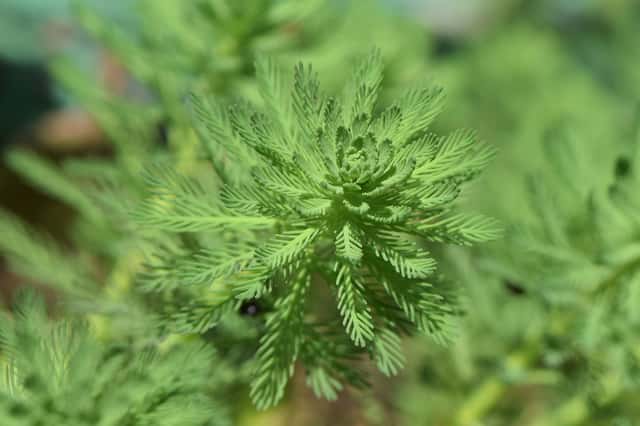
Myriophyllum aquaticum, commonly known as parrot's feather, is a rhizomatous perennial aquatic plant native to the Amazon basin of South America. It produces creeping stems that root in submerged mud and erect stems that emerge from the water surface up to 12-24 inches, covered in bright light green pinnate leaves arranged in feathery whorls that resemble parrot feathers. In summer, it bears tiny, almost imperceptible white or yellowish flowers in the leaf axils of the emergent stems. Widely used ornamentally for ponds and aquariums due to its oxygenating and filtering action, this species is now listed as an invasive alien species of Union concern (EU Regulation 1143/2014): its cultivation, sale, and release into the wild are prohibited in Italy and the rest of the European Union, as it forms dense mats that choke waterways and displace native flora.
How to Propagate Parrot's feather?
Stem cutting
- In many areas, the cultivation and distribution of this species are regulated or prohibited (EU Reg. 1143/2014): propagate only in closed containers and never release it into natural waterways or ponds.
- Even small stem fragments can generate new plants: dispose of pruning waste in organic waste bins, never in the water.
- 1 Taking the cutting
Cut a healthy stem section 4-6 inches long, with several leaf whorls.
- 2 Rooting
Bury the base of the cutting 1 inch deep into the muddy substrate of the pond or aquarium, or let it float freely in the water.
- 3 Establishment
Roots form at the submerged nodes within a few days; then anchor the plant to the substrate.
Materials needed:
Rhizome division
- 1 Extraction
Lift a portion of the rooted rhizome from the substrate.
- 2 Division
Separate the rhizome into sections with at least one active node.
- 3 Transplanting
Replant the sections immediately into the muddy substrate, keeping them submerged.
Materials needed:
How Big Does Parrot's feather Grow?
TLDR: Parrot's feather can reach up to 60cm tall with Fast growth rate.
Max height
60cm
Spread
1.5m
Growth rate
Fast
Foliage
Semi-evergreen
Plant Uses
Ornamental
Great for decoration
Ground Cover
Soil coverage
Is your plant showing symptoms?
Click on the symptom to discover possible causes:
What Diseases Commonly Affect Parrot's feather?
TLDR: Parrot's feather is susceptible to 3 known diseases. Monitor regularly for early detection.
Aphids
Aphids are small, soft-bodied, pear-shaped insects (1/16 to 1/8 inch long) that feed by sucking nutrient-rich sap from plants. They reproduce rapidly and can quickly weaken plants, causing distorted growth and transmitting plant viruses. Aphids come in various colors including green, black, red, yellow, brown, and gray. They secrete honeydew, a sticky substance that attracts ants and encourages sooty mold growth.
Leaf Spot
Leaf spot is a common fungal disease caused by various pathogens including Alternaria, Ascochyta, Colletotrichum, Septoria, and Venturia. It primarily affects leaves, causing discolored spots that can lead to premature leaf drop if left untreated.
Slugs and Snails
Slugs and snails are mollusks that feed on plant tissue, causing irregular holes in leaves and damage to young seedlings. They are most active at night and in moist conditions, leaving characteristic silvery slime trails. These pests can quickly devastate gardens, especially during wet seasons.
Meaning & Symbolism
With its feathery foliage resembling parrot feathers, parrot's feather evokes lightness and aquatic abundance; in contemporary ecological language, however, it has also become a symbol of invasive alien species, serving as a warning about the impact of ornamental plants escaped into the wild.
Compare with similar plants
| Attribute | Difficulty | Light | Watering | Pet Safe |
|---|---|---|---|---|
| Field Maple | Easy | Bright indirect | 14d | ✓ |
| Silver Birch | Easy | Direct sun | 14d | ✓ |
| Common Blanketflower | Easy | Direct sun | 10d | ✓ |
| Cushion Bush | Easy | Direct sun | 14d | ✓ |
Choose & Compare
Sources & References
- Pond Informer - Parrots Feather Care Guide
- Bantam Earth - Myriophyllum Aquaticum Plant Care Guide
- Jardineria On - Identification, impact, control
- US FWS - Parrotfeather Ecological Risk Screening Summary
- Weeds Australia - Parrots Feather Profile
- ISPRA - Millefoglio d'acqua brasiliano
- Aqua-Fish.net - Myriophyllum Aquaticum Care





