Solanaceae
Solanum laxum - Potato Vine Care Guide
Solanum laxum
Grow in full sun to part shade with shelter from cold wind, in fertile, well-drained soil. Water regularly while establishing; once mature it tolerates short dry spells. Feed monthly during the growing season, prune hard after flowering to control size, and protect from frost below about -5°C (23°F).
Every 7 days
Bright indirect
-10° - 32°C
40% - 60%
Categories
What is Potato Vine?
Potato Vine (Solanum laxum) is a medium-care plant from the Solanaceae family. Solanum laxum, commonly called potato vine or jasmine nightshade, is a fast-growing semi-evergreen climber native to southeastern Brazil, Paraguay, Argentina and Uruguay. Its twining, semi-woody stems can reach 6-9 m, quickly covering fences, trellises and arbors. From summer into fall it produces c...
Potato Vine grows up to 8.0m, spread of 300cm, watering every 7 days, -10°C – 32°C, 40–60% humidity. It is suitable for indoor environments and not safe for pets.
Without precautions, ingestion can cause irritation in pets. Keep out of reach of cats and dogs. Without adequate drainage, root rot can develop within 14 days.
How to Care for Potato Vine?
TLDR: Potato Vine needs Bright indirect, watering every 7 days, and temperatures between -10-32°C with 40-60% humidity.
How Often Should You Water Potato Vine?
Water deeply whenever the top 3-5 cm of soil dries out, roughly once a week in the growing season; established plants tolerate brief dry spells but perform best with consistent moisture.
How Much Light Does Potato Vine Need?
Give it full sun to light partial shade - a south- or west-facing, sheltered spot brings on the most flowers.
What Is the Best Soil for Potato Vine?
Plant in fertile, well-drained loam, sand or chalk-based soil with a neutral to slightly alkaline pH; add organic matter and grit if the soil is heavy.
What Pot Should You Use for Potato Vine?
A sturdy container with ample drainage holes, trained up a small obelisk or trellis; move to a sheltered spot or indoors in winter in cold climates.
Care Schedule
Fertilize
Every 30 days
Repot
Every 550 days
What Is Potato Vine and Where Does It Come From?
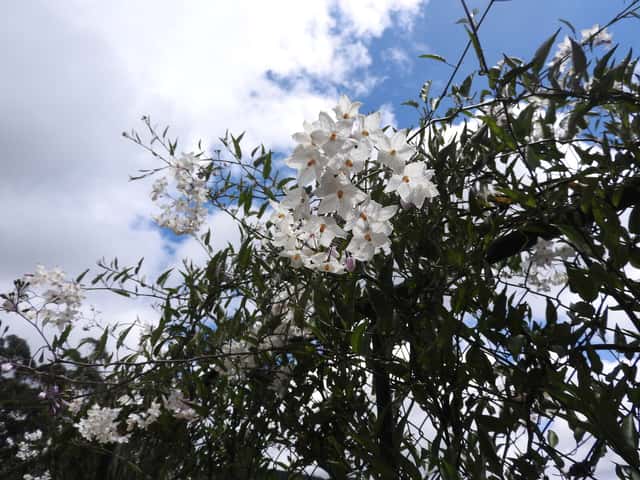
Solanum laxum, commonly called potato vine or jasmine nightshade, is a fast-growing semi-evergreen climber native to southeastern Brazil, Paraguay, Argentina and Uruguay. Its twining, semi-woody stems can reach 6-9 m, quickly covering fences, trellises and arbors. From summer into fall it produces clusters of fragrant, star-shaped white flowers with yellow stamens, followed by small blue-black berries. All parts of the plant - leaves, stems, flowers and especially the unripe berries - contain solanine and other glycoalkaloids and are toxic if ingested by humans and pets; the sap can also irritate skin, so gloves are recommended when pruning.
How to Propagate Potato Vine?
Semi-hardwood stem cuttings
Use clean, sharp tools; avoid direct sun until rooted; wear gloves since the plant sap can irritate skin.
- 1 Cut a healthy 10-15 cm (4-6 in) semi-hardwood stem just below a node
- 2 Strip the leaves from the lower half of the cutting
- 3 Dip the cut end in rooting hormone
- 4 Insert into a light, well-draining potting mix and keep it moist
- 5 Cover with a clear plastic bag to hold humidity and place in bright, indirect light
Materials needed:
Simple layering
Good option if you want to avoid handling cut stems; keep the buried node moist at all times.
- 1 Choose a flexible stem close to the ground
- 2 Wound the bark lightly where it will touch the soil
- 3 Bury that section, leaving the growing tip exposed
- 4 Keep the buried section consistently moist until rooted
- 5 Sever the newly rooted stem from the parent plant and transplant
Materials needed:
How Big Does Potato Vine Grow?
TLDR: Potato Vine can reach up to 8.0m tall with Fast growth rate.
Max height
8.0m
Spread
3.0m
Growth rate
Fast
Foliage
Semi-evergreen
Warning: Toxic Plant
This plant can be toxic if ingested. Keep out of reach of:
Plant Uses
Ornamental
Great for decoration
Is your plant showing symptoms?
Click on the symptom to discover possible causes:
What Diseases Commonly Affect Potato Vine?
TLDR: Potato Vine is susceptible to 5 known diseases. Monitor regularly for early detection.
Aphids
Aphids are small, soft-bodied, pear-shaped insects (1/16 to 1/8 inch long) that feed by sucking nutrient-rich sap from plants. They reproduce rapidly and can quickly weaken plants, causing distorted growth and transmitting plant viruses. Aphids come in various colors including green, black, red, yellow, brown, and gray. They secrete honeydew, a sticky substance that attracts ants and encourages sooty mold growth.
Spider Mites
Spider mites are tiny arachnids (less than 1/20 inch long) related to spiders and ticks that feed on plant sap. They thrive in hot, dry conditions and can cause significant damage to ornamental and vegetable plants. During severe infestations, crop losses can reach 14% or higher as these pests disrupt vital plant processes including photosynthesis, carbon dioxide absorption, and transpiration.
Tomato Spotted Wilt Virus (TSWV)
Tomato Spotted Wilt Virus (TSWV) is one of the most devastating viral diseases affecting over 1,000 plant species across 85 families. It is transmitted by thrips and cannot be cured once a plant is infected. The virus causes severe stunting, bronzing of leaves, necrotic spots, and significant yield losses. Early detection and removal of infected plants is critical to prevent spread.
Gray Mold (Botrytis Blight)
Gray mold, caused by the fungus Botrytis cinerea, is a widespread necrotrophic pathogen affecting over 1,400 plant species. It thrives in cool, humid conditions and attacks weakened or aging plant tissues, causing soft rot and characteristic gray fuzzy growth.
Meaning & Symbolism
In gardens the fragrant white blooms are often associated with abundance and fast-growing new beginnings, echoing its vigorous climbing habit.
Fun Facts
Despite the name, potato vine is not related to edible potatoes beyond sharing the Solanaceae family.
A single plant can climb 6-9 m (20-30 ft) in just a season or two.
Its star-shaped flowers release a sweet, jasmine-like scent, especially in the evening.
Frequently asked questions
Is Solanum laxum toxic?
How fast does potato vine grow?
Does Solanum laxum need full sun?
How do I prune a potato vine?
Compare with similar plants
| Attribute | Difficulty | Light | Watering | Pet Safe |
|---|---|---|---|---|
| Dark Fieldcap | Medium | Low light | 2d | ⚠️ |
| Azalea | Medium | Partial shade | 3d | ⚠️ |
| Muriel's Bamboo | Medium | Partial shade | 3d | ✓ |
| Bougainvillea | Medium | Direct sun | 7d | ⚠️ |




