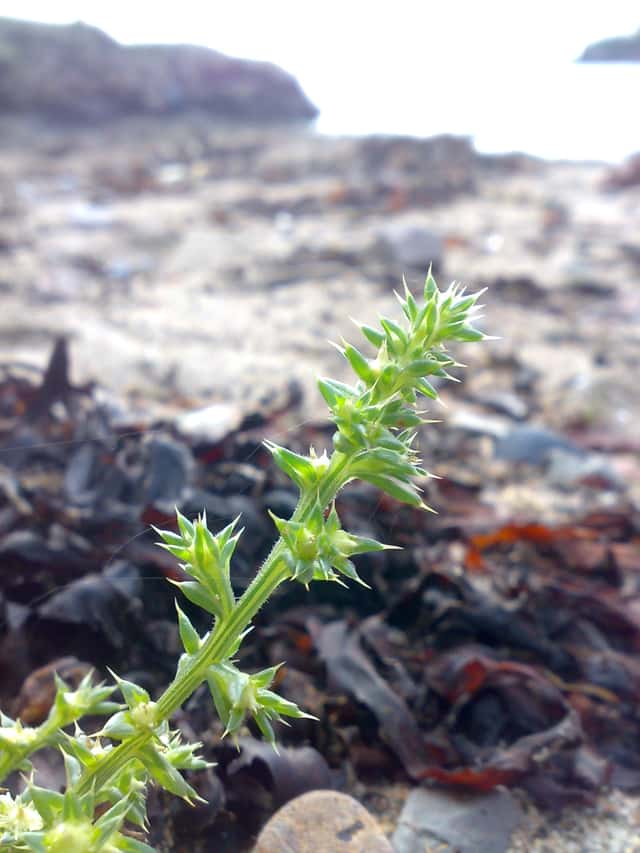
Amaranthaceae
Prickly Russian thistle: Edible Plant
Salsola kali
Requires full sun (at least 6 hours daily) and a sandy, poor, and very well-drained substrate; it tolerates saline soils without issue. It is extremely drought-resistant once established and does not require fertilization or special care.
Every 14 days
Direct sun
-5° - 45°C
20% - 50%
Categories
What is Prickly Russian thistle?
Prickly Russian thistle (Salsola kali) is a easy-care plant from the Amaranthaceae family. Salsola kali, commonly known as prickly Russian thistle, saltwort, or tumbleweed, is an annual halophytic plant in the Amaranthaceae family. It grows in a globose and spiny form on sandy beaches, dunes, and saline soils in coastal areas of Europe, North Africa, and Asia, and has become naturalized a...
Prickly Russian thistle grows up to 1.0m, spread of 100cm, watering every 14 days, -5°C – 45°C, 20–50% humidity. It is not suitable for indoor environments and not safe for pets.
Unlike many tropical plants, Prickly Russian thistle tolerates watering mistakes. Best for beginners. Without precautions, ingestion can cause irritation in pets. Keep out of reach of cats and dogs.
How to Care for Prickly Russian thistle?
TLDR: Prickly Russian thistle needs Direct sun, watering every 14 days, and temperatures between -5-45°C with 20-50% humidity.
How Often Should You Water Prickly Russian thistle?
Water sparingly during initial establishment; afterwards, reduce to a minimum, as excess moisture promotes root rot. Once settled, it tolerates long periods without water.
How Much Light Does Prickly Russian thistle Need?
Requires direct sun exposure for most of the day; it does not tolerate shade or prolonged partial shade.
What Is the Best Soil for Prickly Russian thistle?
Thrives in sandy, nutrient-poor soils with excellent drainage; it tolerates salinity very well. Avoid substrates rich in organic matter or those that retain moisture.
What Pot Should You Use for Prickly Russian thistle?
Cultivation in pots is not recommended; it develops best in open, sandy soil with enough space for its taproot and globose shape.
What Is Prickly Russian thistle and Where Does It Come From?
Salsola kali, commonly known as prickly Russian thistle, saltwort, or tumbleweed, is an annual halophytic plant in the Amaranthaceae family. It grows in a globose and spiny form on sandy beaches, dunes, and saline soils in coastal areas of Europe, North Africa, and Asia, and has become naturalized as an invasive weed in North America. Upon drying in the fall, the plant detaches from its root and rolls with the wind (the 'tumbleweed' effect), thereby dispersing its seeds.
How to Propagate Prickly Russian thistle?
Direct sowing
- Seeds are best kept cold and lose viability quickly, so it is recommended to sow them in the season following their collection.
- 1 Substrate preparation
Use a sandy and poor soil, ensuring perfect drainage.
- 2 Sowing
Scatter the seeds over the surface and cover lightly with sand; seeds have short viability, so it is best to sow them fresh.
- 3 Initial watering
Moisten slightly until the first shoots appear, then progressively reduce watering.
Materials needed:
How Big Does Prickly Russian thistle Grow?
TLDR: Prickly Russian thistle can reach up to 1.0m tall with Fast growth rate.
Max height
1.0m
Spread
1.0m
Growth rate
Fast
Foliage
Deciduous
Warning: Toxic Plant
This plant can be toxic if ingested. Keep out of reach of:
Plant Uses
Edible
Can be consumed
Medicinal
Medicinal properties
Medicinal Uses
- Diuretic
- Emmenagogue
- Vermifuge
- Mild stimulant
Culinary Uses
- Raw or cooked tender shoots
- Cooked seeds used as flour or porridge
Is your plant showing symptoms?
Click on the symptom to discover possible causes:
What Diseases Commonly Affect Prickly Russian thistle?
TLDR: Prickly Russian thistle is susceptible to 6 known diseases. Monitor regularly for early detection.
Root Rot
Root rot is a serious fungal disease that affects the root system of plants, causing them to decay and die. It is primarily caused by overwatering, poor drainage, or soil-borne fungi such as Pythium, Phytophthora, Rhizoctonia, and Fusarium. The disease thrives in waterlogged conditions where roots are deprived of oxygen, making them susceptible to fungal infection.
Aphids
Aphids are small, soft-bodied, pear-shaped insects (1/16 to 1/8 inch long) that feed by sucking nutrient-rich sap from plants. They reproduce rapidly and can quickly weaken plants, causing distorted growth and transmitting plant viruses. Aphids come in various colors including green, black, red, yellow, brown, and gray. They secrete honeydew, a sticky substance that attracts ants and encourages sooty mold growth.
Spider Mites
Spider mites are tiny arachnids (less than 1/20 inch long) related to spiders and ticks that feed on plant sap. They thrive in hot, dry conditions and can cause significant damage to ornamental and vegetable plants. During severe infestations, crop losses can reach 14% or higher as these pests disrupt vital plant processes including photosynthesis, carbon dioxide absorption, and transpiration.
Scale Insects
Scale insects are small sap-sucking pests that appear as brown, shell-like bumps on plant stems and leaves. There are over 25 species, divided into armored (hard) and unarmored (soft) scales. They feed by piercing plant tissue and extracting sap, which weakens the plant and can lead to yellowing, stunted growth, and even death if left untreated. They also excrete honeydew, which attracts ants and promotes sooty mold growth.
Meaning & Symbolism
Represents resilience and the ability to adapt to hostile environments; its habit of rolling with the wind when dry symbolizes constant movement and dispersal.
Compare with similar plants
| Attribute | Difficulty | Light | Watering | Pet Safe |
|---|---|---|---|---|
| Field Maple | Easy | Bright indirect | 14d | ✓ |
| Silver Birch | Easy | Direct sun | 14d | ✓ |
| Common Blanketflower | Easy | Direct sun | 10d | ✓ |
| Cushion Bush | Easy | Direct sun | 14d | ✓ |





