Caryophyllaceae
Procumbent pearlwort: Ground Cover Plant
Sagina procumbens
Procumbent pearlwort is a low-maintenance, frost-hardy plant suitable for rock gardens, between paving stones, or as ground cover. It prefers cooler, moist growing periods, tolerates full sun to partial shade, and requires almost no care except for occasional watering and possible trimming if it spreads excessively.
Every 5 days
Bright indirect
-51° - °C
50% - 90%
Categories
What is Procumbent pearlwort?
Procumbent pearlwort (Sagina procumbens) is a easy-care plant from the Caryophyllaceae family. Sagina procumbens (procumbent pearlwort) is a perennial, creeping herb from the pink family (Caryophyllaceae), native to Europe, Western and Central Asia, and Northwest Africa. It forms dense, hairless, moss-like mats thanks to stems that root at the nodes and spread rapidly vegetatively. The leaves...
Procumbent pearlwort grows up to 10cm, watering every 5 days, 50–90% humidity. It is not suitable for indoor environments and safe for pets.
Unlike many tropical plants, Procumbent pearlwort tolerates watering mistakes. Best for beginners. Unlike many popular species, Procumbent pearlwort is safe to keep around pets.
How to Care for Procumbent pearlwort?
TLDR: Procumbent pearlwort needs Bright indirect, watering every 5 days, and temperatures between -51-30°C with 50-90% humidity.
How Often Should You Water Procumbent pearlwort?
Keep the soil evenly moist, especially during the cooler months of active growth; avoid waterlogged soil for long periods, as this increases the risk of root rot.
How Much Light Does Procumbent pearlwort Need?
Tolerates full sun to partial shade (2-6 hours of indirect light daily); a sunnier location is preferred for a compact, dense growth habit.
What Is the Best Soil for Procumbent pearlwort?
Grows in a wide range of soils—sandy, clay-loam, and shallow rocky soils—as long as they are well-draining yet retain moisture; ideally slightly acidic to neutral pH.
What Pot Should You Use for Procumbent pearlwort?
Shallow, wide bowls or direct planting into cracks between paving stones and in rock gardens; unsuitable for traditional deep pots.
What Is Procumbent pearlwort and Where Does It Come From?
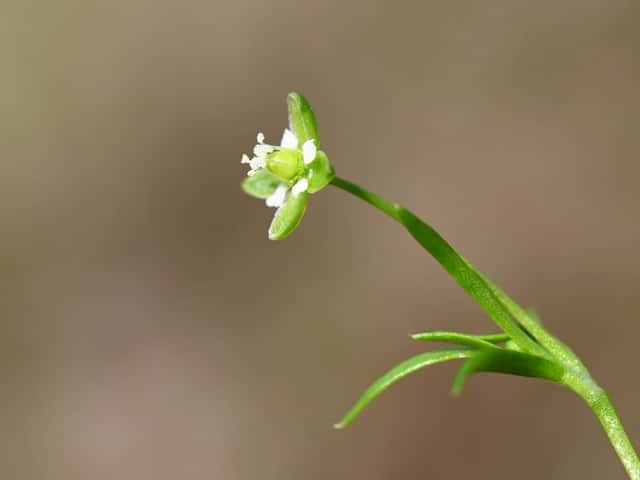
Sagina procumbens (procumbent pearlwort) is a perennial, creeping herb from the pink family (Caryophyllaceae), native to Europe, Western and Central Asia, and Northwest Africa. It forms dense, hairless, moss-like mats thanks to stems that root at the nodes and spread rapidly vegetatively. The leaves are linear, 1-2 cm long. Small, solitary flowers have 4-5 sepals and 4-5 small white petals (sometimes absent) with 4 free stigmas. The plant tolerates trampling exceptionally well, which is why it is commonly found in lawns, cracks between paving stones, and in moist flower pots.
How to Propagate Procumbent pearlwort?
Division
- Keep the soil evenly moist during the rooting process.
- 1 Digging up a section of the mat
Carefully cut and dig up a section of the densely grown mat along with the roots—the stems root at the nodes.
- 2 Division
Divide the dug-up section into smaller clumps using your hands or a knife.
- 3 Planting
Plant the clumps in a new location in moist, well-draining soil and water thoroughly.
Materials needed:
Sowing seeds
- Moisten the substrate with a fine mister to avoid washing away the tiny seeds.
- 1 Substrate preparation
Prepare a fine, moist, and well-draining substrate.
- 2 Sowing
Scatter the seeds on the surface and do not cover them—they need light to germinate. Additionally, the plant can reproduce even without insect pollination.
Materials needed:
How Big Does Procumbent pearlwort Grow?
TLDR: Procumbent pearlwort can reach up to 10cm tall with Fast growth rate.
Max height
10cm
Growth rate
Fast
Foliage
Evergreen
Plant Uses
Ornamental
Great for decoration
Ground Cover
Soil coverage
Is your plant showing symptoms?
Click on the symptom to discover possible causes:
What Diseases Commonly Affect Procumbent pearlwort?
TLDR: Procumbent pearlwort is susceptible to 1 known diseases. Monitor regularly for early detection.
Meaning & Symbolism
In Scottish Highland folklore, pearlwort was attributed with protective powers against fairies—a bunch of the plant hung over the threshold was meant to protect the house from their influence. According to legend, it was blessed by Christ, Saint Brigid, and Saint Columba, which is why it was considered a plant that brings good luck.
Compare with similar plants
| Attribute | Difficulty | Light | Watering | Pet Safe |
|---|---|---|---|---|
| Field Maple | Easy | Bright indirect | 14d | ✓ |
| Silver Birch | Easy | Direct sun | 14d | ✓ |
| Common Blanketflower | Easy | Direct sun | 10d | ✓ |
| Cushion Bush | Easy | Direct sun | 14d | ✓ |
Choose & Compare
Sources & References
- Sagina procumbens - Wikipedia
- Sagina procumbens | NC State Extension Gardener Plant Toolbox
- Sagina procumbens | procumbent pearlwort - RHS
- Sagina procumbens (Birds-eye Pearlwort) - Minnesota Wildflowers
- Sagina procumbens - Go Botany
- Superstitions of the Highlands and Islands of Scotland - J.G. Campbell (Project Gutenberg)





