Campanulaceae
Pua ʻala (Brighamia rockii)
Brighamia rockii
A rare plant, grown almost only in botanical gardens. Care follows that of the Hawaiian palm: plenty of light, fast-draining soil, and water only once the soil has dried a little. The stem stores water, so overwatering rots the plant from inside. It dislikes temperatures below 10 °C. Watch for spider mites, which can kill it, and for slugs if it grows in the ground.
Every 14 days
Bright indirect
10° - 35°C
% - %
Categories
What is Pua ʻala?
Pua ʻala (Brighamia rockii) is a medium-care plant from the Campanulaceae family. Brighamia rockii, known in Hawaii as pua ʻala, is a plant in the bellflower family (Campanulaceae) found only on the island of Molokai. It grows on sea cliffs from sea level up to about 470 meters. It has a thick, fleshy stem that is widest at the base and stores water, and it can reach 5 meters. At...
Pua ʻala grows up to 5.0m, watering every 14 days, 10°C – 35°C. It is suitable for indoor environments and safe for pets.
Unlike many popular species, Pua ʻala is safe to keep around pets. Without adequate drainage, root rot can develop within 28 days.
How to Care for Pua ʻala?
TLDR: Pua ʻala needs Bright indirect, watering every 14 days, and temperatures between 10-35°C with 40-70% humidity.
How Often Should You Water Pua ʻala?
Water when the top few centimeters of soil are dry, roughly every 2 weeks in summer and every 3 in winter. If the stem feels soft when you squeeze it, it is rotting: stop watering right away and let it dry.
How Much Light Does Pua ʻala Need?
Lots of light. Outdoors, morning sun with some afternoon shade works best. Indoors, next to a very bright window. Leaf drop at the height of summer can mean too much sun.
What Is the Best Soil for Pua ʻala?
Cactus and succulent mix with grit or perlite so water drains straight through. Use a pot with several drainage holes.
What Pot Should You Use for Pua ʻala?
A terracotta pot with several holes, only a little bigger than the root ball. The stem gets tall, so a heavy pot keeps it from tipping.
Care Schedule
Fertilize
Every 30 days
Repot
Every 900 days
What Is Pua ʻala and Where Does It Come From?
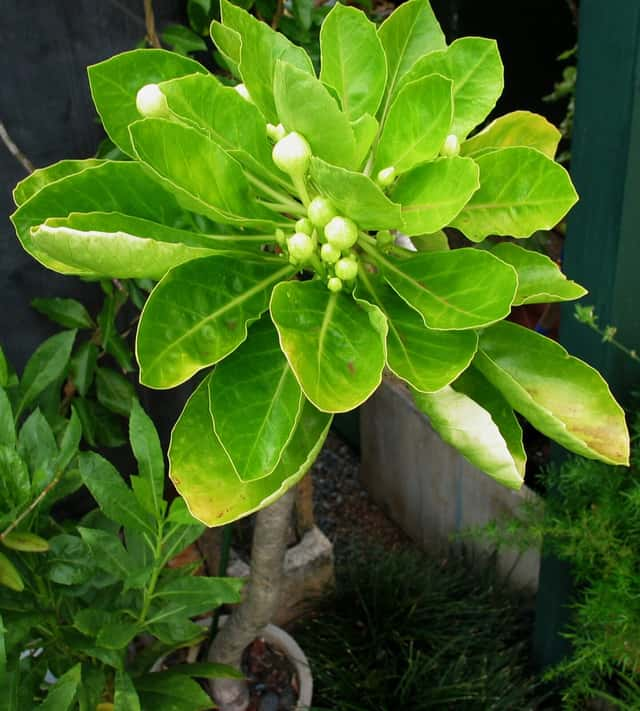
Brighamia rockii, known in Hawaii as pua ʻala, is a plant in the bellflower family (Campanulaceae) found only on the island of Molokai. It grows on sea cliffs from sea level up to about 470 meters. It has a thick, fleshy stem that is widest at the base and stores water, and it can reach 5 meters. At the top sits a rosette of glossy, spoon-shaped leaves 6 to 22 cm long. In autumn it produces clusters of 3 to 8 fragrant white trumpet-shaped flowers. It is critically endangered: few plants remain in the wild, and its native pollinator is gone, so seed now depends on hand pollination. It is a close relative of the Hawaiian palm (Brighamia insignis), the species sold as a houseplant.
How to Propagate Pua ʻala?
Seed
Sow fresh: seeds lose viability in under a year at room temperature.
- 1 Hand pollinate with a small paintbrush, moving pollen from one flower to the shiny stigma of another
- 2 Wait 6 to 8 weeks until the green capsule starts to split
- 3 Keep the capsule in a paper envelope until the seeds drop out
- 4 Scatter the seeds on top of fine, moist mix without covering them, since they need light
- 5 Keep moist with misting until the seedlings come up
Materials needed:
How Big Does Pua ʻala Grow?
TLDR: Pua ʻala can reach up to 5.0m tall with Slow growth rate.
Max height
5.0m
Growth rate
Slow
Foliage
Evergreen
Plant Uses
Ornamental
Great for decoration
Is your plant showing symptoms?
Click on the symptom to discover possible causes:
What Diseases Commonly Affect Pua ʻala?
TLDR: Pua ʻala is susceptible to 5 known diseases. Monitor regularly for early detection.
Spider Mites
Spider mites are tiny arachnids (less than 1/20 inch long) related to spiders and ticks that feed on plant sap. They thrive in hot, dry conditions and can cause significant damage to ornamental and vegetable plants. During severe infestations, crop losses can reach 14% or higher as these pests disrupt vital plant processes including photosynthesis, carbon dioxide absorption, and transpiration.
Root Rot
Root rot is a serious fungal disease that affects the root system of plants, causing them to decay and die. It is primarily caused by overwatering, poor drainage, or soil-borne fungi such as Pythium, Phytophthora, Rhizoctonia, and Fusarium. The disease thrives in waterlogged conditions where roots are deprived of oxygen, making them susceptible to fungal infection.
Mealybugs
Mealybugs are small, soft-bodied insects covered with a white, waxy, cottony material. They are common pests of houseplants and outdoor plants in mild climates. These sap-sucking insects feed on plant tissue, causing damage, stunted growth, and can lead to plant death if left untreated. They produce sticky honeydew which attracts sooty mold.
Slugs and Snails
Slugs and snails are mollusks that feed on plant tissue, causing irregular holes in leaves and damage to young seedlings. They are most active at night and in moist conditions, leaving characteristic silvery slime trails. These pests can quickly devastate gardens, especially during wet seasons.
Fun Facts
The swollen stem base lets the plant rock in strong cliff winds without breaking.
Since its original pollinator disappeared, an introduced hawk moth now does part of that job in the wild.
It once grew on Maui and Lanai, but today survives only on Molokai.
Frequently asked questions
How is it different from the Hawaiian palm?
Why is the stem soft?
The leaves have tiny specks and fine webbing. What is it?
Why did it drop all its leaves?
Compare with similar plants
| Attribute | Difficulty | Light | Watering | Pet Safe |
|---|---|---|---|---|
| Dark Fieldcap | Medium | Low light | 2d | ⚠️ |
| Azalea | Medium | Partial shade | 3d | ⚠️ |
| Muriel's Bamboo | Medium | Partial shade | 3d | ✓ |
| Bougainvillea | Medium | Direct sun | 7d | ⚠️ |




