Boraginaceae
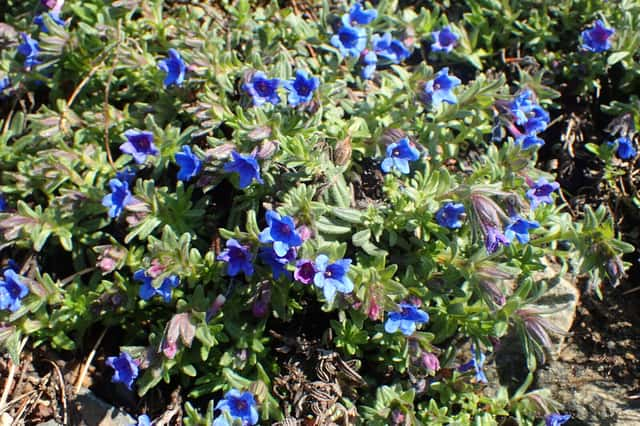
Purple gromwell (Glandora diffusa)
Glandora diffusa
Blue-flowered groundcover for full sun, acidic soil and sharp drainage. It does not tolerate lime or waterlogging.
Every 7 days
Bright indirect
-23° - °C
% - %
Categories
What is Purple gromwell?
Purple gromwell (Glandora diffusa) is a medium-care plant from the Boraginaceae family. Glandora diffusa, long sold as Lithodora diffusa, is a low, evergreen subshrub from northern and western Iberia and western France. It forms a mat of thin stems with narrow, dark green, hairy leaves. From late spring into summer it is covered in small funnel-shaped flowers of an intense blue (white...
Purple gromwell grows up to 30cm, spread of 90cm, watering every 7 days. It is not suitable for indoor environments and safe for pets.
Unlike many popular species, Purple gromwell is safe to keep around pets.
How to Care for Purple gromwell?
TLDR: Purple gromwell needs Bright indirect, watering every 7 days, and temperatures between -23-30°C with 40-70% humidity.
How Often Should You Water Purple gromwell?
Water about once a week, letting the surface dry between waterings. Keep the soil lightly moist in summer but never soggy: the roots rot easily.
How Much Light Does Purple gromwell Need?
Full sun. In low light it flowers poorly and gets sparse.
What Is the Best Soil for Purple gromwell?
Sandy or loamy, well-drained soil, acidic to neutral. On chalky soil the leaves yellow; in heavy clay the roots rot. Peat-free ericaceous compost or pine bark helps keep it acidic.
What Pot Should You Use for Purple gromwell?
Wide, shallow pot or trough with good drainage holes and an acidic, gritty alpine mix. Do not leave water in the saucer.
What Is Purple gromwell and Where Does It Come From?
Glandora diffusa, long sold as Lithodora diffusa, is a low, evergreen subshrub from northern and western Iberia and western France. It forms a mat of thin stems with narrow, dark green, hairy leaves. From late spring into summer it is covered in small funnel-shaped flowers of an intense blue (white forms exist). It reaches 15 to 30 cm tall and spreads to about 90 cm. It is a plant for rock gardens, banks, edging and containers, and it only thrives in acidic to neutral, well-drained soil.
How to Propagate Purple gromwell?
Semi-hardwood cuttings
Use an acidic, airy mix. Too much moisture rots the cuttings.
- 1 In midsummer, cut 5-8 cm tips from this year's shoots that have started to firm up
- 2 Strip the lower leaves
- 3 Insert in a mix of sand and ericaceous compost
- 4 Keep in a sheltered, bright spot, lightly moist, until rooted
Materials needed:
Layering
Works well because the stems already grow along the ground.
- 1 Pick a low, flexible stem
- 2 Pin a section of it to the soil with a wire staple
- 3 Cover with a little mix and keep moist
- 4 Cut from the parent once rooted and replant
Materials needed:
How Big Does Purple gromwell Grow?
TLDR: Purple gromwell can reach up to 30cm tall with Slow growth rate.
Max height
30cm
Spread
90cm
Growth rate
Slow
Foliage
Evergreen
Plant Uses
Ornamental
Great for decoration
Ground Cover
Soil coverage
Is your plant showing symptoms?
Click on the symptom to discover possible causes:
What Diseases Commonly Affect Purple gromwell?
TLDR: Purple gromwell is susceptible to 3 known diseases. Monitor regularly for early detection.
Root Rot
Root rot is a serious fungal disease that affects the root system of plants, causing them to decay and die. It is primarily caused by overwatering, poor drainage, or soil-borne fungi such as Pythium, Phytophthora, Rhizoctonia, and Fusarium. The disease thrives in waterlogged conditions where roots are deprived of oxygen, making them susceptible to fungal infection.
Aphids
Aphids are small, soft-bodied, pear-shaped insects (1/16 to 1/8 inch long) that feed by sucking nutrient-rich sap from plants. They reproduce rapidly and can quickly weaken plants, causing distorted growth and transmitting plant viruses. Aphids come in various colors including green, black, red, yellow, brown, and gray. They secrete honeydew, a sticky substance that attracts ants and encourages sooty mold growth.
Whiteflies
Whiteflies are small, soft-bodied, winged insects closely related to aphids and mealybugs. They are moth-like in appearance, about 1/16 inch long, triangular in shape, and gray-white in color. These sap-sucking pests feed on plant tissue, causing yellowing, stunted growth, and wilting. They also excrete honeydew, which attracts ants and promotes sooty mold growth. Whiteflies can transmit serious plant viruses.
Fun Facts
Nurseries still label it Lithodora diffusa, though the name moved to Glandora
It needs a cold winter to flower well
It grows wild in northern Portugal and Spain
Frequently asked questions
Are Lithodora diffusa and Glandora diffusa the same plant?
Why are the leaves turning yellow?
When should I trim it?
Why is it dying from the center?
Compare with similar plants
| Attribute | Difficulty | Light | Watering | Pet Safe |
|---|---|---|---|---|
| Dark Fieldcap | Medium | Low light | 2d | ⚠️ |
| Azalea | Medium | Partial shade | 3d | ⚠️ |
| Muriel's Bamboo | Medium | Partial shade | 3d | ✓ |
| Bougainvillea | Medium | Direct sun | 7d | ⚠️ |




