Poaceae
Purple Moor Grass: Ground Cover Plant
Molinia caerulea
Purple moor grass is an undemanding and hardy ornamental grass that thrives in full sun to light shade in moist but well-drained soil. It is slow-growing and may take a couple of seasons to establish properly, but thereafter requires minimal care beyond an annual cutback in early spring.
Every 5 days
Bright indirect
-25° - 35°C
50% - 90%
Categories
What is Purple Moor Grass?
Purple Moor Grass (Molinia caerulea) is a easy-care plant from the Poaceae family. Purple moor grass (Molinia caerulea) is a deciduous, clump-forming grass from the genus Molinia, native to moist heaths, bogs, and woodland edges in Europe and Asia. The plant forms dense, upright clumps of narrow, light green leaves that turn golden yellow in autumn. From mid to late summer, slende...
Purple Moor Grass grows up to 1.2m, spread of 60cm, watering every 5 days, -25°C – 35°C, 50–90% humidity. It is not suitable for indoor environments and safe for pets.
Unlike many tropical plants, Purple Moor Grass tolerates watering mistakes. Best for beginners. Unlike many popular species, Purple Moor Grass is safe to keep around pets.
How to Care for Purple Moor Grass?
TLDR: Purple Moor Grass needs Bright indirect, watering every 5 days, and temperatures between -25-35°C with 50-90% humidity.
How Often Should You Water Purple Moor Grass?
Keep the soil consistently moist, especially during the establishment phase and in dry summer periods. Once established, the plant tolerates shorter dry spells but thrives best without prolonged drying out.
How Much Light Does Purple Moor Grass Need?
Choose a location in full sun for the most vigorous growth and best autumn color; the plant also does well in light shade, although flowering may be somewhat sparser.
What Is the Best Soil for Purple Moor Grass?
Prefers moist, humus-rich, and slightly acidic to neutral soil (pH approx. 4.5-7), e.g., peat soil or clay-loam. Good drainage is important, as the plant does not tolerate continuously waterlogged soil in winter.
What Pot Should You Use for Purple Moor Grass?
Can be grown in a spacious pot with good drainage and a depth of at least 30-40 cm, preferably with drainage holes and a layer of gravel at the bottom; choose frost-proof material such as terracotta or fiberclay, as the plant often overwinters outdoors.
Care Schedule
Fertilize
Every 365 days
What Is Purple Moor Grass and Where Does It Come From?
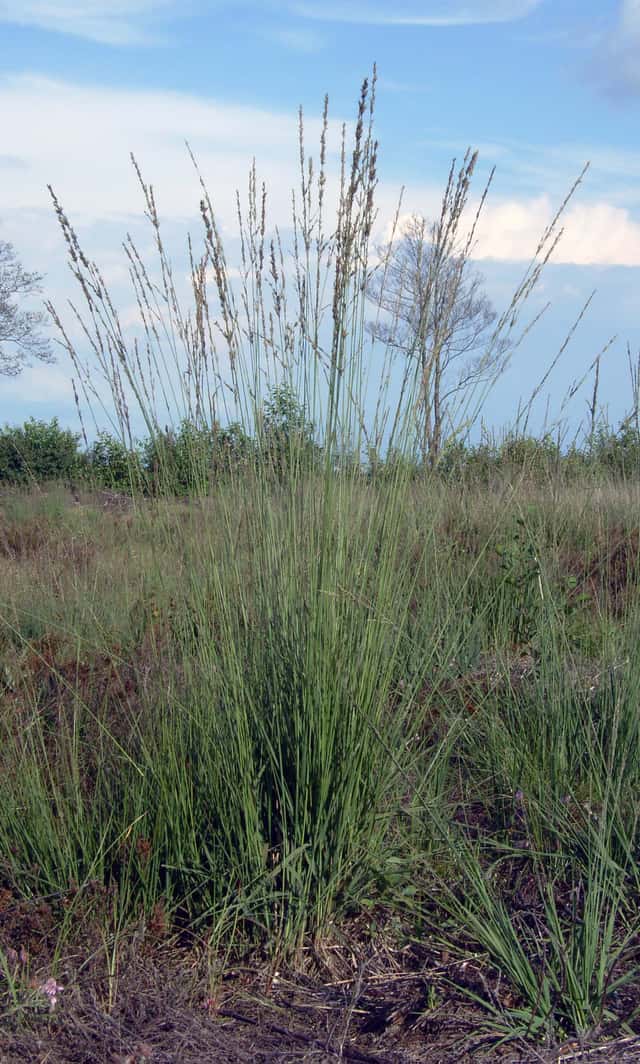
Purple moor grass (Molinia caerulea) is a deciduous, clump-forming grass from the genus Molinia, native to moist heaths, bogs, and woodland edges in Europe and Asia. The plant forms dense, upright clumps of narrow, light green leaves that turn golden yellow in autumn. From mid to late summer, slender, arching flower stalks emerge with dark purple to reddish-brown spikelets on yellowish stems, giving a light and transparent appearance in the garden bed.
How to Propagate Purple Moor Grass?
Division of clumps
Divide the clump in spring, just before new growth begins. Newly established divisions can be slow to establish – be patient.
- 1 Dig up a mature clump in early spring, before new leaves emerge
- 2 Divide the clump into smaller sections with a sharp spade or two forks back-to-back, each with healthy roots and shoots
- 3 Replant the divisions at the same depth in improved, moist soil
- 4 Water thoroughly after planting and keep consistently moist until the plant is established
Materials needed:
Seed propagation
Seeds germinate unevenly and can take a long time. Division is preferred for named varieties.
- 1 Sow seeds in pots with moist seed compost in early spring
- 2 Place in a warm, bright environment; germination can take about a month
- 3 If nothing germinates, cold stratify the pot for 4-6 weeks and then move back to warmth
- 4 Prick out seedlings when they are large enough to handle
Materials needed:
How Big Does Purple Moor Grass Grow?
TLDR: Purple Moor Grass can reach up to 1.2m tall with Slow growth rate.
Max height
1.2m
Spread
60cm
Growth rate
Slow
Foliage
Deciduous
Plant Uses
Ornamental
Great for decoration
Ground Cover
Soil coverage
Is your plant showing symptoms?
Click on the symptom to discover possible causes:
What Diseases Commonly Affect Purple Moor Grass?
TLDR: Purple Moor Grass is susceptible to 3 known diseases. Monitor regularly for early detection.
Rust
Rust is a common fungal disease caused by fungi in the order Pucciniales that affects a wide variety of plants. The disease gets its name from the characteristic orange, yellow, or reddish-brown pustules that appear on leaves, resembling metal rust. This obligate fungal parasite requires living plants to survive and can cause significant economic losses in agricultural crops.
Leaf Spot
Leaf spot is a common fungal disease caused by various pathogens including Alternaria, Ascochyta, Colletotrichum, Septoria, and Venturia. It primarily affects leaves, causing discolored spots that can lead to premature leaf drop if left untreated.
Anthracnose
Anthracnose is a fungal disease caused by fungi in the genus Colletotrichum that affects many plants, including vegetables, fruits, and trees. The disease thrives in cool, wet conditions, causing dark, sunken lesions on leaves, stems, flowers, and fruits.
Meaning & Symbolism
As a native heath and bog plant, purple moor grass often symbolizes the wild and unspoiled nature of Northern European wetlands, as well as resilience to harsh growing conditions.
Compare with similar plants
| Attribute | Difficulty | Light | Watering | Pet Safe |
|---|---|---|---|---|
| Field Maple | Easy | Bright indirect | 14d | ✓ |
| Muriel's Bamboo | Medium | Partial shade | 3d | ✓ |
| Silver Birch | Easy | Direct sun | 14d | ✓ |
| Common Blanketflower | Easy | Direct sun | 10d | ✓ |





