Poaceae
Purple pampas grass (Cortaderia jubata)
Cortaderia jubata
It looks after itself in mild, moist climates on sandy soil in full sun, but does not tolerate hard frost, intense heat or long drought. Because it is invasive in many regions, planting it is not recommended; where it already grows, cut and bag the plumes before they shed seed (late summer) and pull new seedlings. Wear gloves and long sleeves: the leaves cut.
Every 7 days
Bright indirect
° - °C
% - %
Categories
What is Purple pampas grass?
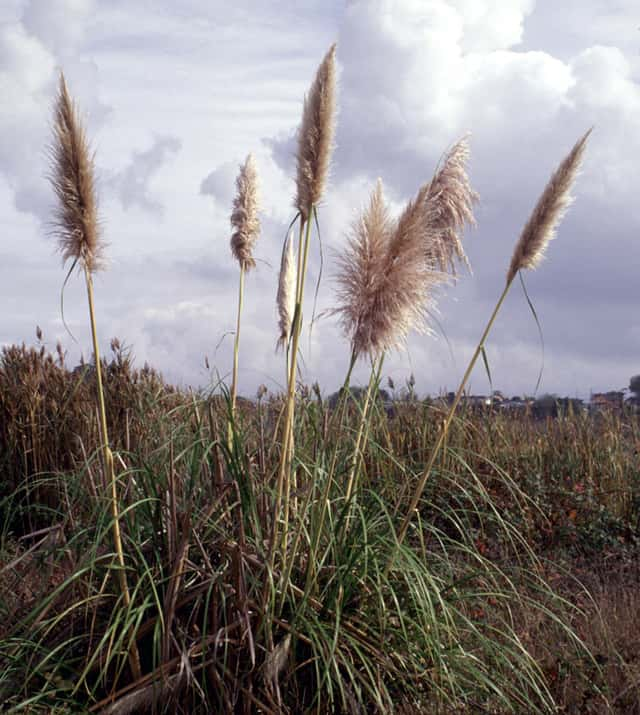
Purple pampas grass (Cortaderia jubata) is a easy-care plant from the Poaceae family. Cortaderia jubata is a giant perennial grass from the Andes (Ecuador, Peru, Bolivia, Chile and northern Argentina), related to pampas grass (C. selloana). It forms tussocks of long, narrow leaves up to 2 m, with edges sharp enough to cut skin and densely hairy sheaths. From late summer into fall it...
Purple pampas grass grows up to 4.0m, watering every 7 days. It is not suitable for indoor environments and safe for pets.
Unlike many tropical plants, Purple pampas grass tolerates watering mistakes. Best for beginners. Unlike many popular species, Purple pampas grass is safe to keep around pets.
How to Care for Purple pampas grass?
TLDR: Purple pampas grass needs Bright indirect, watering every 7 days, and temperatures between 15-30°C with 40-70% humidity.
How Often Should You Water Purple pampas grass?
Prefers soil that stays slightly moist, as on fog-influenced coasts. Established plants need water only in dry spells, about once a week; long drought and heat stress them.
How Much Light Does Purple pampas grass Need?
Full sun or partial sun. In deep shade it grows less and flowers poorly; seeds also germinate far better in light.
What Is the Best Soil for Purple pampas grass?
Typically grows in sandy, free-draining soil but adapts to other types, including poor soils and disturbed ground such as cliffs, road cuts and landslides.
What Is Purple pampas grass and Where Does It Come From?
Cortaderia jubata is a giant perennial grass from the Andes (Ecuador, Peru, Bolivia, Chile and northern Argentina), related to pampas grass (C. selloana). It forms tussocks of long, narrow leaves up to 2 m, with edges sharp enough to cut skin and densely hairy sheaths. From late summer into fall it sends up stiff stems 2 to 4 m tall (occasionally up to 7 m) topped by plumes that open deep violet, turn pink and mature creamy white. All plants are female and set seed without pollination (apomixis): one plant can release close to a million wind-borne seeds. That is why it has become invasive on the California coast and in New Zealand, Australia and South Africa, and why sale and planting have been banned in the European Union since 2019.
How to Propagate Purple pampas grass?
Clump division
Only do this where the species is allowed. Clump fragments left on moist soil resprout, so bag debris when clearing an area.
- 1 Wearing heavy gloves, cut the leaves back to about 30 cm
- 2 Split off a rooted section of the clump with a spade or mattock
- 3 Replant and keep the soil moist until established
Materials needed:
Seed
Seeds are clones of the mother plant and germinate better in light. In the field they survive less than 6 months.
- 1 Scatter seed on moist mix without covering
- 2 Keep in a bright, humid place
- 3 Pot on once seedlings reach 10 cm
Materials needed:
How Big Does Purple pampas grass Grow?
TLDR: Purple pampas grass can reach up to 4.0m tall with Fast growth rate.
Max height
4.0m
Growth rate
Fast
Foliage
Evergreen
Plant Uses
Ornamental
Great for decoration
Is your plant showing symptoms?
Click on the symptom to discover possible causes:
What Diseases Commonly Affect Purple pampas grass?
TLDR: Purple pampas grass is susceptible to 1 known diseases. Monitor regularly for early detection.
Fun Facts
Every plant is female and sets seed without pollination, so each seedling is a clone of its mother
The invasive California population seems to trace back to a single genotype from Ecuador
It entered the plant trade through France around 1876
Frequently asked questions
How do I tell it from regular pampas grass?
Can I plant it in my garden?
How do I get rid of it?
Is it toxic to dogs and cats?
Compare with similar plants
| Attribute | Difficulty | Light | Watering | Pet Safe |
|---|---|---|---|---|
| Field Maple | Easy | Bright indirect | 14d | ✓ |
| Muriel's Bamboo | Medium | Partial shade | 3d | ✓ |
| Iberian Houseleek | Easy | Direct sun | 14d | ✓ |
| Silver Birch | Easy | Direct sun | 14d | ✓ |
Choose & Compare
Sources & References
- Wikipedia — Cortaderia jubata
- Washington State Noxious Weed Control Board — Written findings: Cortaderia jubata
- Cal-IPC — Cortaderia jubata plant profile
- Invasive Species Ireland — Purple pampas grass
- NZ Plant Conservation Network — Cortaderia jubata
- ASPCA — Pampas grass (Cortaderia selloana), non-toxic
- RHS — Cortaderia selloana (genus generally pest- and disease-free)





