Zingiberaceae
Purple Roscoea: Edible Plant
Roscoea purpurea
Roscoea purpurea thrives best in dappled partial shade in moist but well-drained, humus-rich soil. During the growing season from spring to autumn, it requires regular watering as it does not tolerate drought well; conversely, waterlogging is the most common cause of death in winter, so the soil should be kept relatively dry during dormancy. This hardy plant can withstand frosts down to about 5°F (-15°C) or lower, provided the rhizomes are planted sufficiently deep and protected with a layer of mulch.
Every 6 days
Partial shade
-15° - 28°C
55% - 85%
Categories
What is Purple Roscoea?
Purple Roscoea (Roscoea purpurea) is a medium-care plant from the Zingiberaceae family. The Purple Roscoea (Roscoea purpurea) is a herbaceous perennial plant from the ginger family (Zingiberaceae), native to the high altitudes of the Himalayas—primarily Nepal and Northern India—where it grows in alpine meadows, rocky outcrops, terraces, and forest edges. In early summer, it sprouts bro...
Purple Roscoea grows up to 45cm, spread of 30cm, watering every 6 days, -15°C – 28°C, 55–85% humidity. It is not suitable for indoor environments and safe for pets.
Unlike many popular species, Purple Roscoea is safe to keep around pets.
How to Care for Purple Roscoea?
TLDR: Purple Roscoea needs Partial shade, watering every 6 days, and temperatures between -15-28°C with 55-85% humidity.
How Often Should You Water Purple Roscoea?
Keep the soil consistently moist but never waterlogged during the growing season—water deeply about once a week so that moisture reaches the root zone. After the foliage dies back in autumn, significantly reduce watering, as excess winter moisture quickly leads to rhizome rot.
How Much Light Does Purple Roscoea Need?
A location in partial shade, such as under light tree canopy or an east-facing spot, most closely mimics its natural conditions. If the soil is kept consistently moist, the plant can tolerate sunnier locations, though harsh midday sun should be avoided.
What Is the Best Soil for Purple Roscoea?
A loose, humus-rich substrate consisting of sandy to loamy soil with a slightly acidic to neutral pH of 5.5 to 6.5 is ideal. A layer of compost or leaf mulch improves water retention, while good drainage prevents waterlogging in winter.
What Pot Should You Use for Purple Roscoea?
When grown in containers, a deep pot with generous drainage holes is suitable, as the rhizomes require depth to grow and standing water must be strictly avoided. Unglazed terracotta pots are advantageous as they allow excess moisture to evaporate through the walls.
Care Schedule
Fertilize
Every 30 days
Repot
Every 730 days
What Is Purple Roscoea and Where Does It Come From?
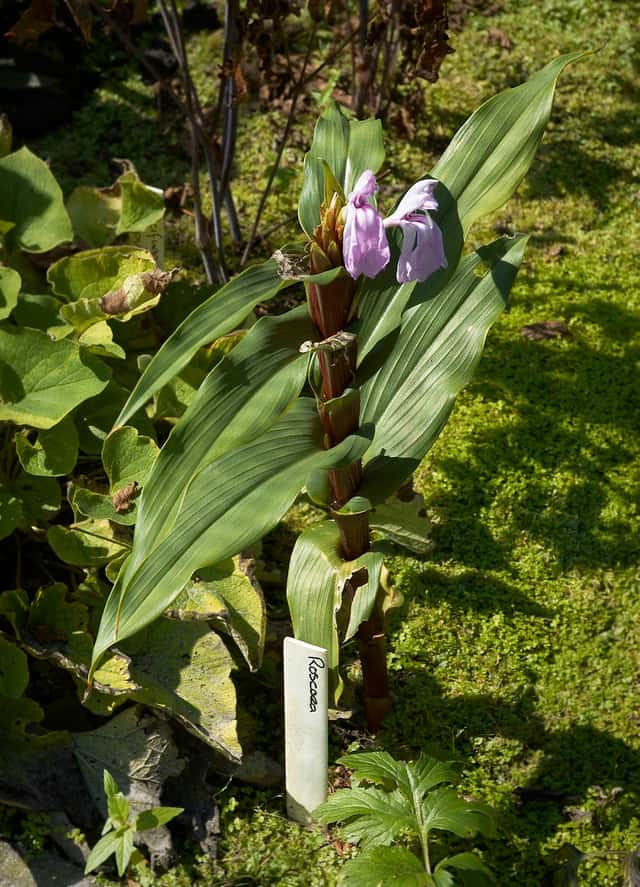
The Purple Roscoea (Roscoea purpurea) is a herbaceous perennial plant from the ginger family (Zingiberaceae), native to the high altitudes of the Himalayas—primarily Nepal and Northern India—where it grows in alpine meadows, rocky outcrops, terraces, and forest edges. In early summer, it sprouts broad, orchid-like leaves and a fleshy pseudostem from a short, vertical rhizome, reaching heights of 12 to 20 inches (30 to 50 cm). From summer to early autumn, large purple to mauve flowers appear with a three-part corolla and a prominent lip, resembling tropical orchids and giving rise to the common name 'Ginger Orchid.' As a geophyte, the plant goes completely dormant in winter, surviving the cold season underground within its rhizome.
How to Propagate Purple Roscoea?
Rhizome Division
The fastest method to obtain flowering-sized plants; best performed in early spring before growth starts or in autumn after the leaves have died back.
- 1 Carefully dig up the rhizome clump in early spring or autumn
- 2 Divide the rhizome with a sharp, clean knife into pieces containing at least one growth bud
- 3 Plant the sections immediately about 4-6 inches (10-15 cm) deep in humus-rich, well-drained soil
Materials needed:
Sowing Seeds
A slower method; seedlings usually require several years to reach their first flowering.
- 1 Collect ripe seeds in autumn or sow in spring
- 2 Sow seeds shallowly in moist, well-drained seed-starting mix and cover lightly with soil
- 3 Keep consistently moist at 60-68°F (15-20°C) until seedlings appear
Materials needed:
How Big Does Purple Roscoea Grow?
TLDR: Purple Roscoea can reach up to 45cm tall with Medium growth rate.
Max height
45cm
Spread
30cm
Growth rate
Medium
Foliage
Deciduous
Plant Uses
Ornamental
Great for decoration
Medicinal
Medicinal properties
Edible
Can be consumed
Medicinal Uses
- In traditional Ayurvedic medicine, the rhizomes belong to the Astavarga group of plants and are considered a strengthening, rejuvenating tonic.
- In folk medicine, the rhizomes are used to treat diabetes, diarrhea, dysentery, and malaria.
- In Northern India, a tonic is traditionally prepared from the tubers to treat urinary tract infections.
- The tubers contain polyphenolic compounds such as kaempferol and ferulic acid with proven antioxidant effects.
Culinary Uses
- In Nepal, the rhizomes are traditionally boiled and consumed as a vegetable.
- The starch- and fiber-rich tubers provide a nutritious food source in rural Himalayan regions.
Is your plant showing symptoms?
Click on the symptom to discover possible causes:
What Diseases Commonly Affect Purple Roscoea?
TLDR: Purple Roscoea is susceptible to 3 known diseases. Monitor regularly for early detection.
Slugs and Snails
Slugs and snails are mollusks that feed on plant tissue, causing irregular holes in leaves and damage to young seedlings. They are most active at night and in moist conditions, leaving characteristic silvery slime trails. These pests can quickly devastate gardens, especially during wet seasons.
Root Rot
Root rot is a serious fungal disease that affects the root system of plants, causing them to decay and die. It is primarily caused by overwatering, poor drainage, or soil-borne fungi such as Pythium, Phytophthora, Rhizoctonia, and Fusarium. The disease thrives in waterlogged conditions where roots are deprived of oxygen, making them susceptible to fungal infection.
Mosaic Virus
Mosaic virus is a group of plant viruses that cause mottled, patchy patterns on leaves and can affect a wide variety of plants. The virus creates characteristic yellow, white, and green mosaic patterns, often accompanied by stunted growth and deformed plant parts. This highly contagious disease spreads rapidly through insect vectors and contaminated tools.
Meaning & Symbolism
Because the Purple Roscoea retreats completely each year only to sprout again from its hidden rhizome the following summer, it is occasionally interpreted in gardening circles as a symbol of resilience, renewal, and hidden beauty that survives even the harshest winters.
Compare with similar plants
| Attribute | Difficulty | Light | Watering | Pet Safe |
|---|---|---|---|---|
| Dark Fieldcap | Medium | Low light | 2d | ⚠️ |
| Azalea | Medium | Partial shade | 3d | ⚠️ |
| Muriel's Bamboo | Medium | Partial shade | 3d | ✓ |
| Bougainvillea | Medium | Direct sun | 7d | ⚠️ |




