Marantaceae
Red Prayer Plant (Maranta leuconeura var. erythroneura)
Maranta leuconeura var. erythroneura
Thrives in medium to bright indirect light, consistently moist (never soggy) soil, and humidity above 50%. Sensitive to chlorinated tap water and dry air, both of which cause crispy brown leaf tips.
Every 7 days
Partial shade
15° - 27°C
50% - 70%
Categories
What is Red Prayer Plant?
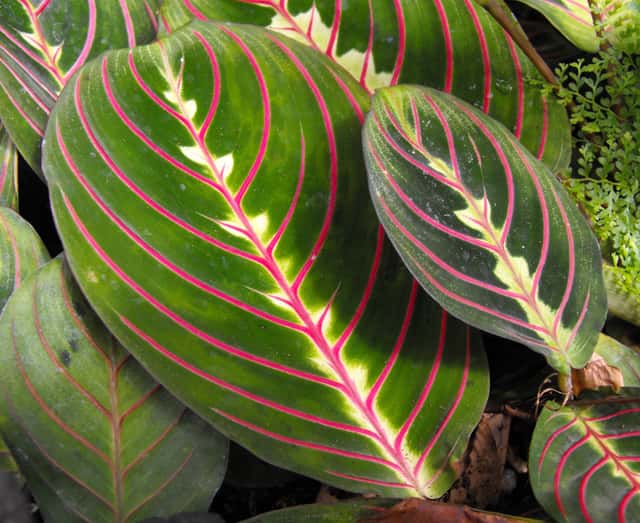
Red Prayer Plant (Maranta leuconeura var. erythroneura) is a medium-care plant from the Marantaceae family. The Red Prayer Plant (Maranta leuconeura var. erythroneura) is one of the most striking members of the Marantaceae family, native to the tropical rainforests of Brazil. Its deep green, herringbone-patterned leaves are laced with vivid red veins, making it a true living work of art. The nickname "pra...
Red Prayer Plant grows up to 30cm, spread of 60cm, watering every 7 days, 15°C – 27°C, 50–70% humidity. It is suitable for indoor environments and safe for pets.
Unlike many popular species, Red Prayer Plant is safe to keep around pets. Without adequate drainage, root rot can develop within 14 days.
How to Care for Red Prayer Plant?
TLDR: Red Prayer Plant needs Partial shade, watering every 7 days, and temperatures between 15-27°C with 50-70% humidity.
How Often Should You Water Red Prayer Plant?
Water when the top 2-3 cm of soil feels dry, roughly every 7 days. Use filtered or overnight-rested water to avoid chlorine and fluoride buildup, which can scorch the leaves.
How Much Light Does Red Prayer Plant Need?
Place in medium to bright indirect light, such as near a sheer-curtained window or a few feet back from a sunny window. Direct sun scorches and fades the colorful foliage.
What Is the Best Soil for Red Prayer Plant?
Use a light, well-draining, organically rich mix based on coco coir, perlite, and pine bark. Avoid compacted soils that hold excess water around the roots.
What Pot Should You Use for Red Prayer Plant?
Ceramic or plastic pots with generous drainage holes work best; avoid highly porous terracotta, which dries out too quickly for a plant that likes consistent moisture.
Care Schedule
Fertilize
Every 30 days
Misting
Every 7 days
Repot
Every 1095 days
What Is Red Prayer Plant and Where Does It Come From?
The Red Prayer Plant (Maranta leuconeura var. erythroneura) is one of the most striking members of the Marantaceae family, native to the tropical rainforests of Brazil. Its deep green, herringbone-patterned leaves are laced with vivid red veins, making it a true living work of art. The nickname "prayer plant" comes from its daily leaf movement: the leaves open flat during the day to capture light and fold upward at night like praying hands, a phenomenon called nyctinasty.
How to Propagate Red Prayer Plant?
Stem cutting
Change the water every 3-4 days if propagating in water. A rooting hormone can speed up the process.
- 1 Cut a healthy stem just below a node, keeping at least one leaf
- 2 Remove the leaves closest to the base of the cutting
- 3 Place the cutting in filtered water or a light, moist potting mix
- 4 Keep in bright indirect light with high humidity until roots form
- 5 Transplant into a permanent pot once roots reach 2-3 cm
Materials needed:
Rhizome division
Only divide mature, well-established plants with multiple visible clumps.
- 1 Remove the plant from its pot and shake off excess soil from the roots
- 2 Locate natural divisions in the rhizome, each with its own leaves and roots
- 3 Carefully separate the sections by hand or with a clean knife
- 4 Replant each division into a pot with light, well-draining soil
- 5 Water thoroughly and keep in indirect light until established
Materials needed:
How Big Does Red Prayer Plant Grow?
TLDR: Red Prayer Plant can reach up to 30cm tall with Medium growth rate.
Max height
30cm
Spread
60cm
Growth rate
Medium
Foliage
Evergreen
Plant Uses
Ornamental
Great for decoration
Is your plant showing symptoms?
Click on the symptom to discover possible causes:
What Diseases Commonly Affect Red Prayer Plant?
TLDR: Red Prayer Plant is susceptible to 9 known diseases. Monitor regularly for early detection.
Spider Mites
Spider mites are tiny arachnids (less than 1/20 inch long) related to spiders and ticks that feed on plant sap. They thrive in hot, dry conditions and can cause significant damage to ornamental and vegetable plants. During severe infestations, crop losses can reach 14% or higher as these pests disrupt vital plant processes including photosynthesis, carbon dioxide absorption, and transpiration.
Root Rot
Root rot is a serious fungal disease that affects the root system of plants, causing them to decay and die. It is primarily caused by overwatering, poor drainage, or soil-borne fungi such as Pythium, Phytophthora, Rhizoctonia, and Fusarium. The disease thrives in waterlogged conditions where roots are deprived of oxygen, making them susceptible to fungal infection.
Leaf Spot
Leaf spot is a common fungal disease caused by various pathogens including Alternaria, Ascochyta, Colletotrichum, Septoria, and Venturia. It primarily affects leaves, causing discolored spots that can lead to premature leaf drop if left untreated.
Bacterial Leaf Spot
Bacterial leaf spot is a plant disease caused by bacteria in the Xanthomonas and Pseudomonas genera that affects various ornamental and edible plants. The bacteria infect leaves through wounds or natural openings, causing characteristic lesions that can lead to premature leaf drop and plant weakening.
Meaning & Symbolism
Because it folds its leaves like praying hands each night, the plant symbolizes faith, gratitude, and spiritual protection, and is often gifted as a wish for peace and good energy in the home.
Fun Facts
The leaves move throughout the day following an internal circadian rhythm, even under constant artificial light.
The common name "prayer plant" comes from the way the leaves rise up at night like hands folded in prayer.
It is native to the understory of Brazilian rainforests, where it grows in the dappled shade of taller trees.
Frequently asked questions
Why do Red Prayer Plant leaves close at night?
Is the Red Prayer Plant toxic to cats and dogs?
Why are the leaf tips turning brown?
How often should I fertilize a Red Prayer Plant?
Compare with similar plants
| Attribute | Difficulty | Light | Watering | Pet Safe |
|---|---|---|---|---|
| Dark Fieldcap | Medium | Low light | 2d | ⚠️ |
| Azalea | Medium | Partial shade | 3d | ⚠️ |
| Muriel's Bamboo | Medium | Partial shade | 3d | ✓ |
| Bougainvillea | Medium | Direct sun | 7d | ⚠️ |




