Amaryllidaceae
Resurrection lily: Perfect Plant for Beginners
Lycoris squamigera
Plant bulbs in well-draining, organically rich soil in full sun to part shade. Water regularly during the spring growth period, then let the soil dry out over summer dormancy before flower stalks emerge. Avoid overwatering, which encourages bulb rot.
Every 10 days
Bright indirect
-25° - 35°C
40% - 70%
Categories
What is Resurrection lily?
Resurrection lily (Lycoris squamigera) is a easy-care plant from the Amaryllidaceae family. Lycoris squamigera is a hardy bulb in the Amaryllidaceae family, prized for its surprising bloom cycle: strap-shaped, silvery-green leaves emerge in early spring, photosynthesize, and die back completely by early summer, leaving bare ground. Then, seemingly out of nowhere in late summer, leafless fl...
Resurrection lily grows up to 60cm, spread of 60cm, watering every 10 days, -25°C – 35°C, 40–70% humidity. It is not suitable for indoor environments and not safe for pets.
Unlike many tropical plants, Resurrection lily tolerates watering mistakes. Best for beginners. Without precautions, ingestion can cause irritation in pets. Keep out of reach of cats and dogs.
How to Care for Resurrection lily?
TLDR: Resurrection lily needs Bright indirect, watering every 10 days, and temperatures between -25-35°C with 40-70% humidity.
How Often Should You Water Resurrection lily?
Water deeply about once a week while leaves are actively growing in spring; reduce sharply once foliage yellows and dies back, then resume light watering when flower stalks appear.
How Much Light Does Resurrection lily Need?
Thrives in full sun to light part shade; at least 4-6 hours of direct sun encourages the best flowering.
What Is the Best Soil for Resurrection lily?
Needs loose, well-draining, organically rich soil with a neutral to slightly acidic pH; soggy soil quickly leads to bulb rot.
Care Schedule
Fertilize
Every 14 days
Misting
Every 3 days
Rotate
Every 7 days
Repot
Every 365 days
What Is Resurrection lily and Where Does It Come From?
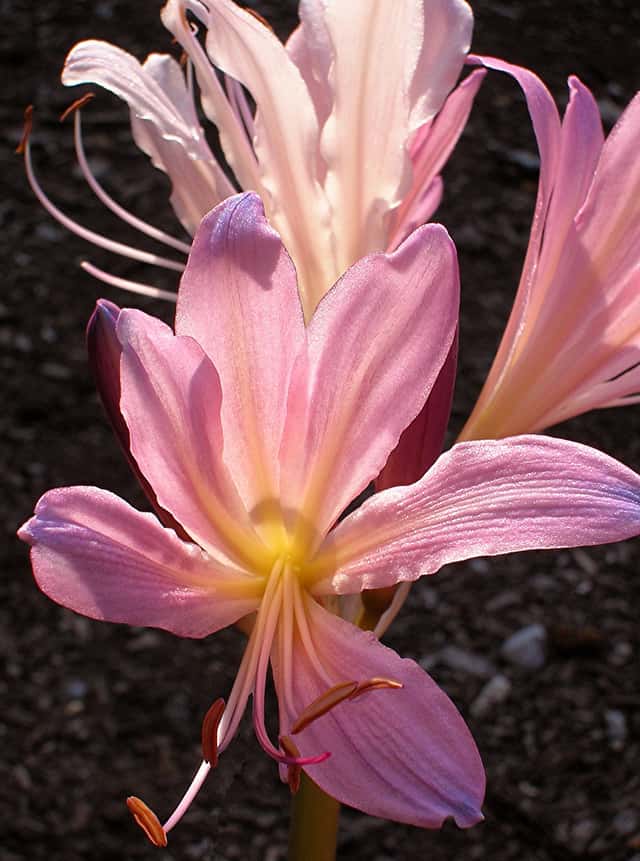
Lycoris squamigera is a hardy bulb in the Amaryllidaceae family, prized for its surprising bloom cycle: strap-shaped, silvery-green leaves emerge in early spring, photosynthesize, and die back completely by early summer, leaving bare ground. Then, seemingly out of nowhere in late summer, leafless flower stalks shoot up and open into clusters of fragrant, rose-pink, trumpet-shaped blooms. All parts of the plant contain lycorine alkaloids and should be kept away from children and pets.
How Big Does Resurrection lily Grow?
TLDR: Resurrection lily can reach up to 60cm tall with Medium growth rate.
Max height
60cm
Spread
60cm
Growth rate
Medium
Foliage
Deciduous
Warning: Toxic Plant
This plant can be toxic if ingested. Keep out of reach of:
Plant Uses
Ornamental
Great for decoration
Is your plant showing symptoms?
Click on the symptom to discover possible causes:
What Diseases Commonly Affect Resurrection lily?
TLDR: Resurrection lily is susceptible to 3 known diseases. Monitor regularly for early detection.
Root Rot
Root rot is a serious fungal disease that affects the root system of plants, causing them to decay and die. It is primarily caused by overwatering, poor drainage, or soil-borne fungi such as Pythium, Phytophthora, Rhizoctonia, and Fusarium. The disease thrives in waterlogged conditions where roots are deprived of oxygen, making them susceptible to fungal infection.
Aphids
Aphids are small, soft-bodied, pear-shaped insects (1/16 to 1/8 inch long) that feed by sucking nutrient-rich sap from plants. They reproduce rapidly and can quickly weaken plants, causing distorted growth and transmitting plant viruses. Aphids come in various colors including green, black, red, yellow, brown, and gray. They secrete honeydew, a sticky substance that attracts ants and encourages sooty mold growth.
Mosaic Virus
Mosaic virus is a group of plant viruses that cause mottled, patchy patterns on leaves and can affect a wide variety of plants. The virus creates characteristic yellow, white, and green mosaic patterns, often accompanied by stunted growth and deformed plant parts. This highly contagious disease spreads rapidly through insect vectors and contaminated tools.
Meaning & Symbolism
Known as the resurrection or surprise lily because leafless flower stalks suddenly appear in late summer after the spring foliage has long died back, symbolizing surprise, transformation, and reunion.
Compare with similar plants
| Attribute | Difficulty | Light | Watering | Pet Safe |
|---|---|---|---|---|
| Field Maple | Easy | Bright indirect | 14d | ✓ |
| Silver Birch | Easy | Direct sun | 14d | ✓ |
| Common Blanketflower | Easy | Direct sun | 10d | ✓ |
| Cushion Bush | Easy | Direct sun | 14d | ✓ |





