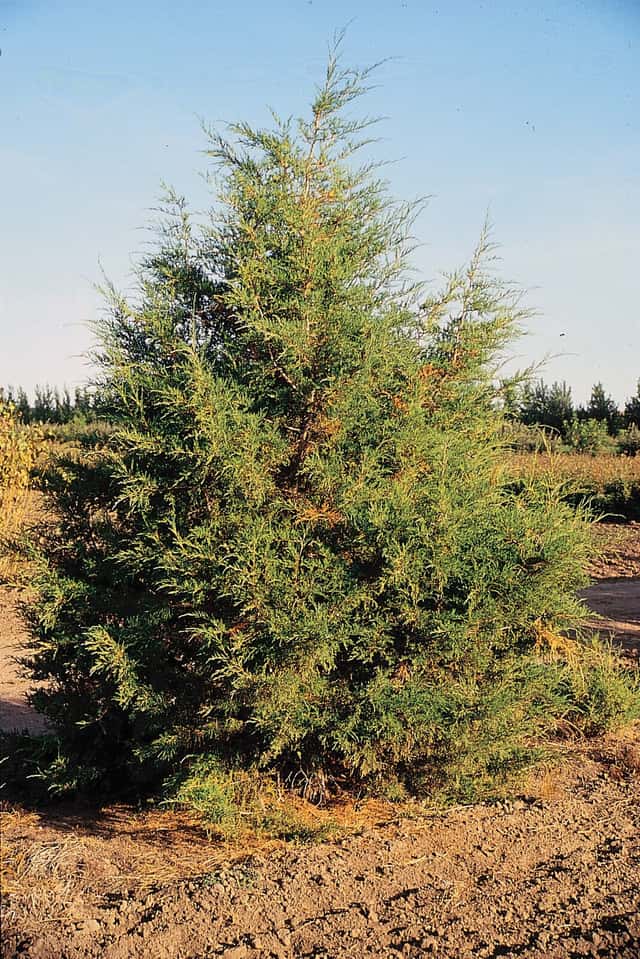
Cupressaceae
Rocky Mountain Juniper (Juniperus scopulorum) Care Guide
Juniperus scopulorum
Give this juniper full sun, well-draining soil, and infrequent deep watering. Once established it is highly drought-tolerant and needs little fuss beyond an annual shaping prune; its main enemies are soggy soil and high humidity, which invite root rot and twig blight.
Every 14 days
Direct sun
-37° - 35°C
30% - 60%
Categories
What is Rocky Mountain Juniper?
Rocky Mountain Juniper (Juniperus scopulorum) is a easy-care plant from the Cupressaceae family. The Rocky Mountain juniper (Juniperus scopulorum) is a slow-growing, cold-hardy evergreen conifer native to the mountains and foothills of western North America, from British Columbia and Alberta south through the Rockies to Arizona, New Mexico, and western Texas. Depending on the cultivar, it grows...
Rocky Mountain Juniper grows up to 12.0m, spread of 450cm, watering every 14 days, -37°C – 35°C, 30–60% humidity. It is not suitable for indoor environments and safe for pets.
Unlike many tropical plants, Rocky Mountain Juniper tolerates watering mistakes. Best for beginners. Unlike many popular species, Rocky Mountain Juniper is safe to keep around pets.
How to Care for Rocky Mountain Juniper?
TLDR: Rocky Mountain Juniper needs Direct sun, watering every 14 days, and temperatures between -37-35°C with 30-60% humidity.
How Often Should You Water Rocky Mountain Juniper?
Water deeply but infrequently, roughly every 2 weeks, letting the soil dry out between waterings. Young plants need more consistent moisture to establish; mature specimens are drought-tolerant and rarely need supplemental water except in extended dry spells.
How Much Light Does Rocky Mountain Juniper Need?
Provide full sun (6+ hours of direct light daily) for the densest, most compact growth and best blue-green color. It tolerates partial shade but foliage becomes sparser and less vibrant.
What Is the Best Soil for Rocky Mountain Juniper?
Plant in well-draining soil - sandy, rocky, or loamy - with a neutral to slightly alkaline pH (6.0-8.0). It tolerates poor, dry soils but cannot tolerate waterlogged or compacted ground.
What Pot Should You Use for Rocky Mountain Juniper?
Prefers open ground or a large, deep, heavy container with excellent drainage holes; unglazed terracotta helps wick excess moisture away from the roots.
What Is Rocky Mountain Juniper and Where Does It Come From?
The Rocky Mountain juniper (Juniperus scopulorum) is a slow-growing, cold-hardy evergreen conifer native to the mountains and foothills of western North America, from British Columbia and Alberta south through the Rockies to Arizona, New Mexico, and western Texas. Depending on the cultivar, it grows as a narrow columnar tree or a broad shrub, reaching 9-12 m (30-40 ft) tall in the wild, with scale-like, blue-green to silvery foliage and small, berry-like blue-grey cones. Exceptionally drought-, wind-, and cold-tolerant, it thrives in rocky, well-draining soils and is a popular choice for windbreaks, hedges, and xeriscape gardens across USDA zones 3a-7b.
How to Propagate Rocky Mountain Juniper?
Semi-hardwood cutting
Bottom heat and a humidity dome speed up rooting; be patient, junipers root slowly.
- 1 Take a 10-15 cm semi-hardwood cutting from a healthy side branch
- 2 Strip the needles from the lower third of the cutting
- 3 Dip the cut end in rooting hormone
- 4 Insert into a well-draining mix of sand and perlite
- 5 Keep in bright, indirect light with consistent light moisture until roots form
Materials needed:
Seed propagation
Seed propagation is slow and unpredictable; cuttings are more reliable for named cultivars.
- 1 Collect ripe blue-grey cones in fall
- 2 Remove and clean the seeds from the fleshy cone
- 3 Cold-stratify seeds in moist sand for 60-90 days in the refrigerator
- 4 Sow in well-draining seed mix and keep outdoors or in a cold frame
- 5 Germination can take a year or more; keep soil lightly moist
Materials needed:
How Big Does Rocky Mountain Juniper Grow?
TLDR: Rocky Mountain Juniper can reach up to 12.0m tall with Slow growth rate.
Max height
12.0m
Spread
4.5m
Growth rate
Slow
Foliage
Evergreen
Warning: Toxic Plant
This plant can be toxic if ingested. Keep out of reach of:
Plant Uses
Ornamental
Great for decoration
Aromatic
Pleasant fragrance
Is your plant showing symptoms?
Click on the symptom to discover possible causes:
What Diseases Commonly Affect Rocky Mountain Juniper?
TLDR: Rocky Mountain Juniper is susceptible to 6 known diseases. Monitor regularly for early detection.
Phytophthora Root Rot
Disease caused by fungus-like organisms (oomycetes) that live in soil and can survive for years. It affects roots, stem, and crown of plants, being especially severe in waterlogged or poorly drained soils. It is the second most common cause of root rot in trees and shrubs.
Rust
Rust is a common fungal disease caused by fungi in the order Pucciniales that affects a wide variety of plants. The disease gets its name from the characteristic orange, yellow, or reddish-brown pustules that appear on leaves, resembling metal rust. This obligate fungal parasite requires living plants to survive and can cause significant economic losses in agricultural crops.
Scale Insects
Scale insects are small sap-sucking pests that appear as brown, shell-like bumps on plant stems and leaves. There are over 25 species, divided into armored (hard) and unarmored (soft) scales. They feed by piercing plant tissue and extracting sap, which weakens the plant and can lead to yellowing, stunted growth, and even death if left untreated. They also excrete honeydew, which attracts ants and promotes sooty mold growth.
Spider Mites
Spider mites are tiny arachnids (less than 1/20 inch long) related to spiders and ticks that feed on plant sap. They thrive in hot, dry conditions and can cause significant damage to ornamental and vegetable plants. During severe infestations, crop losses can reach 14% or higher as these pests disrupt vital plant processes including photosynthesis, carbon dioxide absorption, and transpiration.
Meaning & Symbolism
In Western and Indigenous North American traditions, juniper is a symbol of protection, purification, and endurance - a hardy sentinel able to withstand harsh mountain winters and rocky, thin soils.
Fun Facts
Its wood is aromatic and rot-resistant, historically used for fence posts and furniture much like true cedar.
The species name scopulorum means of the rocks, referring to its native rocky mountain habitat.
Some columnar cultivars, like Skyrocket, are so narrow they are used as living exclamation points in landscaping.
It can live for several centuries in the wild, with some specimens estimated at over 300 years old.
Frequently asked questions
How much sun does a Rocky Mountain juniper need?
How often should I water Rocky Mountain juniper?
Is Rocky Mountain juniper toxic?
What diseases affect Rocky Mountain juniper?
How fast does Rocky Mountain juniper grow?
Compare with similar plants
| Attribute | Difficulty | Light | Watering | Pet Safe |
|---|---|---|---|---|
| Field Maple | Easy | Bright indirect | 14d | ✓ |
| Silver Birch | Easy | Direct sun | 14d | ✓ |
| Common Blanketflower | Easy | Direct sun | 10d | ✓ |
| Cushion Bush | Easy | Direct sun | 14d | ✓ |





