Onagraceae
Royal Fuchsia (Fuchsia regia)
Fuchsia regia
Give it part shade, a cool spot and fertile soil that stays moist but drains well. It takes light frost (to about −10 °C, losing its leaves). Prune once a year after flowering, and give it support if you want it to climb. Hot, dry conditions and strong afternoon sun harm it.
Every 3 days
Partial shade
-10° - °C
% - %
Categories
What is Royal fuchsia?
Royal fuchsia (Fuchsia regia) is a medium-care plant from the Onagraceae family. Fuchsia regia is a fuchsia native only to southeastern and southern Brazil (from Bahia to northern Rio Grande do Sul). It grows in high-altitude Atlantic Forest near streams, in a cool, rainy climate. It can be a shrub 1.5 to 5 m tall or climb into trees as a vine. Its slender branches are wine-purp...
Royal fuchsia grows up to 3.0m, spread of 100cm, watering every 3 days. It is not suitable for indoor environments and safe for pets.
Unlike many popular species, Royal fuchsia is safe to keep around pets.
How to Care for Royal fuchsia?
TLDR: Royal fuchsia needs Partial shade, watering every 3 days, and temperatures between -10-30°C with 40-70% humidity.
How Often Should You Water Royal fuchsia?
Keep the soil moist but not soggy: in hot weather, water every 2 or 3 days. Water less in winter and never leave the roots in standing water.
How Much Light Does Royal fuchsia Need?
Part shade or morning sun. In the wild it lives in forest shade; strong afternoon sun scorches the leaves, especially in hot climates.
What Is the Best Soil for Royal fuchsia?
Fertile, humus-rich, well-drained soil, slightly acid to neutral. A little grit in the planting hole helps prevent winter waterlogging.
What Pot Should You Use for Royal fuchsia?
A large pot with drainage holes, or a hanging basket that shows off the arching branches. Use a rich mix and never let it dry out.
What Is Royal fuchsia and Where Does It Come From?
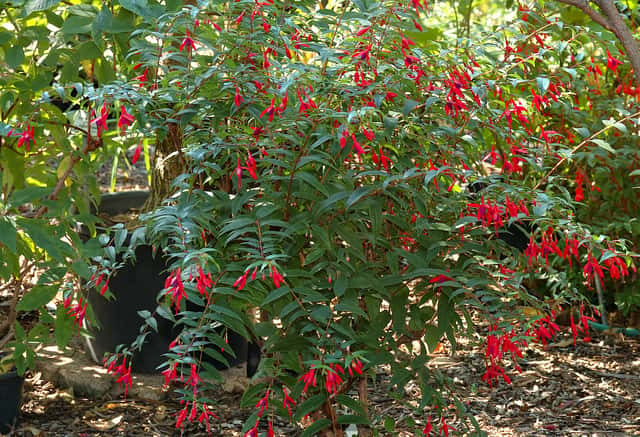
Fuchsia regia is a fuchsia native only to southeastern and southern Brazil (from Bahia to northern Rio Grande do Sul). It grows in high-altitude Atlantic Forest near streams, in a cool, rainy climate. It can be a shrub 1.5 to 5 m tall or climb into trees as a vine. Its slender branches are wine-purple and arching, and the lance-shaped leaves have reddish stalks. The flowers hang like earrings, with a red tube and sepals and purple petals, and attract hummingbirds. Dark purple berries follow.
How to Propagate Royal fuchsia?
Stem cutting
In a trial with 7-21 cm cuttings, almost all rooted within 40 days; 14 cm cuttings made the most roots.
- 1 In the morning, cut a 10-15 cm semi-ripe cutting
- 2 Keep only one pair of leaves at the tip and cut the base at an angle
- 3 Insert about 3 cm deep in fine vermiculite or a light, moist mix
- 4 Keep humid and shaded until roots form
Materials needed:
Seed
Cuttings are much faster and give plants identical to the parent.
- 1 Take seeds from ripe berries and rinse them
- 2 Sow on the surface of a fine, moist mix
- 3 Keep moist in bright light without direct sun
Materials needed:
How Big Does Royal fuchsia Grow?
TLDR: Royal fuchsia can reach up to 3.0m tall with Fast growth rate.
Max height
3.0m
Spread
1.0m
Growth rate
Fast
Foliage
Semi-evergreen
Plant Uses
Ornamental
Great for decoration
Is your plant showing symptoms?
Click on the symptom to discover possible causes:
What Diseases Commonly Affect Royal fuchsia?
TLDR: Royal fuchsia is susceptible to 7 known diseases. Monitor regularly for early detection.
Aphids
Aphids are small, soft-bodied, pear-shaped insects (1/16 to 1/8 inch long) that feed by sucking nutrient-rich sap from plants. They reproduce rapidly and can quickly weaken plants, causing distorted growth and transmitting plant viruses. Aphids come in various colors including green, black, red, yellow, brown, and gray. They secrete honeydew, a sticky substance that attracts ants and encourages sooty mold growth.
Fuchsia gall mite
The Fuchsia gall mite is a microscopic pest that causes severe distortion of the plant's growth. It feeds on the sap of new shoots, injecting chemicals that cause the plant to produce abnormal, hairy, and swollen galls instead of healthy leaves and flowers. If left untreated, it can completely stop the plant from blooming and eventually kill it.
Spider Mites
Spider mites are tiny arachnids (less than 1/20 inch long) related to spiders and ticks that feed on plant sap. They thrive in hot, dry conditions and can cause significant damage to ornamental and vegetable plants. During severe infestations, crop losses can reach 14% or higher as these pests disrupt vital plant processes including photosynthesis, carbon dioxide absorption, and transpiration.
Curculionidae
Curculionidae (weevils) are small beetles that feed on plants. Adults chew leaf margins, leaving crescent-shaped notches, primarily at night. The larvae live in the substrate and consume roots, causing decline, yellowing, and wilting even when the substrate is moist, and in severe cases, plant death. They frequently affect ornamentals and garden plants such as strawberries, citrus, roses, hydrangeas, azaleas, blueberries, begonias, and many potted plants.
Fun Facts
It is one of the few fuchsias native to Brazil and grows only in the southeast and south.
In the forest it can climb trees as a vine and reach 15 m.
Its flowers attract hummingbirds.
Frequently asked questions
Can royal fuchsia take full sun?
Is it frost hardy?
When should I prune it?
Is it toxic to pets?
Compare with similar plants
| Attribute | Difficulty | Light | Watering | Pet Safe |
|---|---|---|---|---|
| Dark Fieldcap | Medium | Low light | 2d | ⚠️ |
| Azalea | Medium | Partial shade | 3d | ⚠️ |
| Muriel's Bamboo | Medium | Partial shade | 3d | ✓ |
| Bougainvillea | Medium | Direct sun | 7d | ⚠️ |