Salicaceae
Dappled Willow (Salix integra) Care Guide
Salix integra
Give dappled willow full sun to light afternoon shade, keep the soil consistently moist, and prune hard in late winter to promote the brightest new variegated growth. It tolerates wet or clay soils better than most shrubs but still benefits from good drainage overall.
Every 7 days
Bright indirect
-25° - 32°C
40% - 70%
Categories
What is Dappled Willow?
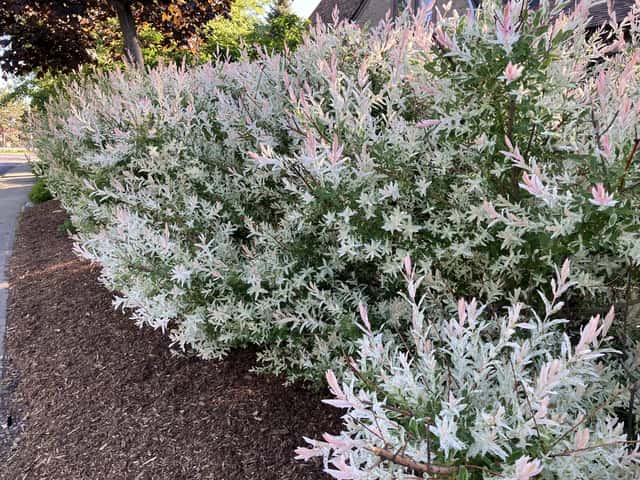
Dappled Willow (Salix integra) is a medium-care plant from the Salicaceae family. Salix integra is a deciduous shrub in the willow family (Salicaceae), grown mainly for its ornamental foliage rather than its inconspicuous yellow catkins. The widely planted cultivar 'Hakuro-nishiki' (dappled willow) produces slender, lance-shaped leaves splashed with pink, cream and green when the...
Dappled Willow grows up to 2.5m, spread of 215cm, watering every 7 days, -25°C – 32°C, 40–70% humidity. It is not suitable for indoor environments and safe for pets.
Unlike many popular species, Dappled Willow is safe to keep around pets.
How to Care for Dappled Willow?
TLDR: Dappled Willow needs Bright indirect, watering every 7 days, and temperatures between -25-32°C with 40-70% humidity.
How Often Should You Water Dappled Willow?
Water generously and keep soil evenly moist, especially in the first couple of growing seasons; established plants usually do well with about one deep watering per week, adjusted upward during hot or dry spells.
How Much Light Does Dappled Willow Need?
Plant in full sun for the brightest pink and white variegation; in hot summer climates, a bit of afternoon shade helps prevent leaf scorch on the white portions of the leaves.
What Is the Best Soil for Dappled Willow?
Best in moist, fertile, well-drained soil rich in organic matter, but unusually tolerant of heavier clay and periodically wet soil compared to most ornamental shrubs.
What Pot Should You Use for Dappled Willow?
If grown in a container, use a large, sturdy pot with generous drainage holes and a moisture-retentive but well-draining potting mix, since this fast grower and thirsty rooter quickly fills small containers.
What Is Dappled Willow and Where Does It Come From?
Salix integra is a deciduous shrub in the willow family (Salicaceae), grown mainly for its ornamental foliage rather than its inconspicuous yellow catkins. The widely planted cultivar 'Hakuro-nishiki' (dappled willow) produces slender, lance-shaped leaves splashed with pink, cream and green when they emerge, maturing to green by summer and turning gold in fall. It is fast-growing, cold-hardy, and adaptable to a range of soils, including damp or heavier ground where many other ornamentals struggle.
How to Propagate Dappled Willow?
Stem Cutting
Willows root so readily that cuttings can simply be placed in a jar of water until roots appear, then potted up.
- 1 Select a healthy, disease-free branch with new growth.
- 2 Take a 4-6 inch (10-15 cm) cutting with at least two leaf nodes.
- 3 Remove the leaves from the lower third of the cutting.
- 4 Insert the cutting into moist sand, perlite, or a well-draining potting mix (rooting hormone is optional since willows produce natural rooting compounds).
- 5 Keep the medium consistently moist and place in bright, indirect light until roots form.
- 6 Transplant once a healthy root system develops, usually within a few weeks.
Materials needed:
Water Propagation
A very reliable method for willows; roots usually appear within 1-2 weeks.
- 1 Cut a healthy 4-6 inch (10-15 cm) cutting from recent growth.
- 2 Remove the leaves from the lower third.
- 3 Place the cutting in a jar of clean water, keeping at least one node submerged.
- 4 Change the water every few days and keep in bright, indirect light.
- 5 Transplant to soil once roots are a few centimeters long.
Materials needed:
How Big Does Dappled Willow Grow?
TLDR: Dappled Willow can reach up to 2.5m tall with Fast growth rate.
Max height
2.5m
Spread
2.1m
Growth rate
Fast
Foliage
Deciduous
Plant Uses
Ornamental
Great for decoration
Medicinal Uses
- Bark historically used as a traditional source of salicin, a natural precursor to aspirin
Is your plant showing symptoms?
Click on the symptom to discover possible causes:
What Diseases Commonly Affect Dappled Willow?
TLDR: Dappled Willow is susceptible to 9 known diseases. Monitor regularly for early detection.
Crown Gall
Crown gall is a bacterial disease caused by Agrobacterium tumefaciens that affects over 140 species of plants. The bacteria insert DNA into plant cells, causing them to divide uncontrollably and form large tumor-like growths (galls) primarily on roots, stems, and at the soil line. These galls restrict water and nutrient flow, severely impacting plant health and potentially killing the plant.
Powdery Mildew
Powdery mildew is a common fungal disease caused by various fungi species including Erysiphe, Podosphaera, Oïdium, and Leveillula. It affects over 10,000 plant species worldwide. The disease thrives in warm, dry climates with high humidity and appears as a distinctive white powdery coating on plant surfaces.
Leaf Spot
Leaf spot is a common fungal disease caused by various pathogens including Alternaria, Ascochyta, Colletotrichum, Septoria, and Venturia. It primarily affects leaves, causing discolored spots that can lead to premature leaf drop if left untreated.
Rust
Rust is a common fungal disease caused by fungi in the order Pucciniales that affects a wide variety of plants. The disease gets its name from the characteristic orange, yellow, or reddish-brown pustules that appear on leaves, resembling metal rust. This obligate fungal parasite requires living plants to survive and can cause significant economic losses in agricultural crops.
Meaning & Symbolism
Willows are traditional symbols of flexibility, resilience and healing, bending in storms without breaking; the dappled willow's soft pink-and-white foliage adds an association with gentleness and renewal.
Fun Facts
The pink and white coloring is most vivid on new spring growth and fades to green as leaves mature.
Dappled willow roots so easily that cuttings will sprout in a plain glass of water.
It's commonly grafted onto hardier willow rootstock like goat willow to improve disease resistance.
Despite being a willow, its bark contains only trace amounts of salicin and is not considered toxic to pets.
Frequently asked questions
How often should I water a dappled willow?
Is dappled willow toxic to pets?
Why is my dappled willow losing its pink color?
How do I keep a dappled willow small?
Can dappled willow grow in wet soil?
Compare with similar plants
| Attribute | Difficulty | Light | Watering | Pet Safe |
|---|---|---|---|---|
| Dark Fieldcap | Medium | Low light | 2d | ⚠️ |
| Azalea | Medium | Partial shade | 3d | ⚠️ |
| Muriel's Bamboo | Medium | Partial shade | 3d | ✓ |
| Bougainvillea | Medium | Direct sun | 7d | ⚠️ |
Choose & Compare
Sources & References
- NC State Extension Gardener Plant Toolbox - Salix integra Hakuro Nishiki
- Missouri Botanical Garden Plant Finder - Salix integra Hakuro-nishiki
- The Care and Propagation of Japanese Dappled Willows
- ASPCA Toxic and Non-Toxic Plants - Pussy Willow (Salix)
- Cornell Willowpedia - Pests and Diseases
- Gardenia.net - Salix integra Hakuro-Nishiki Dappled Willow
- Greg App - The Complete Dappled Willow Plant Care Guide




