Asteraceae
Santa Maria feverfew: Full Sun Plant
Parthenium hysterophorus
This is not a plant for cultivation: it is an invasive species that emerges spontaneously in disturbed soil and can flower and release seeds in about 4 weeks. If it appears on your land or garden, eliminate it before flowering, always wearing gloves, long sleeves, and if possible, a mask, as contact and pollen cause allergies. Do not allow livestock to graze where it is present.
Every 7 days
Direct sun
° - °C
% - %
Categories
What is Santa Maria feverfew?
Santa Maria feverfew (Parthenium hysterophorus) is a easy-care plant from the Asteraceae family. Santa Maria feverfew (Parthenium hysterophorus) is an annual herb in the daisy family (Asteraceae), native to the Americas, with its center of origin in northeastern Mexico. It grows upright with a deep taproot, reaching 1.5 m, or sometimes 2 m in fertile soil. It begins as a ground-level rosette be...
Santa Maria feverfew grows up to 2.0m, watering every 7 days. It is not suitable for indoor environments and safe for pets.
Unlike many tropical plants, Santa Maria feverfew tolerates watering mistakes. Best for beginners. Unlike many popular species, Santa Maria feverfew is safe to keep around pets.
How to Care for Santa Maria feverfew?
TLDR: Santa Maria feverfew needs Direct sun, watering every 7 days, and temperatures between 15-30°C with 40-70% humidity.
How Often Should You Water Santa Maria feverfew?
Does not require watering: it thrives on rainfall and grows whenever there is moisture and mild temperatures. Watering only helps the plant spread.
How Much Light Does Santa Maria feverfew Need?
Full sun. It dominates open and disturbed areas, such as roadsides, pastures, and croplands.
What Is the Best Soil for Santa Maria feverfew?
Grows in almost any soil, but performs best in clayey and medium-textured soils with an alkaline reaction, especially where the earth has been disturbed.
What Pot Should You Use for Santa Maria feverfew?
Not recommended for pots. Due to the allergies it causes and the risk of spreading seeds, it should not be cultivated.
What Is Santa Maria feverfew and Where Does It Come From?
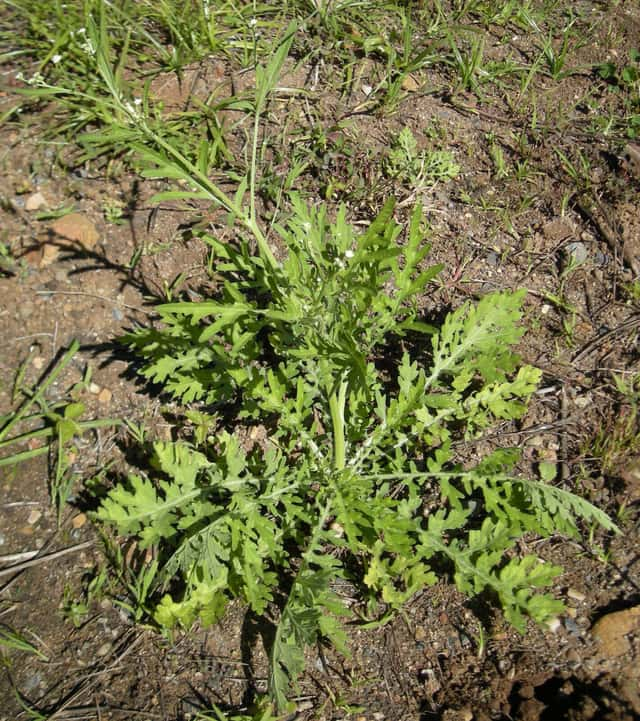
Santa Maria feverfew (Parthenium hysterophorus) is an annual herb in the daisy family (Asteraceae), native to the Americas, with its center of origin in northeastern Mexico. It grows upright with a deep taproot, reaching 1.5 m, or sometimes 2 m in fertile soil. It begins as a ground-level rosette before bolting and branching into a shrub-like form. The leaves are light green, deeply lobed, resembling carrot leaves, and covered with soft hairs. The flowers are small white or cream heads, 4 to 10 mm in diameter, produced in large quantities at the branch tips, each containing small black seeds. It is considered one of the ten most aggressive weeds in the world and has spread to approximately 40 countries. In Brazil, it appears mainly in São Paulo and Paraná, in vacant lots, roadsides, degraded pastures, coffee plantations, and vineyards. The plant contains parthenin, a substance that causes contact dermatitis, allergic reactions, and asthma attacks in sensitive individuals, and is toxic to livestock.
How to Propagate Santa Maria feverfew?
Seed
This is the only form of reproduction and the reason it is so invasive. Do not propagate: to control it, pull or cut before flowering using gloves and protection, clean tools and machinery, and do not move contaminated soil to other areas.
- 1 Each flower forms small, black, wedge-shaped seeds that fall near the parent plant.
- 2 Water, vehicles, machinery, and animals carry the seeds over long distances.
- 3 With rain and temperatures between 8 and 30 °C, the seeds germinate and form a rosette.
- 4 In warm climates, the plant can flower and release new seeds in about 4 weeks.
Materials needed:
How Big Does Santa Maria feverfew Grow?
TLDR: Santa Maria feverfew can reach up to 2.0m tall with Fast growth rate.
Max height
2.0m
Growth rate
Fast
Warning: Toxic Plant
This plant can be toxic if ingested. Keep out of reach of:
Is your plant showing symptoms?
Click on the symptom to discover possible causes:
What Diseases Commonly Affect Santa Maria feverfew?
TLDR: Santa Maria feverfew is susceptible to 1 known diseases. Monitor regularly for early detection.
Compare with similar plants
| Attribute | Difficulty | Light | Watering | Pet Safe |
|---|---|---|---|---|
| Field Maple | Easy | Bright indirect | 14d | ✓ |
| Iberian Houseleek | Easy | Direct sun | 14d | ✓ |
| Silver Birch | Easy | Direct sun | 14d | ✓ |
| Common Blanketflower | Easy | Direct sun | 10d | ✓ |
Choose & Compare
Sources & References
- Embrapa Meio Ambiente - Comunicado Técnico 29: Losna-branca (Parthenium hysterophorus)
- Wikipedia - Parthenium hysterophorus
- Business Queensland - Parthenium (restricted invasive plant)
- Embrapa - Alternativas de controle de losna-branca
- ECHO - Parthenium hysterophorus current status and effects on mammals (review)





