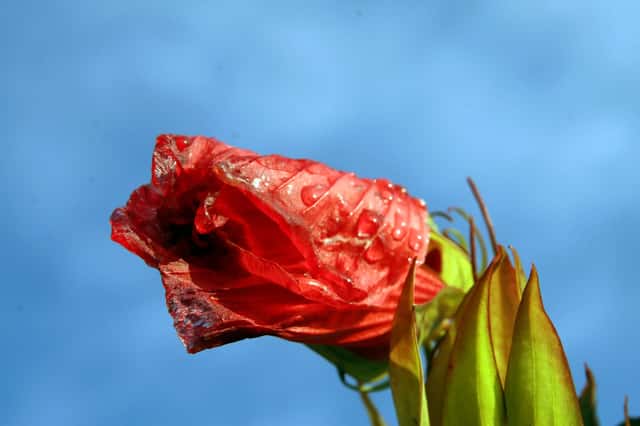
Malvaceae
Scarlet Rosemallow (Hibiscus coccineus)
Hibiscus coccineus
Give this marsh hibiscus full sun and keep the soil consistently moist to wet - it tolerates standing water and even light salt exposure. It dies back to the ground after frost but resprouts vigorously from its roots in spring. Minimal fertilizing is needed in rich soil, and light pruning after flowering keeps growth tidy.
Every 3 days
Bright indirect
4° - 35°C
50% - 80%
Categories
What is Scarlet Rosemallow?
Scarlet Rosemallow (Hibiscus coccineus) is a easy-care plant from the Malvaceae family. Hibiscus coccineus, commonly called scarlet rosemallow or Texas Star hibiscus, is a tall, deciduous perennial in the mallow family native to marshes and swamps of the southeastern United States. It produces striking star-shaped scarlet-red flowers up to 6 inches wide atop maple-like foliage from lat...
Scarlet Rosemallow grows up to 2.4m, spread of 91cm, watering every 3 days, 4°C – 35°C, 50–80% humidity. It is not suitable for indoor environments and safe for pets.
Unlike many tropical plants, Scarlet Rosemallow tolerates watering mistakes. Best for beginners. Unlike many popular species, Scarlet Rosemallow is safe to keep around pets.
How to Care for Scarlet Rosemallow?
TLDR: Scarlet Rosemallow needs Bright indirect, watering every 3 days, and temperatures between 4-35°C with 50-80% humidity.
How Often Should You Water Scarlet Rosemallow?
Keep soil consistently moist to wet; water every 2-3 days in dry weather, aiming for about 2 inches of water per week. This plant does not tolerate prolonged drought.
How Much Light Does Scarlet Rosemallow Need?
Plant in full sun for the best flowering, though it tolerates partial shade with fewer blooms and leggier growth.
What Is the Best Soil for Scarlet Rosemallow?
Grows best in rich, organic, consistently moist to wet soil; tolerates boggy conditions and slight salinity near coastal areas.
What Pot Should You Use for Scarlet Rosemallow?
Best grown directly in garden beds or large pond-edge containers with drainage holes; if potted, choose a wide, sturdy container that can hold consistently moist soil.
What Is Scarlet Rosemallow and Where Does It Come From?
Hibiscus coccineus, commonly called scarlet rosemallow or Texas Star hibiscus, is a tall, deciduous perennial in the mallow family native to marshes and swamps of the southeastern United States. It produces striking star-shaped scarlet-red flowers up to 6 inches wide atop maple-like foliage from late summer into early fall, reaching 6-8 feet in height. It thrives in consistently moist to wet soil and full sun, making it a favorite for pond edges, rain gardens, and pollinator plantings.
How to Propagate Scarlet Rosemallow?
Seed propagation
Seeds germinate readily in warm, consistently moist soil near a pond edge or in trays kept damp.
- 1 Collect ripe seed pods after they turn brown and split
- 2 Press seeds gently into moist potting mix after the last frost
- 3 Keep soil consistently moist until germination
- 4 Transplant seedlings once they have several true leaves
Materials needed:
Stem cutting propagation
Use clean, sharp tools and keep cuttings out of direct hot sun while rooting.
- 1 Take a 10-15 cm cutting from healthy new growth
- 2 Remove lower leaves and dip the cut end in rooting hormone
- 3 Insert into moist potting mix or water
- 4 Keep humidity high and soil moist until roots form
Materials needed:
How Big Does Scarlet Rosemallow Grow?
TLDR: Scarlet Rosemallow can reach up to 2.4m tall with Medium growth rate.
Max height
2.4m
Spread
91cm
Growth rate
Medium
Foliage
Deciduous
Plant Uses
Ornamental
Great for decoration
Is your plant showing symptoms?
Click on the symptom to discover possible causes:
What Diseases Commonly Affect Scarlet Rosemallow?
TLDR: Scarlet Rosemallow is susceptible to 9 known diseases. Monitor regularly for early detection.
Aphids
Aphids are small, soft-bodied, pear-shaped insects (1/16 to 1/8 inch long) that feed by sucking nutrient-rich sap from plants. They reproduce rapidly and can quickly weaken plants, causing distorted growth and transmitting plant viruses. Aphids come in various colors including green, black, red, yellow, brown, and gray. They secrete honeydew, a sticky substance that attracts ants and encourages sooty mold growth.
Whiteflies
Whiteflies are small, soft-bodied, winged insects closely related to aphids and mealybugs. They are moth-like in appearance, about 1/16 inch long, triangular in shape, and gray-white in color. These sap-sucking pests feed on plant tissue, causing yellowing, stunted growth, and wilting. They also excrete honeydew, which attracts ants and promotes sooty mold growth. Whiteflies can transmit serious plant viruses.
Gray Mold (Botrytis Blight)
Gray mold, caused by the fungus Botrytis cinerea, is one of the most common fungal diseases in plants. It affects over 200 plant species, including ornamentals, vegetables, fruits, and houseplants. The disease thrives in cool, humid conditions with poor air circulation, causing grayish spots and soft rot on infected tissues.
Bacterial Leaf Spot
Bacterial leaf spot is a plant disease caused by bacteria in the Xanthomonas and Pseudomonas genera that affects various ornamental and edible plants. The bacteria infect leaves through wounds or natural openings, causing characteristic lesions that can lead to premature leaf drop and plant weakening.
Meaning & Symbolism
Represents delicate beauty and resilience; its scarlet star-shaped blooms attract hummingbirds and pollinators, symbolizing vitality in Southern wetland gardens.
Fun Facts
Its scarlet, star-shaped flowers can reach up to 6 inches wide and last only a single day, opening fresh each morning.
Native bees nest inside the plant's hollow, dead stems, so gardeners are encouraged to leave cut stems standing over winter.
Despite dying back completely after the first hard frost, its roots survive to let it resprout into a 6-8 foot shrub each summer.
Frequently asked questions
How often should I water Hibiscus coccineus?
Is scarlet rosemallow toxic to pets?
Does this hibiscus come back every year?
What pests and diseases affect scarlet rosemallow?
Compare with similar plants
| Attribute | Difficulty | Light | Watering | Pet Safe |
|---|---|---|---|---|
| Field Maple | Easy | Bright indirect | 14d | ✓ |
| Silver Birch | Easy | Direct sun | 14d | ✓ |
| Common Blanketflower | Easy | Direct sun | 10d | ✓ |
| Cushion Bush | Easy | Direct sun | 14d | ✓ |





