Hydrangeaceae
Scentless Mock Orange (Philadelphus inodorus)
Philadelphus inodorus
Scentless mock orange is a low-maintenance, fast-growing shrub that thrives in full sun to part shade with average, well-drained soil. It tolerates heat, humidity, and short dry spells once established, but performs best with consistent moisture. Prune right after flowering since blooms form on wood produced the previous year.
Every 7 days
Bright indirect
-30° - 35°C
30% - 70%
Categories
What is Scentless Mock Orange?
Scentless Mock Orange (Philadelphus inodorus) is a easy-care plant from the Hydrangeaceae family. Philadelphus inodorus, commonly known as scentless mock orange, is a deciduous flowering shrub native to the southeastern United States and belonging to the hydrangea family (Hydrangeaceae). It forms a dense, upright, multi-stemmed shrub reaching 6 to 8 feet (1.8 to 2.4 m) tall and wide, with dark g...
Scentless Mock Orange grows up to 2.4m, spread of 240cm, watering every 7 days, -30°C – 35°C, 30–70% humidity. It is not suitable for indoor environments and safe for pets.
Unlike many tropical plants, Scentless Mock Orange tolerates watering mistakes. Best for beginners. Unlike many popular species, Scentless Mock Orange is safe to keep around pets.
How to Care for Scentless Mock Orange?
TLDR: Scentless Mock Orange needs Bright indirect, watering every 7 days, and temperatures between -30-35°C with 30-70% humidity.
How Often Should You Water Scentless Mock Orange?
Water deeply once a week during the first growing season to establish a strong root system. Once established, this shrub tolerates brief dry spells, but blooms best with regular moisture during spring.
How Much Light Does Scentless Mock Orange Need?
Plant in full sun for the heaviest flowering, though it also tolerates partial shade. At least 4-6 hours of direct sun per day is ideal.
What Is the Best Soil for Scentless Mock Orange?
Grow in average, well-drained soil. This shrub adapts to a wide range of soil types as long as drainage is adequate and the soil is not constantly waterlogged.
What Pot Should You Use for Scentless Mock Orange?
Best grown directly in garden soil rather than containers; if pot culture is attempted, use a large, deep pot with excellent drainage to accommodate its vigorous root system.
What Is Scentless Mock Orange and Where Does It Come From?
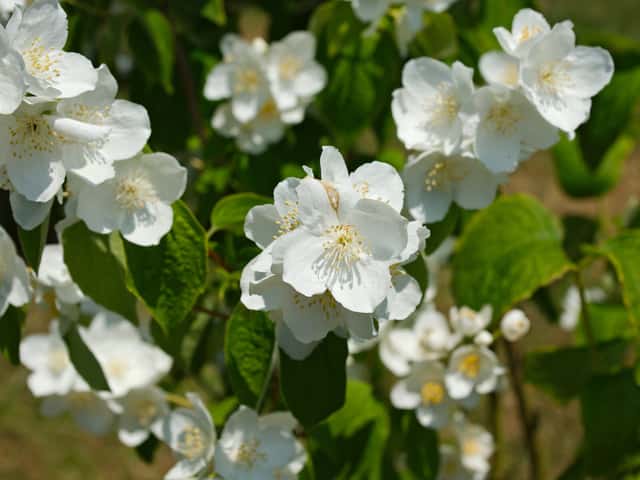
Philadelphus inodorus, commonly known as scentless mock orange, is a deciduous flowering shrub native to the southeastern United States and belonging to the hydrangea family (Hydrangeaceae). It forms a dense, upright, multi-stemmed shrub reaching 6 to 8 feet (1.8 to 2.4 m) tall and wide, with dark green, oval, finely toothed leaves and mature bark that peels in thin, orange-brown strips. In late spring, it produces abundant clusters of cup-shaped, four-petaled white flowers about 1 inch (2.5 cm) across. Unlike many of its relatives, the flowers of this species have little to no fragrance, which is reflected in its species name inodorus, meaning odorless. It is a tough, adaptable, fast-growing shrub well suited to informal hedges, shrub borders, and naturalized plantings.
How to Propagate Scentless Mock Orange?
Softwood Stem Cutting
Keep the growing medium consistently moist but not soggy, and provide bottom heat to speed rooting.
- 1 Take a 4-6 inch softwood cutting from a healthy, non-flowering stem in early summer
- 2 Remove the lower leaves and dip the cut end in rooting hormone
- 3 Insert the cutting into a moist, well-draining propagation mix
- 4 Cover with a plastic bag or place in a humid propagation chamber to retain moisture
- 5 Keep in bright, indirect light until roots form, then transplant
Materials needed:
Ground Layering
Layering in spring gives the new plant a full growing season to establish roots before winter.
- 1 Select a low, flexible branch near the base of the shrub
- 2 Wound the underside of the branch where it will touch the soil
- 3 Bury that section of the branch a few inches deep, leaving the tip exposed
- 4 Keep the soil consistently moist until roots develop
- 5 Once rooted, sever the new plant from the parent and transplant
Materials needed:
How Big Does Scentless Mock Orange Grow?
TLDR: Scentless Mock Orange can reach up to 2.4m tall with Fast growth rate.
Max height
2.4m
Spread
2.4m
Growth rate
Fast
Foliage
Deciduous
Plant Uses
Ornamental
Great for decoration
Is your plant showing symptoms?
Click on the symptom to discover possible causes:
What Diseases Commonly Affect Scentless Mock Orange?
TLDR: Scentless Mock Orange is susceptible to 6 known diseases. Monitor regularly for early detection.
Powdery Mildew
Powdery mildew is a common fungal disease caused by various fungi species including Erysiphe, Podosphaera, Oïdium, and Leveillula. It affects over 10,000 plant species worldwide. The disease thrives in warm, dry climates with high humidity and appears as a distinctive white powdery coating on plant surfaces.
Leaf Spot
Leaf spot is a common fungal disease caused by various pathogens including Alternaria, Ascochyta, Colletotrichum, Septoria, and Venturia. It primarily affects leaves, causing discolored spots that can lead to premature leaf drop if left untreated.
Aphids
Aphids are small, soft-bodied, pear-shaped insects (1/16 to 1/8 inch long) that feed by sucking nutrient-rich sap from plants. They reproduce rapidly and can quickly weaken plants, causing distorted growth and transmitting plant viruses. Aphids come in various colors including green, black, red, yellow, brown, and gray. They secrete honeydew, a sticky substance that attracts ants and encourages sooty mold growth.
Spider Mites
Spider mites are tiny arachnids (less than 1/20 inch long) related to spiders and ticks that feed on plant sap. They thrive in hot, dry conditions and can cause significant damage to ornamental and vegetable plants. During severe infestations, crop losses can reach 14% or higher as these pests disrupt vital plant processes including photosynthesis, carbon dioxide absorption, and transpiration.
Meaning & Symbolism
Like other mock orange species, Philadelphus inodorus is often associated with purity, renewal, and the arrival of late spring, thanks to its clean white blossoms that appear just as the growing season reaches its peak.
Fun Facts
The species name inodorus means odorless in Latin, distinguishing this plant from its fragrant mock orange relatives.
Mature stems develop peeling, papery orange-brown bark that adds winter interest to the garden.
It is native to the Appalachian region and southeastern United States, where it grows along streambanks and rocky slopes.
Frequently asked questions
Does Philadelphus inodorus have a fragrance?
When does scentless mock orange bloom?
How much sun does it need?
When should I prune scentless mock orange?
Compare with similar plants
| Attribute | Difficulty | Light | Watering | Pet Safe |
|---|---|---|---|---|
| Field Maple | Easy | Bright indirect | 14d | ✓ |
| Silver Birch | Easy | Direct sun | 14d | ✓ |
| Common Blanketflower | Easy | Direct sun | 10d | ✓ |
| Cushion Bush | Easy | Direct sun | 14d | ✓ |





