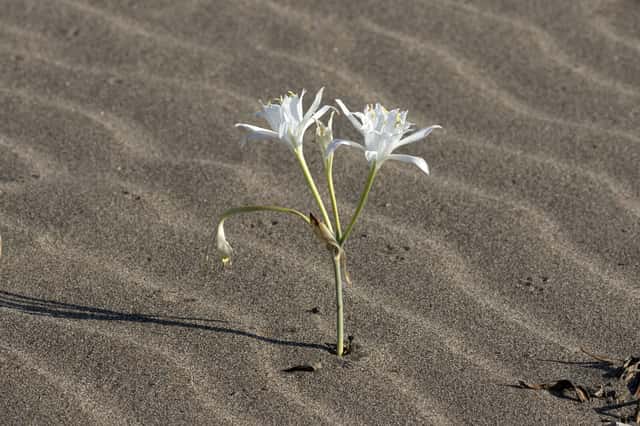
Amaryllidaceae
Sea Daffodil (Pancratium maritimum)
Pancratium maritimum
Sea daffodil is an easygoing coastal bulb built for tough beach conditions: give it full sun, very sandy, sharply draining soil, and let it stay dry through its summer dormancy. Water moderately while leaves are actively growing in spring, then taper off as flowering approaches so the bulb can 'bake' in dry soil through summer heat. It tolerates salt spray, poor soil, and drought far better than overwatering, which is the main cause of bulb and root rot.
Every 10 days
Direct sun
-5° - °C
% - %
Categories
What is Sea Daffodil?
Sea Daffodil (Pancratium maritimum) is a easy-care plant from the Amaryllidaceae family. Pancratium maritimum, the sea daffodil, is a bulbous perennial of the Amaryllidaceae family native to Mediterranean, Black Sea and Macaronesian coastlines, where it grows rooted deep in shifting beach dunes. From August to October it produces clusters of large, white, funnel-shaped flowers with a fr...
Sea Daffodil grows up to 50cm, spread of 30cm, watering every 10 days. It is not suitable for indoor environments and not safe for pets.
Unlike many tropical plants, Sea Daffodil tolerates watering mistakes. Best for beginners. Without precautions, ingestion can cause irritation in pets. Keep out of reach of cats and dogs.
How to Care for Sea Daffodil?
TLDR: Sea Daffodil needs Direct sun, watering every 10 days, and temperatures between -5-30°C with 40-70% humidity.
How Often Should You Water Sea Daffodil?
Water only when the top few centimeters of soil are completely dry, and stop watering altogether once flowering finishes in autumn so the bulb rests dry through winter and next summer.
How Much Light Does Sea Daffodil Need?
Give it a minimum of 6-8 hours of direct sun daily; it will not flower, and may rot, in shade or part shade.
What Is the Best Soil for Sea Daffodil?
Plant in light, sandy, very well-drained soil, ideally neutral to mildly alkaline; avoid rich organic mixes that hold moisture around the bulb.
What Pot Should You Use for Sea Daffodil?
Use a wide, unglazed terracotta pot with generous drainage holes, which lets excess moisture evaporate and mimics the free-draining dune sand the bulb needs.
Care Schedule
Fertilize
Every 20 days
Repot
Every 1460 days
What Is Sea Daffodil and Where Does It Come From?
Pancratium maritimum, the sea daffodil, is a bulbous perennial of the Amaryllidaceae family native to Mediterranean, Black Sea and Macaronesian coastlines, where it grows rooted deep in shifting beach dunes. From August to October it produces clusters of large, white, funnel-shaped flowers with a fringed corona and a sweet, exotic scent that intensifies at dusk, pollinated almost exclusively by the convolvulus hawk-moth. Its strap-like, blue-green leaves often die back during the hottest, driest part of summer before the flower stalks emerge from the bare sand.
How to Propagate Sea Daffodil?
Offsets transplant far more reliably than seed and can flower within a year or two, versus three to four years from seed.
- 1 Wait until the bulb enters summer dormancy after flowering ends.
- 2 Lift the clump carefully and separate the small offset bulbs growing around the mother bulb.
- 3 Replant offsets immediately at a depth of about 15-30 cm in sandy, free-draining soil.
- 4 Keep the soil barely moist until new growth appears, then resume normal seasonal watering.
Materials needed:
Seed-grown plants are slow, typically taking three to four years to flower, so division is faster for gardeners wanting quicker results.
- 1 Collect fresh black seeds from ripe seed pods in autumn.
- 2 Soak stored seed in warm water for about an hour before sowing, or sow fresh seed directly.
- 3 Sow in a sandy seed-starting mix and keep at around 20-22C.
- 4 Germination can take one to three months; grow seedlings on for several years before they reach flowering size.
Materials needed:
How Big Does Sea Daffodil Grow?
TLDR: Sea Daffodil can reach up to 50cm tall with Slow growth rate.
Max height
50cm
Spread
30cm
Growth rate
Slow
Foliage
Evergreen
Warning: Toxic Plant
This plant can be toxic if ingested. Keep out of reach of:
Plant Uses
Ornamental
Great for decoration
Is your plant showing symptoms?
Click on the symptom to discover possible causes:
What Diseases Commonly Affect Sea Daffodil?
TLDR: Sea Daffodil is susceptible to 4 known diseases. Monitor regularly for early detection.
Root Rot
Root rot is a serious fungal disease that affects the root system of plants, causing them to decay and die. It is primarily caused by overwatering, poor drainage, or soil-borne fungi such as Pythium, Phytophthora, Rhizoctonia, and Fusarium. The disease thrives in waterlogged conditions where roots are deprived of oxygen, making them susceptible to fungal infection.
Aphids
Aphids are small, soft-bodied, pear-shaped insects (1/16 to 1/8 inch long) that feed by sucking nutrient-rich sap from plants. They reproduce rapidly and can quickly weaken plants, causing distorted growth and transmitting plant viruses. Aphids come in various colors including green, black, red, yellow, brown, and gray. They secrete honeydew, a sticky substance that attracts ants and encourages sooty mold growth.
Spider Mites
Spider mites are tiny arachnids (less than 1/20 inch long) related to spiders and ticks that feed on plant sap. They thrive in hot, dry conditions and can cause significant damage to ornamental and vegetable plants. During severe infestations, crop losses can reach 14% or higher as these pests disrupt vital plant processes including photosynthesis, carbon dioxide absorption, and transpiration.
Slugs and Snails
Slugs and snails are mollusks that feed on plant tissue, causing irregular holes in leaves and damage to young seedlings. They are most active at night and in moist conditions, leaving characteristic silvery slime trails. These pests can quickly devastate gardens, especially during wet seasons.
Meaning & Symbolism
In Mediterranean folklore the sea daffodil is linked to purity and resilience, since it blooms in pure white from bare, wind-scoured sand where little else survives.
Fun Facts
Its large white flowers are pollinated almost exclusively by a single moth species, the convolvulus hawk-moth, which can hover and reach the long floral tube.
The bulbs anchor deep in shifting dune sand and can survive being partially buried or exposed by moving sand and salt spray.
Woolly fibers from its seed coat have traditionally been used in the Mediterranean to stuff felt shoes and garments.
Despite growing in some of the harshest, driest, saltiest soil on the coast, it is considered a low-difficulty, pest- and disease-resistant garden bulb.
Frequently asked questions
Is Pancratium maritimum poisonous?
Can I grow sea daffodil away from the coast?
Why is my sea daffodil not flowering?
How cold-hardy is Pancratium maritimum?
When does sea daffodil bloom?
Compare with similar plants
| Attribute | Difficulty | Light | Watering | Pet Safe |
|---|---|---|---|---|
| Field Maple | Easy | Bright indirect | 14d | ✓ |
| Silver Birch | Easy | Direct sun | 14d | ✓ |
| Common Blanketflower | Easy | Direct sun | 10d | ✓ |
| Cushion Bush | Easy | Direct sun | 14d | ✓ |





