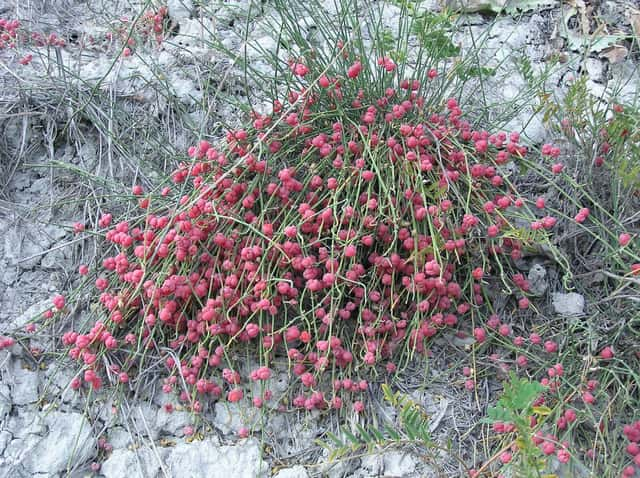
Ephedraceae
Sea Grape: Edible Plant
Ephedra distachya
Requires a sunny location and well-draining, dry, sandy soil; it also tolerates lime. Once established, it is drought-tolerant and needs infrequent watering. It is frost-resistant but does not tolerate standing water. It only flowers and fruits well after a warm summer. It will only produce fruit if both male and female plants are nearby. Keep away from pets and children as it contains ephedrine.
Every 21 days
Direct sun
-23° - 40°C
20% - 50%
Categories
What is Sea Grape?
Sea Grape (Ephedra distachya) is a medium-care plant from the Ephedraceae family. The Sea Grape (Ephedra distachya) is a low, densely branched, evergreen shrub from the Ephedraceae family. It typically grows 25–50 cm tall, rarely reaching 1 meter. Its leaves are tiny scales; photosynthesis is carried out by the green, jointed, twig-like shoots. It is dioecious: male and female in...
Sea Grape grows up to 1.0m, watering every 21 days, -23°C – 40°C, 20–50% humidity. It is not suitable for indoor environments and not safe for pets.
Without precautions, ingestion can cause irritation in pets. Keep out of reach of cats and dogs.
How to Care for Sea Grape?
TLDR: Sea Grape needs Direct sun, watering every 21 days, and temperatures between -23-40°C with 20-50% humidity.
How Often Should You Water Sea Grape?
After planting, water regularly only until established. Afterwards, rainfall is sufficient; during drought, one thorough watering every three weeks is enough. Do not water in winter. Roots will begin to rot in wet, heavy soil.
How Much Light Does Sea Grape Need?
Requires full sun. In shade, it becomes leggy and fails to bloom. Plant in the sunniest, warmest spot in the garden, such as a rock garden or a sandy slope.
What Is the Best Soil for Sea Grape?
Requires loose, sandy, or sandy loam soil with excellent drainage. It tolerates calcareous (lime-rich) soil well. Do not plant in nutrient-rich, heavy clay.
What Pot Should You Use for Sea Grape?
Best suited for gardens or rock gardens. If grown in a pot, choose a wide, deep terracotta pot with large drainage holes and a sandy-gravelly soil mix.
What Is Sea Grape and Where Does It Come From?
The Sea Grape (Ephedra distachya) is a low, densely branched, evergreen shrub from the Ephedraceae family. It typically grows 25–50 cm tall, rarely reaching 1 meter. Its leaves are tiny scales; photosynthesis is carried out by the green, jointed, twig-like shoots. It is dioecious: male and female inflorescences develop on separate plants. Its distribution ranges from Southern and Central Europe to Western and Central Asia, growing on stabilized sand dunes and dry grasslands. The small, red, fleshy 'berries' of the female plants are edible. All parts contain ephedrine.
How to Propagate Sea Grape?
Seed Sowing
Provide frost protection for young plants during their first winter. You will only get fruit if both male and female plants are present.
- 1 Sow seeds in sandy soil in autumn after ripening, or in spring
- 2 Keep in a bright, sheltered place, slightly moist
- 3 Prick out emerging seedlings into individual pots
- 4 Spend the first winter in a protected location
- 5 Plant out in spring after the frosts have passed
Materials needed:
Division
Avoid standing water during the rooting period.
- 1 Carefully dig up the clump in spring or autumn
- 2 Divide into sections with roots
- 3 Plant immediately in sandy soil
- 4 Water until they take root
Materials needed:
Layering
Prostrate shoots often root on their own naturally.
- 1 Bend a shoot close to the ground downward
- 2 Secure it to the soil and cover with sandy earth
- 3 Cut away from the mother plant after rooting
- 4 Transplant to its final location
Materials needed:
How Big Does Sea Grape Grow?
TLDR: Sea Grape can reach up to 1.0m tall with Slow growth rate.
Max height
1.0m
Growth rate
Slow
Foliage
Evergreen
Warning: Toxic Plant
This plant can be toxic if ingested. Keep out of reach of:
Plant Uses
Ornamental
Great for decoration
Medicinal
Medicinal properties
Edible
Can be consumed
Medicinal Uses
- In folk medicine, tea brewed from the shoots was used to relieve asthma, hay fever, coughs, and catarrh
- It was also applied for muscle and rheumatic pain
- Its active ingredients are ephedrine and pseudoephedrine: stimulants that increase blood pressure and heart rate, therefore use only under medical supervision; it is a banned substance in many sports
Culinary Uses
- The red, approximately 6 mm fleshy fruits of the female plants can be eaten raw; they are sweet but somewhat tasteless
- Young shoots can also be consumed raw, but only in moderation due to their ephedrine content
Is your plant showing symptoms?
Click on the symptom to discover possible causes:
What Diseases Commonly Affect Sea Grape?
TLDR: Sea Grape is susceptible to 2 known diseases. Monitor regularly for early detection.
Root Rot
Root rot is a serious fungal disease that affects the root system of plants, causing them to decay and die. It is primarily caused by overwatering, poor drainage, or soil-borne fungi such as Pythium, Phytophthora, Rhizoctonia, and Fusarium. The disease thrives in waterlogged conditions where roots are deprived of oxygen, making them susceptible to fungal infection.
Overwatering
Overwatering occurs when plants receive too much water, depriving roots of oxygen and causing root rot. This environmental stress is one of the most common causes of houseplant death, as waterlogged soil prevents roots from breathing and functioning properly.
Compare with similar plants
| Attribute | Difficulty | Light | Watering | Pet Safe |
|---|---|---|---|---|
| Dark Fieldcap | Medium | Low light | 2d | ⚠️ |
| Azalea | Medium | Partial shade | 3d | ⚠️ |
| Muriel's Bamboo | Medium | Partial shade | 3d | ✓ |
| Bougainvillea | Medium | Direct sun | 7d | ⚠️ |




