Asteraceae
Pájaro bobo: Ground Cover Plant
Tessaria absinthioides
Grow in full sun in sandy, well-drained soil; it tolerates both drought and temporarily waterlogged or brackish soils. Water sparingly, allowing the substrate to dry between waterings, and avoid environments with constant high humidity. It is a low-maintenance, hardy, and fast-growing plant, ideal for xeriscaping or riparian restoration projects.
Every 12 days
Direct sun
5° - 40°C
15% - 55%
Categories
What is Pájaro bobo?
Pájaro bobo (Tessaria absinthioides) is a easy-care plant from the Asteraceae family. The Pájaro bobo (Tessaria absinthioides) is a perennial shrub in the Asteraceae family, native to riverbanks and brackish soils from southern Peru and Bolivia to northern and central Chile, Argentina, Paraguay, and Uruguay. Featuring grayish-green foliage with a pubescent appearance, it reaches up t...
Pájaro bobo grows up to 3.0m, spread of 250cm, watering every 12 days, 5°C – 40°C, 15–55% humidity. It is not suitable for indoor environments and safe for pets.
Unlike many tropical plants, Pájaro bobo tolerates watering mistakes. Best for beginners. Unlike many popular species, Pájaro bobo is safe to keep around pets.
How to Care for Pájaro bobo?
TLDR: Pájaro bobo needs Direct sun, watering every 12 days, and temperatures between 5-40°C with 15-55% humidity.
How Often Should You Water Pájaro bobo?
Water every 10-14 days, allowing the surface of the substrate to dry; it tolerates drought well due to its adaptation to arid environments, but also withstands occasional flooding typical of riparian soils.
How Much Light Does Pájaro bobo Need?
Requires direct full sun for most of the day; in shade or partial shade, its flowering and vigor are significantly reduced.
What Is the Best Soil for Pájaro bobo?
Prefers sandy, well-drained soils with a neutral to slightly alkaline pH (6.5-8.5); it tolerates saline soils, which is common in its natural habitat of riverbanks and coastal deserts.
What Pot Should You Use for Pájaro bobo?
If grown in a pot, use a wide and deep container with good drainage (terracotta or similar) and a sandy substrate; in temperate climates, direct soil cultivation is preferable given its shrubby habit and fast growth rate.
Care Schedule
Fertilize
Every 180 days
What Is Pájaro bobo and Where Does It Come From?
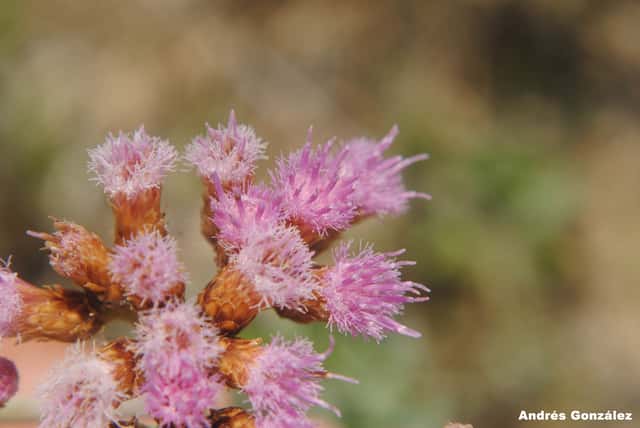
The Pájaro bobo (Tessaria absinthioides) is a perennial shrub in the Asteraceae family, native to riverbanks and brackish soils from southern Peru and Bolivia to northern and central Chile, Argentina, Paraguay, and Uruguay. Featuring grayish-green foliage with a pubescent appearance, it reaches up to 2-3 meters in height, with elongated leaves and serrated edges. Its flower heads, grouped in terminal corymbs, display marginal flowers ranging from pale to deep pink between December and March. It is a pioneer species with extremely high adaptive capacity: it colonizes sandy, arid, waterlogged, or saline soils alike, and in the Atacama Desert, it survives by obtaining moisture almost exclusively from coastal fog (camanchaca).
How Big Does Pájaro bobo Grow?
TLDR: Pájaro bobo can reach up to 3.0m tall with Fast growth rate.
Max height
3.0m
Spread
2.5m
Growth rate
Fast
Foliage
Evergreen
Plant Uses
Medicinal
Medicinal properties
Ground Cover
Soil coverage
Medicinal Uses
- Traditional use as a stomachic and depurative
- Used for skin conditions due to its anti-inflammatory properties
- Investigated for its selective cytotoxic and antitumor activity in preclinical studies
- Used in folk medicine for rheumatism, prostate issues, and as a decongestant
Is your plant showing symptoms?
Click on the symptom to discover possible causes:
What Diseases Commonly Affect Pájaro bobo?
TLDR: Pájaro bobo is susceptible to 4 known diseases. Monitor regularly for early detection.
Aphids
Aphids are small, soft-bodied, pear-shaped insects (1/16 to 1/8 inch long) that feed by sucking nutrient-rich sap from plants. They reproduce rapidly and can quickly weaken plants, causing distorted growth and transmitting plant viruses. Aphids come in various colors including green, black, red, yellow, brown, and gray. They secrete honeydew, a sticky substance that attracts ants and encourages sooty mold growth.
Powdery Mildew
Powdery mildew is a common fungal disease caused by various fungi species including Erysiphe, Podosphaera, Oïdium, and Leveillula. It affects over 10,000 plant species worldwide. The disease thrives in warm, dry climates with high humidity and appears as a distinctive white powdery coating on plant surfaces.
Spider Mites
Spider mites are tiny arachnids (less than 1/20 inch long) related to spiders and ticks that feed on plant sap. They thrive in hot, dry conditions and can cause significant damage to ornamental and vegetable plants. During severe infestations, crop losses can reach 14% or higher as these pests disrupt vital plant processes including photosynthesis, carbon dioxide absorption, and transpiration.
Whiteflies
Whiteflies are small, soft-bodied, winged insects closely related to aphids and mealybugs. They are moth-like in appearance, about 1/16 inch long, triangular in shape, and gray-white in color. These sap-sucking pests feed on plant tissue, causing yellowing, stunted growth, and wilting. They also excrete honeydew, which attracts ants and promotes sooty mold growth. Whiteflies can transmit serious plant viruses.
Meaning & Symbolism
A symbol of resilience and extreme adaptation: it survives in the Atacama Desert by obtaining moisture almost exclusively from coastal fog, representing the ability of plant life to thrive in arid and brackish lands where few other species manage to establish themselves.
Compare with similar plants
| Attribute | Difficulty | Light | Watering | Pet Safe |
|---|---|---|---|---|
| Field Maple | Easy | Bright indirect | 14d | ✓ |
| Silver Birch | Easy | Direct sun | 14d | ✓ |
| Common Blanketflower | Easy | Direct sun | 10d | ✓ |
| Cushion Bush | Easy | Direct sun | 14d | ✓ |
Choose & Compare
Sources & References
- Tessaria absinthioides - Wikipedia
- Tessaria absinthioides - Arbustos Chilebosque
- Tessaria absinthioides - Fundacion R.A. Philippi
- Evaluation of cytotoxic and antitumoral properties of Tessaria absinthioides, pajaro bobo, aqueous extract - Medicina (Buenos Aires)
- Tessaria absinthioides aqueous extract cytotoxic/antitumoral study - PubMed
- Tessaria absinthioides (Hook. and Arn.) DC. - Plants of the World Online, Kew





