Orchidaceae
Dendrobium moniliforme: Sekkoku Orchid Care Guide
Dendrobium moniliforme
Give this orchid bright, indirect light and a well-drained bark or mounted setup that dries quickly between waterings. Water generously through the warm growing season, then cut back sharply in winter to trigger a cool, dry rest that is essential for flowering.
Every 4 days
Bright indirect
7° - 25°C
50% - 70%
Categories
What is Sekkoku Orchid?
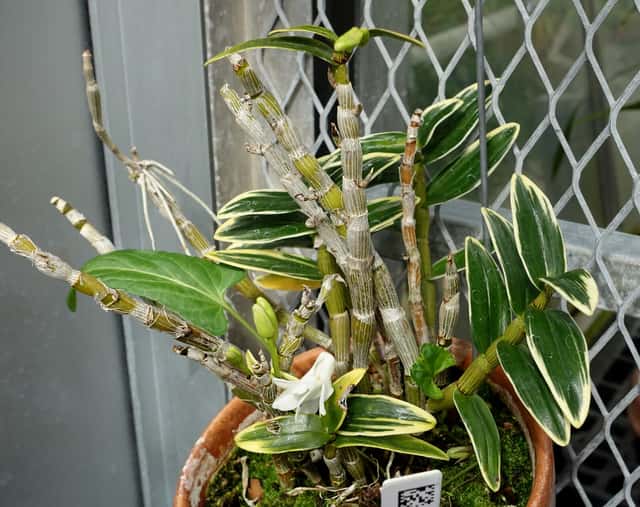
Sekkoku Orchid (Dendrobium moniliforme) is a medium-care plant from the Orchidaceae family. Dendrobium moniliforme, known in Japan as Sekkoku and in Korea as Seokgok, is a compact epiphytic orchid native to cool, high-elevation forests of Japan, Korea, and China. Slender, cane-like pseudobulbs bear small clusters of fragrant white flowers with a yellow-green lip in late winter and spring....
Sekkoku Orchid grows up to 45cm, watering every 4 days, 7°C – 25°C, 50–70% humidity. It is suitable for indoor environments and safe for pets.
Unlike many popular species, Sekkoku Orchid is safe to keep around pets. Without adequate drainage, root rot can develop within 8 days.
How to Care for Sekkoku Orchid?
TLDR: Sekkoku Orchid needs Bright indirect, watering every 4 days, and temperatures between 7-25°C with 50-70% humidity.
How Often Should You Water Sekkoku Orchid?
Let the potting medium approach dryness between waterings during the growing season, and water only sparingly in winter to prevent shriveled pseudobulbs while still allowing the plant its required cool, dry rest.
How Much Light Does Sekkoku Orchid Need?
Provide 6-8 hours of bright, filtered light daily; a spot near an east-facing or lightly shaded south-facing window works well, but protect the plant from harsh direct midday sun.
What Is the Best Soil for Sekkoku Orchid?
Mount on bark or pot loosely in coarse orchid bark or tree fern fiber that drains and dries quickly; avoid dense, moisture-retentive mixes that invite root rot.
What Pot Should You Use for Sekkoku Orchid?
Small clay pot, slotted orchid basket, or cork/bark mount — anything that allows roots to dry quickly and get airflow.
Care Schedule
Fertilize
Every 14 days
Repot
Every 730 days
What Is Sekkoku Orchid and Where Does It Come From?
Dendrobium moniliforme, known in Japan as Sekkoku and in Korea as Seokgok, is a compact epiphytic orchid native to cool, high-elevation forests of Japan, Korea, and China. Slender, cane-like pseudobulbs bear small clusters of fragrant white flowers with a yellow-green lip in late winter and spring. For centuries it has been cultivated as a prized ornamental in East Asia, admired for its resilience and delicate blooms rather than showy size.
How to Propagate Sekkoku Orchid?
Keiki removal
Never remove a keiki before it has its own roots, and avoid disturbing the parent plant's leafless canes since they still store energy for future blooms.
- 1 Wait until a keiki (baby plantlet) growing from an old cane develops several roots at least 2-3 cm long
- 2 Sterilize a sharp blade and cut the keiki away from the parent cane, keeping the roots intact
- 3 Pot the keiki in a small basket or pot with fine-grade orchid bark or sphagnum moss
- 4 Keep humidity high and water lightly until new growth appears
Materials needed:
Clump division
Avoid dividing into sections smaller than 3 canes, as smaller divisions take much longer to flower again.
- 1 Unpot the plant after flowering, when new growth begins
- 2 Gently separate the root mass into sections with at least 3-4 healthy canes each
- 3 Repot each division in fresh, well-draining orchid mix
- 4 Keep in bright, indirect light and water sparingly until roots establish
Materials needed:
How Big Does Sekkoku Orchid Grow?
TLDR: Sekkoku Orchid can reach up to 45cm tall with Slow growth rate.
Max height
45cm
Growth rate
Slow
Foliage
Semi-evergreen
Plant Uses
Ornamental
Great for decoration
Medicinal
Medicinal properties
Medicinal Uses
- Traditional Chinese medicine tonic (dried stems, known as "Shi Hu")
Is your plant showing symptoms?
Click on the symptom to discover possible causes:
What Diseases Commonly Affect Sekkoku Orchid?
TLDR: Sekkoku Orchid is susceptible to 9 known diseases. Monitor regularly for early detection.
Root Rot
Root rot is a serious fungal disease that affects the root system of plants, causing them to decay and die. It is primarily caused by overwatering, poor drainage, or soil-borne fungi such as Pythium, Phytophthora, Rhizoctonia, and Fusarium. The disease thrives in waterlogged conditions where roots are deprived of oxygen, making them susceptible to fungal infection.
Phytophthora Root Rot
Disease caused by fungus-like organisms (oomycetes) that live in soil and can survive for years. It affects roots, stem, and crown of plants, being especially severe in waterlogged or poorly drained soils. It is the second most common cause of root rot in trees and shrubs.
Gray Mold (Botrytis Blight)
Gray mold, caused by the fungus Botrytis cinerea, is one of the most common fungal diseases in plants. It affects over 200 plant species, including ornamentals, vegetables, fruits, and houseplants. The disease thrives in cool, humid conditions with poor air circulation, causing grayish spots and soft rot on infected tissues.
Anthracnose
Anthracnose is a fungal disease caused by fungi in the genus Colletotrichum that affects many plants, including vegetables, fruits, and trees. The disease thrives in cool, wet conditions, causing dark, sunken lesions on leaves, stems, flowers, and fruits.
Meaning & Symbolism
In Japan, Sekkoku has been cultivated and collected since the Edo period as one of the classic "appreciation plants," alongside Fukiran and Omoto, valued for subtle leaf variegation and refined, understated beauty rather than dramatic size or color.
Fun Facts
Sekkoku has been cultivated in Japan since the Edo period, with collectors prizing subtle leaf variegation much like the classic Fukiran orchids.
It is one of the few orchids that can survive brief winter temperatures near freezing when kept dry.
In traditional Chinese medicine, dried stems of related Dendrobium species (including D. moniliforme) are known as "Shi Hu" and used as a tonic herb.
New plantlets, called keikis, often sprout directly from old flowering canes instead of from seed.
Frequently asked questions
Does Dendrobium moniliforme need a winter rest?
Can I grow Dendrobium moniliforme indoors?
Why are my Dendrobium moniliforme roots turning brown and mushy?
Should I cut off the leafless canes?
Compare with similar plants
| Attribute | Difficulty | Light | Watering | Pet Safe |
|---|---|---|---|---|
| Dark Fieldcap | Medium | Low light | 2d | ⚠️ |
| Azalea | Medium | Partial shade | 3d | ⚠️ |
| Muriel's Bamboo | Medium | Partial shade | 3d | ✓ |
| Bougainvillea | Medium | Direct sun | 7d | ⚠️ |
Choose & Compare
Sources & References
- Dendrobium Moniliforme plant care guide & info - Ploi
- Dendrobium Moniliforme - Learn Everything About This Orchid - Planticulous
- Understanding Dendrobium moniliforme: The Basics - Greg
- Common Dendrobium Orchid Diseases (And How To Treat Them) - Cafe Planta
- How To Diagnose and Treat Root Rot in Dendrobium Orchids - Cafe Planta




