Asteraceae
Shaggy Soldier (Galinsoga quadriradiata)
Galinsoga quadriradiata
It needs no care: it comes up on its own in fertile, disturbed, sunny soil. It grows fast in warm weather, flowers within 40-60 days and drops thousands of seeds. In a vegetable garden the usual job is the opposite of care: pull it before it flowers. It dies at the first frost.
Every 3 days
Bright indirect
10° - °C
% - %
Categories
What is Shaggy soldier?
Shaggy soldier (Galinsoga quadriradiata) is a easy-care plant from the Asteraceae family. Galinsoga quadriradiata is an annual herb in the daisy family, native to central Mexico and tropical America. It now turns up in vegetable plots, flower beds, lawns and disturbed ground worldwide. It is usually about 25 cm tall but can reach 80 cm. It branches heavily, with opposite, oval, toothed l...
Shaggy soldier grows up to 80cm, watering every 3 days. It is not suitable for indoor environments and safe for pets.
Unlike many tropical plants, Shaggy soldier tolerates watering mistakes. Best for beginners. Unlike many popular species, Shaggy soldier is safe to keep around pets.
How to Care for Shaggy soldier?
TLDR: Shaggy soldier needs Bright indirect, watering every 3 days, and temperatures between 10-30°C with 40-70% humidity.
How Often Should You Water Shaggy soldier?
It likes moist soil. In dry weather, water every 3 days. It copes with short dry spells but grows more in watered ground.
How Much Light Does Shaggy soldier Need?
Full sun or light part shade. It hardly shows up in deep shade.
What Is the Best Soil for Shaggy soldier?
Fertile soil rich in nitrogen and organic matter, like well-fed vegetable beds. It does well in clay or medium loam with good drainage.
What Pot Should You Use for Shaggy soldier?
It is rarely grown in pots. If you want it for leaves, a medium pot with rich soil and a drainage hole is enough.
What Is Shaggy soldier and Where Does It Come From?
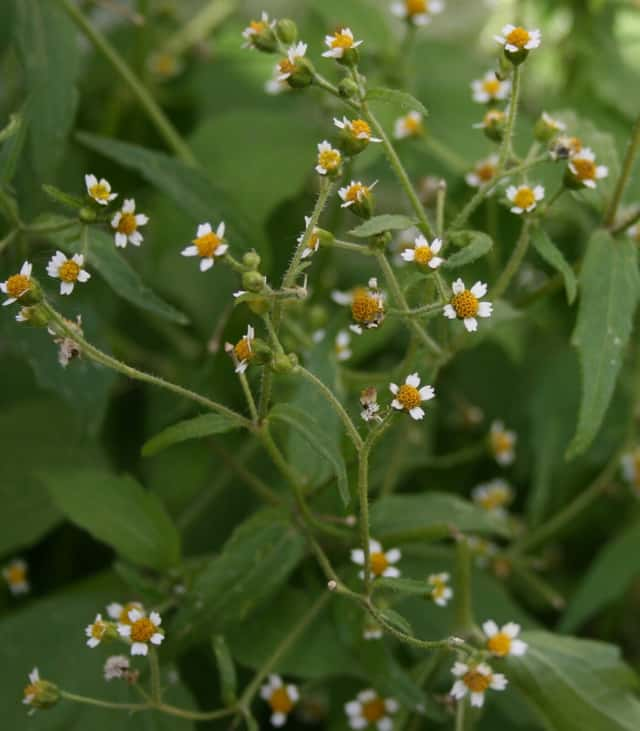
Galinsoga quadriradiata is an annual herb in the daisy family, native to central Mexico and tropical America. It now turns up in vegetable plots, flower beds, lawns and disturbed ground worldwide. It is usually about 25 cm tall but can reach 80 cm. It branches heavily, with opposite, oval, toothed leaves covered in hairs. The flower heads are 5-7 mm across, with five white, three-toothed rays around a yellow center. It looks very much like gallant soldier (Galinsoga parviflora) but is much hairier.
How to Propagate Shaggy soldier?
Seed
The seeds have no dormancy and sprout as soon as they land on warm, moist soil. To keep it from spreading through the garden, pull plants before they set seed.
- 1 Scatter seed on moist, loose soil without burying it deep
- 2 Keep the soil moist
- 3 Wait until soil is above 10 °C, since it germinates best near 24 °C
- 4 Pick young leaves before flowering
Materials needed:
How Big Does Shaggy soldier Grow?
TLDR: Shaggy soldier can reach up to 80cm tall with Fast growth rate.
Max height
80cm
Growth rate
Fast
Plant Uses
Edible
Can be consumed
Culinary Uses
- Young leaves are eaten in salads and cooked greens in some regions
Is your plant showing symptoms?
Click on the symptom to discover possible causes:
What Diseases Commonly Affect Shaggy soldier?
TLDR: Shaggy soldier is susceptible to 5 known diseases. Monitor regularly for early detection.
Aphids
Aphids are small, soft-bodied, pear-shaped insects (1/16 to 1/8 inch long) that feed by sucking nutrient-rich sap from plants. They reproduce rapidly and can quickly weaken plants, causing distorted growth and transmitting plant viruses. Aphids come in various colors including green, black, red, yellow, brown, and gray. They secrete honeydew, a sticky substance that attracts ants and encourages sooty mold growth.
Mosaic Virus
Mosaic virus is a group of plant viruses that cause mottled, patchy patterns on leaves and can affect a wide variety of plants. The virus creates characteristic yellow, white, and green mosaic patterns, often accompanied by stunted growth and deformed plant parts. This highly contagious disease spreads rapidly through insect vectors and contaminated tools.
Root-Knot Nematodes
Root-knot nematodes (Meloidogyne species) are microscopic roundworms that parasitize plant roots, causing characteristic galls or knots. These soil-borne pests are among the most economically damaging plant pathogens worldwide, affecting a wide range of ornamental and edible plants. The nematodes inject enzymes into root cells, causing abnormal swelling and disrupting water and nutrient uptake.
leaf miners
Larval stages of leaf-mining insects are feeding on the leaf tissue of plants, building little tunnels under the leaf surface.
Fun Facts
One plant can produce 7,500 to 10,000 seeds.
A single seed can lead to three or four generations in one year.
The genus is named after the Spanish botanist Mariano Martínez de Galinsoga.
Frequently asked questions
How do I tell it from gallant soldier?
Is it edible?
How do I get rid of it?
Does it bring pests into the garden?
Compare with similar plants
| Attribute | Difficulty | Light | Watering | Pet Safe |
|---|---|---|---|---|
| Field Maple | Easy | Bright indirect | 14d | ✓ |
| Iberian Houseleek | Easy | Direct sun | 14d | ✓ |
| Silver Birch | Easy | Direct sun | 14d | ✓ |
| Common Blanketflower | Easy | Direct sun | 10d | ✓ |
Choose & Compare
Sources & References
- Wikipedia - Galinsoga quadriradiata (shaggy soldier)
- NC State Extension Plant Toolbox - Galinsoga quadriradiata
- FREDON Nord Pas-de-Calais - Lutter contre le galinsoga en maraichage biologique (2009)
- Wikipedia (pt) - Galinsoga quadriradiata
- EPPO Global Database - Galinsoga quadriradiata (GASCI) pests





