Melastomataceae
Showy Medinilla (Medinilla speciosa) Care Guide
Medinilla speciosa
A tropical epiphyte that rewards bright, indirect light and steady humidity with showy pink flower clusters. Keep the soil evenly moist, protect from direct sun and cold drafts, and mist regularly to mimic its native cloud-forest habitat.
Every 7 days
Bright indirect
16° - 27°C
30% - 50%
Categories
What is Showy Medinilla?
Showy Medinilla (Medinilla speciosa) is a medium-care plant from the Melastomataceae family. Medinilla speciosa is a perennial epiphytic evergreen shrub in the Melastomataceae family, native to the misty mountain forests of Indonesia (Java, Sumatra, Sulawesi, the Moluccas and the Lesser Sunda Islands), peninsular Malaysia, Borneo and the Philippines. It grows with woody, branching stems and...
Showy Medinilla grows up to 1.2m, watering every 7 days, 16°C – 27°C, 30–50% humidity. It is suitable for indoor environments and not safe for pets.
Without precautions, ingestion can cause irritation in pets. Keep out of reach of cats and dogs. Without adequate drainage, root rot can develop within 14 days.
How to Care for Showy Medinilla?
TLDR: Showy Medinilla needs Bright indirect, watering every 7 days, and temperatures between 16-27°C with 30-50% humidity.
How Often Should You Water Showy Medinilla?
Water thoroughly about once a week, whenever the top inch of soil feels dry, and let excess water drain away completely; both drought and waterlogging cause leaf and flower drop.
How Much Light Does Showy Medinilla Need?
Provide bright, indirect light. Direct midday sun can scorch the leathery leaves, while too little light reduces flowering.
What Is the Best Soil for Showy Medinilla?
Pot in a light, well-draining, slightly acidic mix, such as equal parts peat moss, perlite and potting soil, or an orchid mix blended with peat moss.
What Pot Should You Use for Showy Medinilla?
A well-draining pot, such as an unglazed terracotta or an orchid pot with extra drainage holes, helps prevent the waterlogged roots that lead to root rot.
Care Schedule
Fertilize
Every 30 days
Misting
Every 3 days
Repot
Every 730 days
What Is Showy Medinilla and Where Does It Come From?
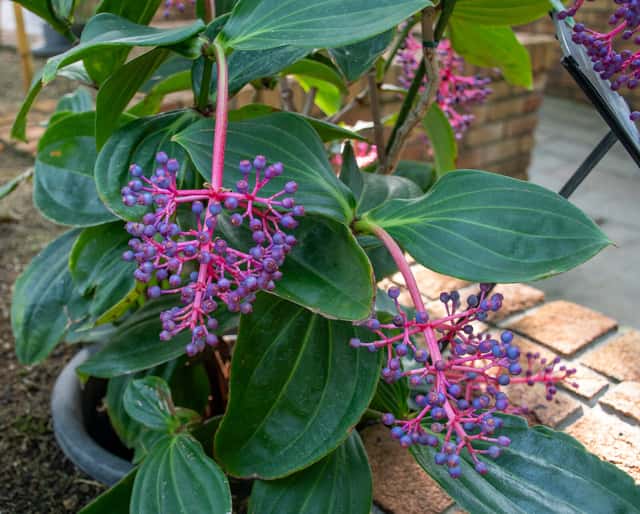
Medinilla speciosa is a perennial epiphytic evergreen shrub in the Melastomataceae family, native to the misty mountain forests of Indonesia (Java, Sumatra, Sulawesi, the Moluccas and the Lesser Sunda Islands), peninsular Malaysia, Borneo and the Philippines. It grows with woody, branching stems and opposite, leathery green leaves up to 20 cm long with prominent veins. From early summer into fall it produces large, pendant panicles of small, bright pink flowers on reddish stems, followed by rounded berries that ripen from pink to a striking metallic purple-black over about a month.
How to Propagate Showy Medinilla?
Stem Cutting
Use clean, sharp tools and keep the growing medium consistently moist but not soggy while roots develop.
- 1 Cut a healthy stem section 10-15 cm long with at least two nodes
- 2 Remove the lower leaves and trim the remaining leaves by about two-thirds to reduce moisture loss
- 3 Dip the cut end in rooting hormone powder
- 4 Insert the cutting into a moist, well-draining mix of peat moss and perlite
- 5 Keep warm, humid and out of direct sun until roots and new growth appear
Materials needed:
Seed Propagation
Germination is slow and success rates are low compared to stem cuttings, so this method is mainly used by collectors.
- 1 Extract seeds from fully ripe purple-black berries
- 2 Sow seeds on the surface of a moist, well-draining seed-starting mix
- 3 Cover the container to maintain high humidity and warmth
- 4 Keep in bright, indirect light until seedlings emerge
Materials needed:
How Big Does Showy Medinilla Grow?
TLDR: Showy Medinilla can reach up to 1.2m tall with Medium growth rate.
Max height
1.2m
Growth rate
Medium
Foliage
Evergreen
Warning: Toxic Plant
This plant can be toxic if ingested. Keep out of reach of:
Plant Uses
Ornamental
Great for decoration
Medicinal
Medicinal properties
Medicinal Uses
- Traditionally, the ripe fruits have been consumed by pregnant women in parts of Southeast Asia as a folk health supplement
- Traditional folk remedy for diarrhea and mouth sores
- Used in traditional medicine for its anti-inflammatory and antibacterial properties
Is your plant showing symptoms?
Click on the symptom to discover possible causes:
What Diseases Commonly Affect Showy Medinilla?
TLDR: Showy Medinilla is susceptible to 9 known diseases. Monitor regularly for early detection.
Leaf Spot
Leaf spot is a common fungal disease caused by various pathogens including Alternaria, Ascochyta, Colletotrichum, Septoria, and Venturia. It primarily affects leaves, causing discolored spots that can lead to premature leaf drop if left untreated.
Powdery Mildew
Powdery mildew is a common fungal disease caused by various fungi species including Erysiphe, Podosphaera, Oïdium, and Leveillula. It affects over 10,000 plant species worldwide. The disease thrives in warm, dry climates with high humidity and appears as a distinctive white powdery coating on plant surfaces.
Root Rot
Root rot is a serious fungal disease that affects the root system of plants, causing them to decay and die. It is primarily caused by overwatering, poor drainage, or soil-borne fungi such as Pythium, Phytophthora, Rhizoctonia, and Fusarium. The disease thrives in waterlogged conditions where roots are deprived of oxygen, making them susceptible to fungal infection.
Mealybugs
Mealybugs are small, soft-bodied insects covered with a white, waxy, cottony material. They are common pests of houseplants and outdoor plants in mild climates. These sap-sucking insects feed on plant tissue, causing damage, stunted growth, and can lead to plant death if left untreated. They produce sticky honeydew which attracts sooty mold.
Meaning & Symbolism
With its cascading clusters of vivid pink flowers, the Showy Medinilla is often associated with natural abundance and exotic elegance in tropical households.
Fun Facts
The genus Medinilla is named after Jose de Medinilla y Pineda, a 19th-century Spanish colonial governor
Its berries ripen from pink to a striking metallic purple-black, giving rise to the common name Showy Asian Grapes
In the wild it grows as an epiphyte, perched on trees in humid mountain forests between 300 and 750 meters elevation
Frequently asked questions
How often should I water Medinilla speciosa?
Is Medinilla speciosa toxic to cats and dogs?
Why is my Medinilla speciosa not flowering?
Does Medinilla speciosa need high humidity?
How do I propagate Medinilla speciosa?
Compare with similar plants
| Attribute | Difficulty | Light | Watering | Pet Safe |
|---|---|---|---|---|
| Dark Fieldcap | Medium | Low light | 2d | ⚠️ |
| Azalea | Medium | Partial shade | 3d | ⚠️ |
| Muriel's Bamboo | Medium | Partial shade | 3d | ✓ |
| Bougainvillea | Medium | Direct sun | 7d | ⚠️ |




