Fabaceae
Silky Wisteria (Wisteria brachybotrys)
Wisteria brachybotrys
Sun or light shade, deep moist soil and a sturdy support. Prune twice a year to get plenty of flowers.
Every 7 days
Bright indirect
-20° - °C
% - %
Categories
What is Silky Wisteria?
Silky Wisteria (Wisteria brachybotrys) is a medium-care plant from the Fabaceae family. Silky wisteria is a deciduous woody climber from Japan, where it grows wild in mountain woods in western Honshu, Shikoku and Kyushu. It twines anticlockwise around its support and can reach 9 metres or more. The name comes from the leaves, which are covered in soft hairs that feel like silk, with up...
Silky Wisteria grows up to 9.0m, spread of 900cm, watering every 7 days. It is not suitable for indoor environments and not safe for pets.
Without precautions, ingestion can cause irritation in pets. Keep out of reach of cats and dogs.
How to Care for Silky Wisteria?
TLDR: Silky Wisteria needs Bright indirect, watering every 7 days, and temperatures between -20-30°C with 40-70% humidity.
How Often Should You Water Silky Wisteria?
Keep the soil reliably moist, especially while young and while the buds are forming: about once a week in dry weather, deeply. Established plants in the ground only need water in long dry spells. Don't let it sit in waterlogged soil.
How Much Light Does Silky Wisteria Need?
Full sun gives the most flowers; light shade works too. Give it a sheltered spot so late frosts don't burn the flower buds.
What Is the Best Soil for Silky Wisteria?
Deep, fertile, moist soil that drains well. Skip nitrogen-rich fertiliser: it gives lots of leaves and few flowers.
What Pot Should You Use for Silky Wisteria?
It does best in the ground. It can grow for some years in a large, deep pot of 50 litres or more with a drainage hole, trained as a small standard, but needs regular watering and feeding.
What Is Silky Wisteria and Where Does It Come From?
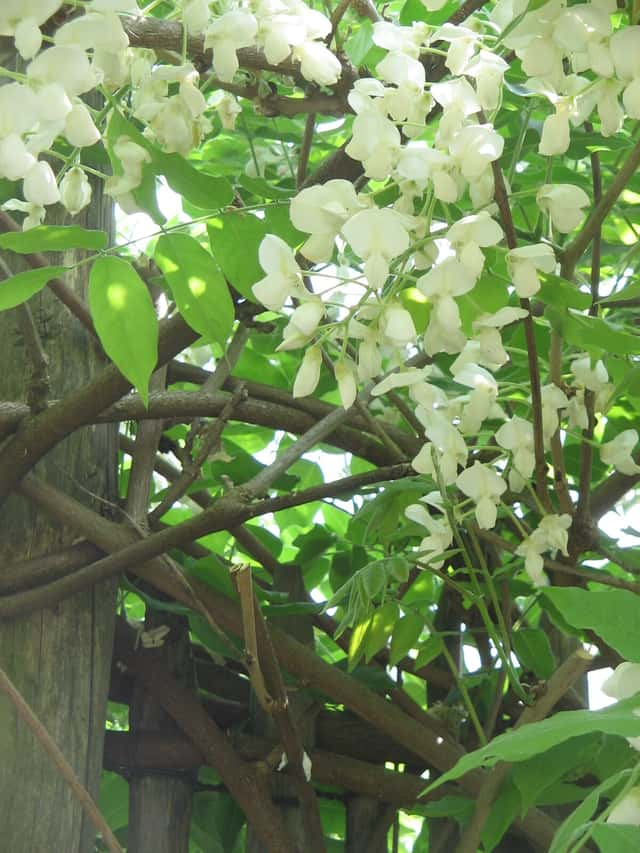
Silky wisteria is a deciduous woody climber from Japan, where it grows wild in mountain woods in western Honshu, Shikoku and Kyushu. It twines anticlockwise around its support and can reach 9 metres or more. The name comes from the leaves, which are covered in soft hairs that feel like silk, with up to 13 leaflets each. In late spring, as the new leaves open, it hangs short, chunky clusters up to 15 cm long of very fragrant pea-like flowers, pale violet or white with a yellow blotch. That is what brachybotrys means: short clusters. The flowers are followed by velvety green pods. In Japan the white forms, such as 'Shiro-kapitan', are grown more than the violet ones.
How to Propagate Silky Wisteria?
Layering
Layering gives a plant identical to the parent that flowers much sooner than a seedling.
- 1 Pick a long, flexible shoot near the ground
- 2 Make a small nick on the underside where it will touch the soil
- 3 Bury that part 5 cm deep and pin it down
- 4 Keep the soil moist and cut it from the parent once it has rooted, usually the following spring
Materials needed:
Softwood cuttings
Keep the compost moist but not soggy and air the bag every few days.
- 1 In early summer, cut a 10-15 cm piece of young shoot
- 2 Remove the lower leaves
- 3 Dip the base in rooting hormone
- 4 Insert in a pot of gritty compost, cover with a plastic bag and keep in bright shade
Materials needed:
How Big Does Silky Wisteria Grow?
TLDR: Silky Wisteria can reach up to 9.0m tall with Fast growth rate.
Max height
9.0m
Spread
9.0m
Growth rate
Fast
Foliage
Deciduous
Warning: Toxic Plant
This plant can be toxic if ingested. Keep out of reach of:
Plant Uses
Ornamental
Great for decoration
Is your plant showing symptoms?
Click on the symptom to discover possible causes:
What Diseases Commonly Affect Silky Wisteria?
TLDR: Silky Wisteria is susceptible to 5 known diseases. Monitor regularly for early detection.
Aphids
Aphids are small, soft-bodied, pear-shaped insects (1/16 to 1/8 inch long) that feed by sucking nutrient-rich sap from plants. They reproduce rapidly and can quickly weaken plants, causing distorted growth and transmitting plant viruses. Aphids come in various colors including green, black, red, yellow, brown, and gray. They secrete honeydew, a sticky substance that attracts ants and encourages sooty mold growth.
Scale Insects
Scale insects are small sap-sucking pests that appear as brown, shell-like bumps on plant stems and leaves. There are over 25 species, divided into armored (hard) and unarmored (soft) scales. They feed by piercing plant tissue and extracting sap, which weakens the plant and can lead to yellowing, stunted growth, and even death if left untreated. They also excrete honeydew, which attracts ants and promotes sooty mold growth.
Powdery Mildew
Powdery mildew is a common fungal disease caused by various fungi species including Erysiphe, Podosphaera, Oïdium, and Leveillula. It affects over 10,000 plant species worldwide. The disease thrives in warm, dry climates with high humidity and appears as a distinctive white powdery coating on plant surfaces.
Leaf Spot
Leaf spot is a common fungal disease caused by various pathogens including Alternaria, Ascochyta, Colletotrichum, Septoria, and Venturia. It primarily affects leaves, causing discolored spots that can lead to premature leaf drop if left untreated.
Fun Facts
The name brachybotrys means 'short clusters' in Greek
Its stems twine anticlockwise, while Japanese wisteria twines clockwise
In Japan the white-flowered forms are grown more than the violet ones
Frequently asked questions
Why isn't my silky wisteria flowering?
How do I prune it?
Is silky wisteria toxic to cats and dogs?
How is it different from Chinese or Japanese wisteria?
Compare with similar plants
| Attribute | Difficulty | Light | Watering | Pet Safe |
|---|---|---|---|---|
| Dark Fieldcap | Medium | Low light | 2d | ⚠️ |
| Azalea | Medium | Partial shade | 3d | ⚠️ |
| Muriel's Bamboo | Medium | Partial shade | 3d | ✓ |
| Bougainvillea | Medium | Direct sun | 7d | ⚠️ |