Asteraceae
Slender Sowthistle (Sonchus tenerrimus)
Sonchus tenerrimus
An easy wild plant: full sun, well-drained soil and little water. It self-seeds and can become weedy in a garden. Pick young leaves before flowering, when they are most tender.
Every 7 days
Bright indirect
-15° - °C
% - %
Categories
What is Slender Sowthistle?
Slender Sowthistle (Sonchus tenerrimus) is a easy-care plant from the Asteraceae family. Sonchus tenerrimus is an annual or biennial herb in the daisy family, sometimes a short-lived perennial, 10 to 80 cm tall. It is native to most of the Mediterranean region and Macaronesia and has naturalized in the Azores, California and Australia. It grows on coastal rocks and walls, dunes, roadsid...
Slender Sowthistle grows up to 80cm, watering every 7 days. It is not suitable for indoor environments and safe for pets.
Unlike many tropical plants, Slender Sowthistle tolerates watering mistakes. Best for beginners. Unlike many popular species, Slender Sowthistle is safe to keep around pets.
How to Care for Slender Sowthistle?
TLDR: Slender Sowthistle needs Bright indirect, watering every 7 days, and temperatures between -15-30°C with 40-70% humidity.
How Often Should You Water Slender Sowthistle?
Drought tolerant. Water about once a week in dry weather, only when the soil is dry; in a rainy winter, rain is enough.
How Much Light Does Slender Sowthistle Need?
Full sun. In the wild it also grows on walls and rocks with some shade, but it flowers better and stays more compact in sun.
What Is the Best Soil for Slender Sowthistle?
Grows in almost any soil, best in sandy, stony or well-drained ground. Avoid soil that stays waterlogged.
What Is Slender Sowthistle and Where Does It Come From?
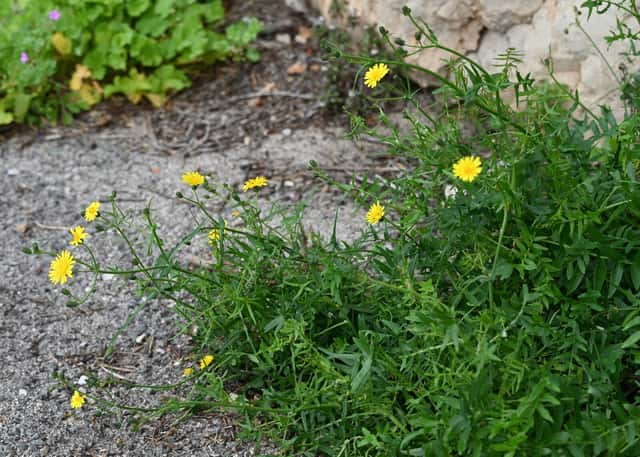
Sonchus tenerrimus is an annual or biennial herb in the daisy family, sometimes a short-lived perennial, 10 to 80 cm tall. It is native to most of the Mediterranean region and Macaronesia and has naturalized in the Azores, California and Australia. It grows on coastal rocks and walls, dunes, roadsides, fields and disturbed ground. The upper leaves are deeply cut into narrow lobes, and the yellow flower heads have a white, cottony base, which helps tell it apart from other sowthistles. It flowers from spring to autumn. In southeastern Spain the tender leaves are among the most eaten wild greens.
How to Propagate Slender Sowthistle?
Seed
Sow in place: the plant does not like being transplanted. It also spreads by itself through its fluffy seeds.
- 1 Scatter the seeds where the plants are to grow in spring
- 2 Cover with a very thin layer of soil
- 3 Keep the soil slightly moist until germination
- 4 Thin the seedlings if they are crowded
Materials needed:
How Big Does Slender Sowthistle Grow?
TLDR: Slender Sowthistle can reach up to 80cm tall with Fast growth rate.
Max height
80cm
Growth rate
Fast
Plant Uses
Edible
Can be consumed
Culinary Uses
- Young leaves raw in salads
- Roots in salads (traditional use in Spain)
Is your plant showing symptoms?
Click on the symptom to discover possible causes:
What Diseases Commonly Affect Slender Sowthistle?
TLDR: Slender Sowthistle is susceptible to 3 known diseases. Monitor regularly for early detection.
Aphids
Aphids are small, soft-bodied, pear-shaped insects (1/16 to 1/8 inch long) that feed by sucking nutrient-rich sap from plants. They reproduce rapidly and can quickly weaken plants, causing distorted growth and transmitting plant viruses. Aphids come in various colors including green, black, red, yellow, brown, and gray. They secrete honeydew, a sticky substance that attracts ants and encourages sooty mold growth.
Powdery Mildew
Powdery mildew is a common fungal disease caused by various fungi species including Erysiphe, Podosphaera, Oïdium, and Leveillula. It affects over 10,000 plant species worldwide. The disease thrives in warm, dry climates with high humidity and appears as a distinctive white powdery coating on plant surfaces.
Rust
Rust is a common fungal disease caused by fungi in the order Pucciniales that affects a wide variety of plants. The disease gets its name from the characteristic orange, yellow, or reddish-brown pustules that appear on leaves, resembling metal rust. This obligate fungal parasite requires living plants to survive and can cause significant economic losses in agricultural crops.
Fun Facts
In southeastern Spain it is one of the favorite wild greens, and it had the highest antioxidant content in a study of the region's edible wild plants.
Its juice was once used to wash the face and make the skin glow.
It reached other continents in ships' ballast.
Frequently asked questions
Is slender sowthistle edible?
How do I tell it from other sowthistles?
Does it need much water?
When does it flower?
Compare with similar plants
| Attribute | Difficulty | Light | Watering | Pet Safe |
|---|---|---|---|---|
| Field Maple | Easy | Bright indirect | 14d | ✓ |
| Iberian Houseleek | Easy | Direct sun | 14d | ✓ |
| Silver Birch | Easy | Direct sun | 14d | ✓ |
| Common Blanketflower | Easy | Direct sun | 10d | ✓ |
Choose & Compare
Sources & References
- Useful Temperate Plants - Sonchus tenerrimus
- Herbari Virtual de les Balears (UIB) - Sonchus tenerrimus var. tenerrimus
- Cretan Flora - Sonchus tenerrimus
- Flora de Pina de Ebro (Aranzadi) - Sonchus tenerrimus
- Horticultura (MAPA) 2008 - Wild edible Asteraceae of SE Spain
- Flora Digital de Portugal (UTAD) - Sonchus tenerrimus





