Asparagaceae
Slime Lily (Albuca) Care Guide
Albuca
Bright light and a strict wet-winter/dry-summer watering rhythm are the two keys to success. Water when the top third of the mix dries out during the active growing season (autumn-spring), then withhold water almost entirely once the leaves yellow and the plant enters summer dormancy.
Every 10 days
Bright indirect
8° - 27°C
30% - 50%
Categories
What is Slime Lily?
Slime Lily (Albuca) is a medium-care plant from the Asparagaceae family. Albuca is a large genus of bulbous geophytes in the family Asparagaceae (subfamily Scilloideae), with over 100 species native mainly to southern Africa, extending into tropical Africa and Arabia. The genus name and the common nickname "slime lily" refer to the mucilaginous sap released when the leav...
Slime Lily grows up to 30cm, watering every 10 days, 8°C – 27°C, 30–50% humidity. It is suitable for indoor environments and not safe for pets.
Without precautions, ingestion can cause irritation in pets. Keep out of reach of cats and dogs. Without adequate drainage, root rot can develop within 20 days.
How to Care for Slime Lily?
TLDR: Slime Lily needs Bright indirect, watering every 10 days, and temperatures between 8-27°C with 30-50% humidity.
How Often Should You Water Slime Lily?
Water only when the topsoil has dried during active growth; reduce drastically to near-zero during summer dormancy to prevent bulb rot.
How Much Light Does Slime Lily Need?
Needs bright light with some direct sun; insufficient light causes leaves to grow straight instead of curling and weakens flowering.
What Is the Best Soil for Slime Lily?
Use a gritty, fast-draining cactus/succulent mix (sand, pumice or perlite) - soggy soil quickly rots the bulb.
What Pot Should You Use for Slime Lily?
Terracotta pot with drainage holes - porous walls help excess moisture evaporate between waterings.
Care Schedule
Fertilize
Every 30 days
Repot
Every 730 days
What Is Slime Lily and Where Does It Come From?
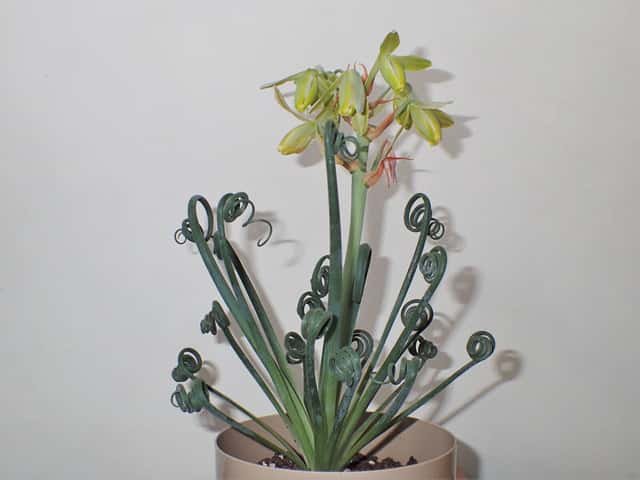
Albuca is a large genus of bulbous geophytes in the family Asparagaceae (subfamily Scilloideae), with over 100 species native mainly to southern Africa, extending into tropical Africa and Arabia. The genus name and the common nickname "slime lily" refer to the mucilaginous sap released when the leaves or bulb scales are cut. Most species are winter-growers: they produce leaves during the cool, wet months, flower in late winter to spring, then lose their foliage and go fully dormant through the hot, dry summer. Popular cultivated species such as Albuca spiralis and Albuca namaquensis are prized for their narrow, curly, spiral-tipped leaves and upright stalks of pendent, yellow-green, vanilla-scented flowers. As desert-adapted geophytes they are tough and forgiving once their dormancy cycle is respected, but are highly sensitive to overwatering while the bulb is dormant.
How to Propagate Slime Lily?
Bulb offset division
Handle offsets gently, they establish faster than seed-grown plants and flower sooner.
- 1 Wait until dormancy when the parent bulb is bare
- 2 Gently unearth the bulb cluster and separate offsets larger than 5 cm
- 3 Let cut surfaces callus for 1-2 days in a dry, shaded spot
- 4 Plant offsets shallowly in gritty cactus mix and keep barely moist until roots form
Materials needed:
Seed propagation
Fresh seed germinates readily, often within a week, but viability drops quickly with storage.
- 1 Sow fresh seed (within 6 months of collection) on the surface of gritty mix
- 2 Cover lightly with a thin layer of sand
- 3 Keep moist and in bright, indirect light until germination
- 4 Grow seedlings on without a dry dormancy for the first year
Materials needed:
How Big Does Slime Lily Grow?
TLDR: Slime Lily can reach up to 30cm tall with Slow growth rate.
Max height
30cm
Growth rate
Slow
Foliage
Deciduous
Warning: Toxic Plant
This plant can be toxic if ingested. Keep out of reach of:
Plant Uses
Ornamental
Great for decoration
Is your plant showing symptoms?
Click on the symptom to discover possible causes:
What Diseases Commonly Affect Slime Lily?
TLDR: Slime Lily is susceptible to 9 known diseases. Monitor regularly for early detection.
Root Rot
Root rot is a serious fungal disease that affects the root system of plants, causing them to decay and die. It is primarily caused by overwatering, poor drainage, or soil-borne fungi such as Pythium, Phytophthora, Rhizoctonia, and Fusarium. The disease thrives in waterlogged conditions where roots are deprived of oxygen, making them susceptible to fungal infection.
Pythium Root Rot
Pythium root rot is a serious fungal disease caused by various Pythium species including P. aphanidermatum, P. ultimum, and P. irregulare. These water molds are present in practically all cultivated soils and attack plant roots under wet conditions, causing rapid wet rot that can extend into the stem. The disease is favored by poor drainage, overwatering, and specific temperatures depending on the species.
Grey Mould
Powdery Mildew
Powdery mildew is a common fungal disease caused by various fungi species including Erysiphe, Podosphaera, Oïdium, and Leveillula. It affects over 10,000 plant species worldwide. The disease thrives in warm, dry climates with high humidity and appears as a distinctive white powdery coating on plant surfaces.
Fun Facts
The name "slime lily" comes from the mucilaginous sap released when the bulb or leaves are cut.
Some cultivated species, like Albuca spiralis, coil their leaf tips into tight corkscrew spirals when grown in strong light.
Flowers are often bicoloured, with a contrasting green or yellow stripe running down the middle of each petal.
Fresh seed germinates almost immediately but loses viability within about six months.
Frequently asked questions
Why do Albuca leaves curl?
Why is my Albuca losing its leaves?
Should I water my Albuca in summer?
Is Albuca toxic to pets?
Compare with similar plants
| Attribute | Difficulty | Light | Watering | Pet Safe |
|---|---|---|---|---|
| Dark Fieldcap | Medium | Low light | 2d | ⚠️ |
| Azalea | Medium | Partial shade | 3d | ⚠️ |
| Muriel's Bamboo | Medium | Partial shade | 3d | ✓ |
| Bougainvillea | Medium | Direct sun | 7d | ⚠️ |
Choose & Compare
Sources & References
- How to Plant, Grow, and Care for Albuca Spiralis - Epic Gardening
- Albuca - Pacific Bulb Society
- Caring for Indoor Sizzle-Frizzle Plants (Albuca Spiralis) - UK Houseplants
- Albuca - Wikipedia
- Albuca namaquensis (Spiral Grass) - World of Succulents
- Toxic and Non-Toxic Plants - ASPCA
- Albuca Spiralis: Caracteristicas y Cuidados Esenciales - Jardineria On
- The Complete Albuca Spiralis Plant Care Guide - Greg




