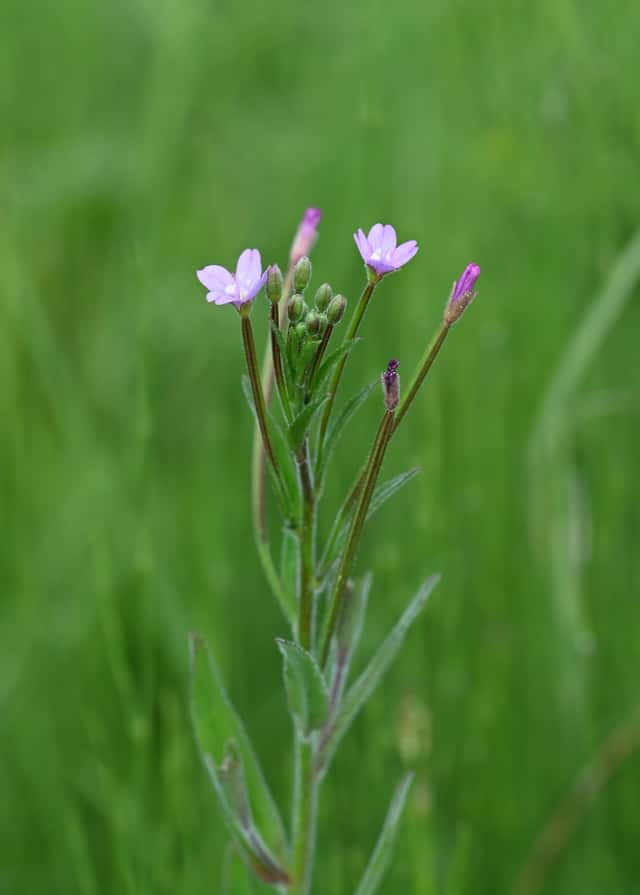
Onagraceae
Small-Flowered Willowherb
Epilobium parviflorum
Grow in moist, fertile, well-draining soil in full sun to partial shade. Keep the soil consistently damp — this plant naturally grows in wet ground and does not tolerate prolonged drought. Minimal feeding or pruning is needed; cut back after flowering to tidy the clump and limit self-seeding.
Every 3 days
Bright indirect
-15° - 30°C
50% - 75%
Categories
What is Small-flowered willowherb?
Small-flowered willowherb (Epilobium parviflorum) is a easy-care plant from the Onagraceae family. Epilobium parviflorum is a hardy perennial herb native to Europe, North Africa and western Asia. It grows along stream banks, marshes and other damp, disturbed ground, forming clumps of soft, downy stems topped with small pink-to-purple four-petalled flowers from July to August. It is best known tod...
Small-flowered willowherb grows up to 1.0m, spread of 60cm, watering every 3 days, -15°C – 30°C, 50–75% humidity. It is not suitable for indoor environments and safe for pets.
Unlike many tropical plants, Small-flowered willowherb tolerates watering mistakes. Best for beginners. Unlike many popular species, Small-flowered willowherb is safe to keep around pets.
How to Care for Small-flowered willowherb?
TLDR: Small-flowered willowherb needs Bright indirect, watering every 3 days, and temperatures between -15-30°C with 50-75% humidity.
How Often Should You Water Small-flowered willowherb?
Water regularly to keep the soil evenly moist at all times; never let it dry out completely, especially in summer.
How Much Light Does Small-flowered willowherb Need?
Thrives in full sun to partial shade; some afternoon shade is helpful in hot climates.
What Is the Best Soil for Small-flowered willowherb?
Prefers fertile, organic-rich, moisture-retentive soil with good drainage and a mildly acid to neutral/alkaline pH (6.0-7.5).
What Pot Should You Use for Small-flowered willowherb?
Best grown directly in garden beds or large outdoor containers with drainage holes; not well suited to small indoor pots.
What Is Small-flowered willowherb and Where Does It Come From?
Epilobium parviflorum is a hardy perennial herb native to Europe, North Africa and western Asia. It grows along stream banks, marshes and other damp, disturbed ground, forming clumps of soft, downy stems topped with small pink-to-purple four-petalled flowers from July to August. It is best known today as a traditional medicinal herb used in European folk medicine.
How to Propagate Small-flowered willowherb?
Seed sowing
Epilobium seeds are tiny and germinate best with consistent moisture and cool temperatures; avoid letting the seedbed dry out.
- 1 Sow seeds directly into moist soil in early spring, or as soon as seed ripens in autumn.
- 2 Press seeds lightly into the surface without covering, as they need light to germinate.
- 3 Keep the soil consistently moist until seedlings emerge.
- 4 Thin seedlings once established to give room to grow.
Materials needed:
Clump division
Water divisions well after planting and keep the soil moist while they establish.
- 1 Dig up an established clump in spring or autumn.
- 2 Split the rootball into smaller sections, each with roots and shoots attached.
- 3 Replant larger divisions directly in their final position.
- 4 Pot up smaller divisions and keep moist until well rooted before transplanting.
Materials needed:
How Big Does Small-flowered willowherb Grow?
TLDR: Small-flowered willowherb can reach up to 1.0m tall with Medium growth rate.
Max height
1.0m
Spread
60cm
Growth rate
Medium
Foliage
Deciduous
Plant Uses
Medicinal
Medicinal properties
Edible
Can be consumed
Medicinal Uses
- Traditionally used in European folk herbalism as a tea, tincture or capsule for prostate and urinary comfort (benign prostatic hyperplasia) — this traditional use is not clinically confirmed; consult a healthcare professional before use.
- Aerial parts historically applied for mild anti-inflammatory and astringent effects on minor skin irritations.
Culinary Uses
- Young leaves can be added raw to salads for a mild, agreeable flavor.
Is your plant showing symptoms?
Click on the symptom to discover possible causes:
What Diseases Commonly Affect Small-flowered willowherb?
TLDR: Small-flowered willowherb is susceptible to 3 known diseases. Monitor regularly for early detection.
Rust
Rust is a common fungal disease caused by fungi in the order Pucciniales that affects a wide variety of plants. The disease gets its name from the characteristic orange, yellow, or reddish-brown pustules that appear on leaves, resembling metal rust. This obligate fungal parasite requires living plants to survive and can cause significant economic losses in agricultural crops.
Powdery Mildew
Powdery mildew is a common fungal disease caused by various fungi species including Erysiphe, Podosphaera, Oïdium, and Leveillula. It affects over 10,000 plant species worldwide. The disease thrives in warm, dry climates with high humidity and appears as a distinctive white powdery coating on plant surfaces.
Aphids
Aphids are small, soft-bodied, pear-shaped insects (1/16 to 1/8 inch long) that feed by sucking nutrient-rich sap from plants. They reproduce rapidly and can quickly weaken plants, causing distorted growth and transmitting plant viruses. Aphids come in various colors including green, black, red, yellow, brown, and gray. They secrete honeydew, a sticky substance that attracts ants and encourages sooty mold growth.
Meaning & Symbolism
A symbol of quiet resilience and healing, often found colonizing riverbanks and disturbed ground where little else grows.
Fun Facts
The genus name Epilobium comes from Greek epi (upon) and lobos (pod), referring to the flower sitting atop the developing seed pod.
Its old folk name "Codlins and cream" comes from the scent of its crushed leaves, reminiscent of stewed apples.
Its tiny seeds carry silky hairs that let them drift on the wind, much like dandelion seeds.
Frequently asked questions
How often should I water small-flowered willowherb?
Does it need full sun?
Is small-flowered willowherb used medicinally?
Is it invasive in gardens?
Compare with similar plants
| Attribute | Difficulty | Light | Watering | Pet Safe |
|---|---|---|---|---|
| Field Maple | Easy | Bright indirect | 14d | ✓ |
| Silver Birch | Easy | Direct sun | 14d | ✓ |
| Common Blanketflower | Easy | Direct sun | 10d | ✓ |
| Cushion Bush | Easy | Direct sun | 14d | ✓ |





